THE HISTORY OF A CRIME AGAINST THE FOOD LAW
THE AMAZING STORY OF THE NATIONAL
FOOD AND DRUGS LAW INTENDED TO
PROTECT THE HEALTH OF THE PEOPLE
PERVERTED TO PROTECT ADULTERATION
OF FOODS AND DRUGS
(This book first appeared at the Soil and Health Library, an
important source of books
on holistic agriculture, holistic health, self-sufficient living, and personal
development)
PROLOGUE
INTRODUCTION
STATEMENT OF THE CASE
1. THE FIGHT FOR THE FOOD AND
DRUGS LAW
EXCERPTS FROM FINAL HEARINGS
TESTIMONY OF PROFESSOR KREMERS
PROFESSOR
KEDZIE'S TESTIMONY
SUMMARY OF THE
TESTIMONY OF VICTOR C. VAUGHAN
TESTIMONY OF DR. ECCLES
OTHER
WITNESSES
FAVORING WITNESSES
STATEMENT OF ROBERT
M. ALLEN, OF LEXINGTON, KY.
CLOSING ADDRESS OF DR. WILEY
SOURCES OF INFORMATION
FURTHER EXCERPTS FROM THE
CLOSING SUMMARY
DR. VAUGHN'S TESTIMONY
LIEBREICH JOINS VAUGHAN
PREVIOUS LEGISLATION
FINAL
ACTIVITIES
2. THE POISON SQUAD
ANOTHER THREATENING STORM
WISE
FORESIGHT
LENGTH AND PURPOSE OF THE
EXPERIMENT
DATA
PUBLISHED
DATA REFUSED PUBLICATION
THE BORAX INVESTIGATION
THE SONG OF THE POISON SQUAD
3. RULES AND REGULATIONS
FOOD STANDARDS COMMITTEE
FOOD INSPECTION DECISIONS
THE BOARD OF FOOD AND DRUG
INSPECTION
FOOD AND DRUG DECISIONS SIGNED BY THE SECRETARIES
OPINIONS OF EXPERTS
FAREWELL TO McCABE AND DUNLAP
RESIGNATION
4. WHAT IS WHISKY?
RECTIFIED WHISKY THE FIRST CAUSE OF PARALYZING THE
FOOD LAW
UNE
CAUSE CELEBRE
A
STRANGE OBSESSION
TROUBLE
BEGINS
(FOOD
INSPECTION DECISION 45.) BLENDED WHISKIES
A
DAY OF JUBILATION
BONAPARTE'S DECISION
THE RECTIFIERS REFUSED
APPOINTMENT OF THE 'WHISKY
COMMISSION'
ASK
FOR A REHEARING
BONAPARTE'S STATE PAPERS
ADDITIONAL COMMENTS
MR.
BONAPARTE REFUSES TO ACCEPT THE "WHISKY COMMISSION'S"
DECISION
ADVENT OF PRESIDENT TAFT
PRESIDENT TAFT
DRAWN INTO THE WHISKY CONTROVERSY
UNIVERSAL CRITICISM OF BOWERS'
REPORT
RECTIFIERS GAINED EVERY POINT
BECOMING A PROHIBITIONIST
THE LAST WORDS OF LLOYD BOWERS
JUSTICE HARLAN SPEAKS
DISASTERS PREVENTED
5. BOARD OF FOOD AND DRUG
INSPECTION AND REFEREE BOARD OF CONSULTING SCIENTIFIC EXPERTS
PROLOGUE
PURPOSE OF CREATING BOARDS
SPECIFIC DUTIES
ORIGIN OF THE REMSEN BOARD
UNIFICATION OF ADULTERATORS
SENSITIVE TO NEWSPAPERS AND
MAGAZINES
THE REFEREE BOARD ALREADY
DECLARED ILLEGAL
PROFESSOR CARLSON ON THE
REMSEN BOARD
POLITICS AND PURE FOOD
EXCERPTS FROM
TESTIMONY BEFORE MOSS COMMITTEE
Dr. Remsen's Testimony
DR. REMSEN'S AVERSION TO NEWSPAPERS
INVESTIGATIONS OF THE BUREAU OF CHEMISTRY REFUSED
PUBLICATION BY SECRETARY WILSON
EXTRACTS FROM THE
DENVER PRESS, AUGUST 25-28, 1909
WILSON'S HOT REPLY
6. POLITICS AND PERSECUTION OF A
STATE
FURTHER ACTIVITIES OF THE
REMSEN BOARD
FURTHER EXCERPTS FROM THE REPORT OF THE MOSS COMMITTEE AND THE RECORD OF THE
INDIANA CASE
TESTIMONY OF DR. IRA REMSEN
CROSS EXAMINATION OF DR. REMSEN
DR. HERTER'S TESTIMONY
A
CHANGE OF MIND
END OF THE INDIANA CASE
CONTEMPT OF COURT
7. ATTITUDE OF ROOSEVELT
IN EARLY
DAYS
ROOSEVELT FAVORED LEGISLATION
ORIGIN OF THE WHITE HOUSE
PREJUDICE
RECIPROCITY WITH
CUBA THE COLLOQUY WHICH UNDID ME
8. THE UNITED STATES
PHARMACOPOEIA
(MOSS
COMMITTEE)
DR.
F. L. DUNLAP'S DUTIES
9. THE BUREAU OF STANDARDS
STICKING TO THE BASE
RISE OF BUREAUCRACY
SCIENTIFIC ETHICS
CHEMICAL ETHICS
PURPOSE OF
ESTABLISHING THE BUREAU OF STANDARDS
THE
BUDGET FOR 1928
DISCOVERY
OF A NEW PRODUCT
ATTEMPT TO MODIFY THE FOOD LAW
LEGALIZING ADULTERATION OF FOODS
NUMBER OF PATENTS
RELATIVE
SWEETNESS OF SUCROSE AND DEXTROSE
CAN
OTHERS DO IT?
OPPONENTS IGNORED
REQUEST BUREAU OF
STANDARDS FOR HEALTH DATA
INJURY
TO HEALTH
FINAL DISPOSITION
OF THE SO-CALLED CORN SUGAR BILL
ALWAYS THE PROBLEM OF AGRICULTURE
DEVELOPMENT OF
DEXTROSE AND LEVULOSE INDUSTRIES
NO DELAY IN STARTING WHAT
ROWLAND FEARED
TRADE
PRACTICES
DUPLICATION OF WORK OF
BUREAU OF CHEMISTRY BY THE BUREAU OF STANDARDS
RESEARCH ASSOCIATES
AUTHORITY FOR THE COLLABORATION OF REPRESENTATIVES OF
BIG BUSINESS WITH THE BUREAU OF STANDARDS
GOVERNMENT TO
PROMOTE RESEARCH AND ENCOURAGE STUDENTS
SUMMARY
10. THE PASSING OF THE
BUREAU OF CHEMISTRY
CHEMISTRY FIRST RECOGNIZED
HOW IT
WAS DONE
THE
CORPUS DELECTI
CAVEAT
PROVING
DEATH
WHY WAS
IT DONE?
INCORPORATION OF THE BUREAU OF
SOILS
PATERNALISM ON THE RAMPAGE
CRITIQUE OF THE BUREAU OF SOILS
A REAL
SURVEY
A LONG WAIT FOR THE RECOVERY
AN UNFORTUNATE EXCHANGE
ANTAGONISM
BETWEEN RESEARCH AND PRACTICAL CHEMISTRY
RESEARCH
NO NEED FOR THIS RADICAL
LEGISLATION
RADICAL CHANGE OF ATTITUDE
AN INTERESTING STORY OF COCA-COLA
THE PATHETIC STORY OF BLEACHED
FLOUR
GOING BACK TO BUSINESS PRACTICES
ATTITUDE OF THE CHIEF OF THE FOOD, DRUGS AND
INSECTICIDE, ADMINISTRATION
THE CONCLUSION OF THE WHOLE
MATTER
ILLEGAL FOOD AND DRUG DECISIONS
EFFECT OF "THE, JUNGLE"
"Remember how long thou hast already put off these things, and how often a certaine day and houre as it were, having been set unto thee by the gods, thou hast neglected it. It is high time for thee to understand the true nature both of the world, whereof thou art a part; and of that Lord and Governour of the World, from whom, as a channell from the spring, thou thy selfe didst flow: And that there is but a certaine limit, of time appointed unto thee, which if thou shalt not make use of to calme and alay the many distempers of thy soule, it will passe away and thou with it, and never after returne."
--From The Golden Book of Marcus Aurelius, published by J. M. Dent & Co., Aldine House, London, W. C., Page 16.
"Bare tabulation will not do; simple enumeration is plainly insufficient. There must be a hint of perspective. The historian must select, and in the awkward process of selection he becomes an artist. One seems to see the historian at this uncomfortable stage desert the laboratory and furtively approach the studio. And why not? There is no need for him to blush when we detect him in the questionable company of artists. For history is an art as well,--the art of representing past events through facts of scientific accuracy. If the facts are inaccurate, it is not history. But if they are not embodied in a picture of a living past, it is not history either. For a smear on a palet is not a picture. So the historian, when his work among the test-tubes of research is done, must turn artist, abandoning his overalls for the velvet jacket. If he can not, so much the less historian he.
"It is so easy for the historian to forget his duty in the multiplicity of his business. To put it crudely, he is asked to raise the dead, to bring the past to life, to give a continuous performance of the miracle of Endor. He must achieve this feat with a restricted armory. For he is not allowed the novelist's liberty of invention. His incantations are strictly limited to the ascertained facts, and with their aid alone he is expected to evoke the past. We ask of the historian a great tapestry, crowded with figures, filled with shifting lights and crowds and landscapes; and we insist sternly (though with perfect propriety) that he shall use no single thread for his weaving that can not be vouched for as to its color, length, and weight by reference to his unvarying authorities, the scientific facts. "
--From "The Missing Muse," by Philip Guedalla, in The Forum for November, 1927, Page 666.
I suppose after the manner of those who steal the titles of other authors an apology should be made to Victor Hugo. The crime that he described was one purely political. It told the story of Louis Napoleon, who, having been elected President of the French Republic in 1848, following the model of his illustrious uncle, became Emperor of the French nation in 1852. Victor Hugo was one of the leaders against this movement and naturally became a persona non grata at Paris. With hundreds of others who had opposed this coup d'état he sought safety in Brussels. He arrived there on the 14th day of December, 1852, and began his "History of a Crime" on that very day. It was completed by May 5, 1853. He did not publish it for twenty-five years afterward.
It has been only twenty-one years since the crime about to be described was committed. Perhaps it would be the part of wisdom if its history, still unpublished, be withheld for another six years. The everthreatening thought of Anno Domini warns that it is not likely that I may still be on this planet after the lapse of six years. This fact should absolve me from any blame for a somewhat premature publication. The theft of his title is not likely to disturb the ashes of Victor Hugo in the Pantheon, to which they were committed by five hundred thousand of his fellow citizens in the summer of 1885, three months after his eighty-third birthday.
Presumably a similar lese majesté might be charged against the author of this story. Probably the truths which are told in the following pages, and a Government less violently set up than that of Napoleon III, will be a safeguard against expatriation. It is advisable and even desirable, while the memories of this crime are still fresh, to set down in simple language a recital thereof. There are many embarrassments in connection with writing a story of this kind which usually would deter or prevent the completion of the work. Many of the authors and participators in this crime have already joined the great majority and entered upon the Great Adventure. I am not unmindful of the excellent adage, nil de mortuis nisi bonum. I will not impute any base motives to those who are no longer here to defend themselves. It is far better to take the safe course. That is to assume that the crimes committed against the Food and Drugs Act were due to errors of judgment and not to any set purpose to destroy the salutary provisions of this law. While in the recital of these crimes, in spite of a purpose to the contrary, there may be found at times language which would indicate that the actors were not simply ignorant, it must be attributed to. the zeal for proper enforcement of the food law which leads to a recital of these facts, rather than to a purpose of. misjudging the motives of the actors themselves.
Twenty years have passed since these offenses against the law began. There are two reasons why I have waited so long before setting down in order this history. The principal one is that my time was all consumed with my efforts toward improving the nutrition, and consequently the health of the nation. The need of better nutrition is shown in an address opposing the repeal of the mixed flour law quoted further on. This was an indictment of the severest kind of the methods of up-bringing our youth. The deplorable condition of our young men was vividly shown in the Great War. Fully one-third of those called to the colors were found to be physically and mentally unfit to serve their country in its hour of need. Another third could only attend to camp and hospital tasks. Only one-third could go into. the trenches and serve their country on the field of battle.
It was a matter of supreme importance to endeavor in all honorable ways to remove the possibility of a similar stigma which might arise from any future crises of the republic. To instruct young persons to be parents, to teach them how to bring up their children after they are born, and to eliminate such a percentage of unfit are problems which require careful study. Having now reached the age of eighty-four, I am forcibly reminded that if this history of a crime is ever to be written it must be done now, without undue delay.
The second reason which has made, me hesitate is because of my high personal regard for those who are not shown as wholly devoted to the public service in the lapses of their conduct respecting the food and drugs legislation. It is always painful to say anything which could even be construed as derogatory to those who have been one's friends.
It is the practice in criminal proceedings before the courts for the opposing counsel to lay before the court and the jury an outline of the points he expects to prove and the nature of the evidence which it is proposed to offer. It is advisable to set down briefly the important points in this history. First of all will be a recital of the efforts made over a period of twenty-five years to secure a national food. and drugs act. Attention is called to the indifference of the people at large in regard to the character of the foods and drugs which they used, and the efforts that were made to overcome this attitude. It was soon found that individual activities were practically useless in securing national legislation. Only mass action could produce any progressive results. The organized bodies of men and women who gradually became interested in this legislation will be pointed out. At the same time the character of the lobbies formed efficiently to block national legislation will be described. Particular attention will be called to the dominant features which always characterized this proposed legislation. There was very little discussion of the question of misbranding. The chief points discussed were the results of adding to our food products preservative substances to keep them from decay, and coloring matters which made them look more attractive and fresh. Brief citations from the evidence before the various committees in the House and the Senate will illustrate the magnitude of the struggle which finally resulted in the approval of the Food and Drugs Act on June 30, 1906.
HISTORY OF A CRIME
CHAPTER I: THE FIGHT FOR THE FOOD AND DRUGS LAW
It would be impossible and perhaps unnecessary to survey the whole field of effort which led to the enactment of the Food and Drugs Law. It will be sufficient to take the last of the hearings as typical of all those that had gone before. If the Latin motto is true, "ex pede, Herculem," we can judge the whole of this opposition by its last expiring effort, just as we can recreate Hercules if we have a. part of his big toe.
The final hearings were before the committee on Interstate and Foreign Commerce, beginning on Tuesday, Feb. 13, 1906. This was just before the time the bill was completed in the Senate and after an agreement had been made to vote on it the 21st of February. These hearings are printed in a volume containing 408 pages. Pages 1 to 40 are taken up with testimony that benzoate of soda is a perfectly harmless substance. These witnesses were made up of both manufacturers and experts. The experts were Dr. Edward Kremers, of the University of Wisconsin, Professor Frank S. Kedzie of the Agricultural College of Michigan, and Dr. Victor C. Vaughan, Dean of the College of Medicine of the University of Michigan. The manufacturers who testified in this case unanimously said that the business of keeping food could not be carried on without the use of some preservative and that eminent scientific men had declared that benzoate of soda, borax, etc., in the proportions used were entirely harmless. Ex-Senator William S. Mason was also before the committee in the interest of a bill prepared by Mr. Meyers, editor of the American Food Journal, ostensibly offered by food manufacturers. This was a publication devoted to the propaganda of rectified whisky.
Although food bills of various kinds had been continually before Congress for a quarter of a century, the character of the opposition thereto had not changed. The excerpts here given are typical of the whole struggle.
Inasmuch as this closing testimony was the final effort to block the passage of the food law, it is summarized at some length. Testimony of Walter H. Williams, President of the Walter H. Williams Company, of Detroit, Michigan. (Page 19 of the hearings.)
In the most palatable foods that we can find there are traces of benzoic acid, and it seems to me if the Almighty put it there, the manufacturer ought to be allowed to use it, if he don't use it in the same quantities as put in the fruit by nature. * * *
We went to three men, each of them connected with one of the largest universities in the United States, men who stand at the very top of their class in the chemical and physiological world.
MR. TOWNSEND: Who were they?
MR. WILLIAMS: Dr. Victor Vaughan, who is dean of medicine and physiology at the University of Michigan, a man whom I do not believe any one can speak too highly of, a man right at the top of his profession. Another gentleman, Dr. Kremers, dean of chemistry of the University of Wisconsin. Another man who has given the subject the very closest attention is Dr. Frank Kedzie of the Michigan Agricultural College. * * *
MR. TOWNSEND: Do you know of any manufacturer of these goods who does not use some form of preservative?
MR. WILLIAMS: I do not.
MR. TOWNSEND: As a manufacturer, do you know of any way to manufacture these goods and keep them as they have to be kept for sale, without a preservative?
MR. WILLIAMS: I do not.
MR. BURKE: Have you had any trouble in any of the states by reason of the state laws interfering with your using this preservative?
MR. WILLIAMS: Our firm has not. We have been told that as soon as this committee gets through with the hearings on this subject there is going to be trouble in Pennsylvania. That is all we know about it.
MR. RICHARDSON: How? What troubles? In what way?
MR. WILLIAMS: We understand that the use of benzoic acid will be condemned, and we also know that as soon as this bill becomes a law, if it ever becomes a law, it will be condemned by the Bureau of Chemistry. * * * Now, the only point is--and all I wish to bring out now--that I don't think this committee ought to recommend any legislation that will give one man the absolute power to say what the manufacturers of this country shall do and what they shall not do. There is a difference of opinion as to what is injurious and what is not injurious. We can show that the best scientific thought in this country will differ with the present Bureau of Chemistry. Now, gentlemen, do not understand for a moment that I am attacking Dr. Wiley or the Bureau of Chemistry or the Department of Agriculture. I am simply pointing out, or trying to point out, the principle of this bill. The principle is wrong. It is not fair; and I think before you allow anyone to condemn any preservative about which there is a question that you ought to investigate the subject fully by a committee of scientists--the best that we can find-appointed by the President or by Congress.
In this connection it is interesting to know that the bill subsequently passed by the House of Representatives contained, a clause, with my full approval, and written by myself, in which such a committee was recognized. Its composition was one eminent chemist, one eminent physiologist, one eminent pharmacist, one eminent bacteriologist, and one eminent pharmacologist. In view of the attitude which the Secretary of Agriculture held toward me at that time I was very certain that he would consult me in regard to the personnel of this committee which was to be appointed by him, and that not only eminent, but fair-minded members would be appointed on this committee. When the bill went to conference with the Senate bill the conferees on the part of the Senate would not consent to encumbering the bill with an additional authority paramount to that of the Bureau of Chemistry. The Senate conferees contended that the whole matter of wholesomeness and unwholesomeness of ingredients in foods would go before the Federal Courts for final determination. The House conferees yielded on this point and the food bill was passed without the nucleus of the Remsen Board. This view of Mr. Williams was shared by practically all the objecting witnesses, both scientific and legal, as well as all of those interested in commercial matters throughout the whole course of the discussion of the various food bills before the committees of Congress. It was also voiced on the floors of both the Senate and the House. In spite of all this publicity and opposition the Congress. of the United States conferred upon the Bureau of Chemistry the sole function of acting as a grand jury in bringing indictments against offenders or supposed offenders of the law. The Congress specifically provided that all these indictments should have a fair, free and open trial before the Federal Courts for the purpose of confirming or denying the acts of, the Bureau of Chemistry.
Professor Kremers at the close of his testimony before the Interstate and Foreign Commerce Committee disclosed the fact that Mr. Williams was the party who secured the participation of Professors Kremers, Kedzie and Vaughan in this hearing. I quote from page 39:
MR. KREMERS: I would like to state just what I have been invited to do. I have been asked as a plant chemist, for that is my specialty in chemistry, to find out what could be learned about the occurrence of benzoic acid in the vegetable kingdom, and also to find out what the best literature, the physiological and therapeutic literature on the subject, has to say with regard to the administration of benzoic acid to the human system and with regard to the course that it took in the human system. That is the extent of my knowledge on this particular subject. I have not gone outside of that.
THE CHAIRMAN: Is there an employment in connection with this matter by you I?
MR. KREMERS: I was employed; yes, sir.
THE CHAIRMAN: By whom?
MR. KREMERS: By Mr. Grosvenor.
THE CHAIRMAN: What Mr. Grosvenor?
MR. KREMERS: Mr. Grosvenor of Detroit. Mr. Elliott O. Grosvenor.
THE CHAIRMAN: Was there a compensation fixed?
MR. KREMERS Yes, sir.
THE CHAIRMAN: Do you have any objection to stating it?
MR. KREMERS: No.
Mr. Kremers in detail stated in the testimony the amount he was to receive for the work and the amount he was to receive in reporting the results of his work to the committee. In his testimony, which I was asked to summarize by the Committee on Interstate and Foreign Commerce, Mr. Kremers gave the results of his many investigations into natural food products in which he found traces of benzoic acid and related bodies. I quote from his testimony, page 33:
MR. KREMERS: Gentlemen, I don't want to take up more of your valuable time unless you desire to ask some questions of me, for I fear I may not have made myself perfectly clear. I will admit that I am accustomed to talking technically on technical subjects, and that I am not an expert in the popularization of scientific subjects. I trust you will pardon my shortcomings in this respect. But briefly let me summarize the facts I have tried to make clear to you. Benzoic acid is found in the vegetable kingdom; it is fairly widely distributed in the vegetable kingdom. We find it among others in the products of the vegetable kingdom which we use for food purposes. We find it even more widely in food products which are used by herbivorous animals. In addition to benzoic acid, we find closely related compounds, namely, benzaldehyde, commonly known as bitter-almond oil, cinnamic aldehyde and quinic acid.
I have tried to make plain the fact that benzoic acid is formed in the human system and that the amount of hippuric acid eliminated from the system is increased whether we administer benzoic acid as such or whether we add it through certain food products; in other words, that benzoic acid is a natural product of the human economy.
Finally, I have tried to make clear to you, gentlemen, that whether it seems desirable to you or not to prohibit the use of benzoic acid from any artificial source rather than the natural source, and there is no bitter-almond oil which, after it is a day old, but that contains some benzoic acid,--that benzoic acid directly or indirectly will be administered to the system through the bitter-almond flavor, as I have explained.
MR. TOWNSEND: You are not a physiologist, are you?
MR. KREMERS: I am not.
MR. TOWNSEND: Are you able to answer as to whether benzoic acid has an injurious effect upon the body?
MR. KREMERS: I told you that I am not a physiologist, but I have prepared myself for a question of that sort, because it occurred to me that it would be a natural question for you to ask. I have here, in order that I might not be compelled to rely entirely upon my memory, a copy of the National Dispensatory, one of the standard commentaries on the United States Pharmacopoeia, a statement concerning the physiological action of benzoic acid. This statement is written by Professor Hare, one of the most prominent writers in this country on therapeutic subjects (Reads) :
"Ordinary doses cause a sense of warmth over the entire body, which feeling increases with the amount ingested, large quantities causing severe burning pain, etc. The drug increases the acidity of the urine as it is eliminated by the kidneys as hippuric acid."
Now, lest the statement might be misunderstood, let us read the last paragraph; but it will be apparent to you that Mr. Hare does not speak of benzoic acid here in quantities such as have been under consideration before you, but in totally different amounts.
"It may be given with benefit in certain diseases due to alkalinity. Benzoic acid is given in the dose of from ten to thirty grains.
Those amounts may be administered by a medical man, and they are very much larger than any amount that is necessary to bring about the preservative action.
MR. TOWNSEND: Does any antiseptic that is taken into the system interfere with digestion?
MR. KREMERS: I dare say it does.
MR. TOWNSEND: In that respect it is injurious?
MR. KREMERS: Not necessarily.
I thought it would be better for me to quote the summary that Mr. Kremers himself made of his testimony rather than to attempt any condensation of it myself. I may add here for the further information of the reader of this story that Dr. W. D. Bigelow, my first assistant in the Bureau of Chemistry, repeated many of the investigations reported by Mr. Kremers, as to the wide distribution of benzoic acid in food products, and failed to confirm them.
Dr. Kedzie testified that he is the son of Professor Kedzie, the distinguished chemist of the Michigan Agricultural College. He was associated with his father as professor of chemistry at that institution, that he undertook these investigations under the same auspices and practically for the same remuneration as was given to Professor Kremers and Professor Vaughan. I quote from page 58:
MR. KEDZIE: I took up this matter of finding where benzoic acid was distributed among materials which I could purchase in the market. I will read these articles in about the order in which I found the greatest quantity of benzoic acid: cranberries, huckleberries, plums, grapes (the Malaga grape), grapefruit, oranges, pineapples, carrots, parsnips, cauliflower, rhubarb, and green peppers. The amount of benzoic acid which I found present in cranberries, taking the dry material, we find the dried substance of the cranberry contains about, on the average, 1/2 of 1% of benzoic acid, but when we calculate it as to the wet substance, it then falls to 5/100 of 1% on account of the water present, or, to put it differently, it is one part in two thousand. * * * In analyzing the sample of catsup in the Michigan market I have found that the amount of benzoic acid varies from one part in twelve hundred to one part in two thousand. These are the first class goods, such as Heinz sells in Michigan, and also sold by Curtice Brothers.
THE CHAIRMAN: Do you find any benzoic acid in catsup made by Heinz?
MR. KEDZIE: Yes, sir; when it is sold in Michigan we do.
MR. MANN: Do you find it labeled that way?
MR. KEDZIE: The Michigan law requires that it shall be labeled with the preservative used.
MR. MANN: Was it so labeled?
MR. KEDZIE: I believe that it was, but I am not absolutely certain. Living at the capital, I would expect that the law would be complied with. The commissioner's office is right where I live.
MR. MANN: I have been told that it never had been done, and wondered whether it had or not.
MR. KEDZIE: I am sorry that I can not be absolutely certain in regard to that.
MR. WAGNER: How recently have you examined Heinz's goods?
MR. KEDZIE: I collected a sample about three weeks ago, and I inquired particularly in getting the bottle, whether it had been long in stock, and was told that it had just been received about two or three days before.
MR. MANN: Have you a memorandum showing the percentage of benzoic acid in these other fruits?
MR. KEDZIE: I made a thorough test of each one and I am prepared to say that in the grapefruit and the pineapple the amount of benzoic acid present there will not probably be far from 1/100 to 2/100 of 1 per cent in the fresh fruit.
MR. MANN: Did you ascertain in each of these fruits just how much benzoic acid was there?
MR. KEDZIE: Only in the cranberries, and that I did over and over again. * * *
THE CHAIRMAN (Mr. Hepburn): What would be the effect of a large dose of benzoic acid upon the human stomach?
MR. KEDZIE: Well, now, Mr. Chairman, I am not a physiological chemist. My work is analytical and what I know about that question is not much. I never took a large dose of benzoic acid-that is, a large dose, of course, would be 60 or 100 grains or more. I never took it and know nothing about it. I am not a doctor of medicine.
THE CHAIRMAN: From your knowledge of the properties and qualities of the acid, what would be the probable effect of benzoic acid upon the human stomach?
MR. KEDZIE: I should expect that if it were taken in very large doses up to 100 grains that it would have an inflammatory action on the stomach.
THE CHAIRMAN: It would be an irritant?
MR. KEDZIE: It would be irritating; yes, sir.
THE CHAIRMAN: You regard it when used as a preservative, in the proportions that were spoken of by Mr. Williams yesterday, as entirely harmless, do you?
MR. KEDZIE: That is my opinion; yes.
Perhaps the wisest comment I can make upon the testimony of these experts is that they were honestly of the opinion that because some of these preservatives were found in natural food products it was perfectly proper to imitate nature and increase these amounts. The weakness of this argument is so apparent that only a few of the causes of the fallacy need be mentioned. Hydrocyanic acid, perhaps one of the most poisonous organic acids known, exists in minute traces in the fruit of peaches and plums, associated often with benzaldehyde, a flavoring agent. It exists in some varieties of cassava in such proportions that fatal effects have resulted from eating the cassava starch. Salicylic acid is present in a flavoring product known as oil of wintergreen and may exist, in traces, also in other food products. Passing from the ranks of organic poisons, arsenic is a widely distributed poisonous material which is often found in our foods, due to absorption from the soil. The presence of these bodies, instead of being a warrant for using more of them, points to the necessity of reducing their quantity to the minimal amount possible.
Another point in this connection is worthy of mention. These experts were paid for the work they did and for the expense of laying it before the committee. I mention this without even a suspicion of criticism. I think payment of this kind is perfectly ethical and proper. On the other hand, during the twenty-five years in which food bills of various kinds were discussed before committees of Congress, not a single expert appeared before these committees urging the enactment of the good sort thereof who received any compensation whatever for his services. Probably officials of the various states who appeared frequently before committees of Congress to urge the passage of these bills had their expenses paid by their respective states, but received -no other compensation. In the twenty-five years of active opposition to the use of preservatives it never occurred to me to think of any compensation save that of my regular salary.
MR. VAUGHAN: I am thoroughly desirous that something should be done to regulate the use of preservatives in foods.
MR. BURKE: Where would you draw the line? Where would you fix the point beyond which it would be dangerous to go in the use of benzoic acid, as to quantity?
MR. VAUGHAN: That brings up a very interesting point. * * * It seems to me that that ought to be settled by a commission of experts, as to what preservatives could be used and in what amounts they could be used, and in what foods they might be used.
MR. STEVENS: In other words, you want a board or bureau of standards?
MR. VAUGHAN: I think so.
MR. BURKE: Have you not an opinion of your own in regard to the matter?
MR. VAUGHAN: Yes; I have an opinion of my own, but that opinion might be changed by further study of the subject. I am sure that benzoic, acid in the quantities in which it is used in tomato catsup, sweet pickles, etc., does not do any harm. I should be opposed to the use of formaldehyde in milk in any quantity, or the use of any other preservatives in milk. I have testified repeatedly against the use of sulphite of soda on Hamburger steak. I am thoroughly in sympathy with the Hepburn bill. It does seem to me, however, that it is the part of wisdom not to say that preservatives shall not be used at all, but to find out what foods need preservatives, and in what quantities they might be used with safety.
MR. BURKE: Is not formaldehyde used very generally now in preserving cream and milk?
MR. VAUGHAN: I do not think it is used generally. It is used to some extent.
MR. BURKE: Where cream is gathered up and shipped some distance to a creamery they use some preservatives, and usually formaldehyde, do they not?
MR. VAUGHAN: I do not know. I have not found much formaldehyde in cream. Borax is used some, and one-half of one per cent of boric acid is used. Formaldehyde is used to some extent.
MR. MANN: Do you understand that the Hepburn bill absolutely forbids the use of preservatives?
MR. VAUGHAN: No, Sir; but I find that it puts into the hands of one man, or of one Department, at least, the question of deciding as to the harmfulness of preservatives.
MR, MANN: You say in the hands of one man or of one Department. Eventually it must be put into the hands of somebody to decide the question, in your opinion, I take it?
MR. VAUGHAN: Certainly, certainly.
MR. TOWNSEND: Right there I want to ask you this question; as I understand, some experiments have been made with benzoic acid to determine whether it is harmful or not, by giving doses of pure benzoic acid to patients. What have you to say in regard to that method of determining the safety of benzoic acid--whether it is harmful or otherwise?
MR. VAUGHAN: The experiments upon benzoic acid, I understand, have been finished by Dr. Wiley, but there is no report on them up to the present time. Dr. Wiley has made a report on boric acid as to preservatives, and while I am a personal friend of Dr. Wiley's, appreciate him very highly and think greatly of him, his experiments have shown that boric acid in large amounts disturbs digestion and interrupts good health, but they have not shown that boric acid in the small quantities which would be used as a preservative, if used at all, has any effect on the animal body.
MR. ADAMS: About what do you mean by "small quantities"?.
MR. VAUGHAN: I mean one-half of one per cent.
Dr. Vaughan then engaged in a somewhat animated discussion with members of the committee in regard to what kind of board should be provided for in the law to decide all these questions. At the end of this discussion the following questions were asked:
MR. BURKE: When benzoic acid is taken in excessive quantities what is the effect?
MR. VAUGHAN: In large quantities it irritates the stomach. In very large quantities it causes acute inflammation of the mucous membranes of the stomach, nausea, and vomiting.
The maximum medical dose of benzoic acid is about ten grams, or one hundred fifty grains, and larger amounts are likely to cause inflammation of the stomach.
MR. MANN: How much benzoic acid could one eat, day after day, year after year, without injury?
MR. VAUGHAN: I could not answer that.
MR. MANN: Have you any idea about it? How much can you eat wholesomely without injury?
MR. VAUGHAN: I should say certainly that the amount that is found in your own body, which is from one to ten grains a day.
MR. MANN: That is formed in addition to your own body. I asked how, much can you eat?
MR. VAUGHAN: I would have to answer only in a general way and say a grain or two, I am sure, taken day by day for one's life, would not do any harm.
MR. MANN: Do you mean one grain or two grains?
MR. VAUGHAN: One grain.
MR. MANN: Would two grains do any harm?
MR. VAUGHAN: Well, I do not know. I would not like to set up my dictum. I do not know enough about it.
MR. MANN: I appreciate your position, Doctor; but still, as far as you can, we would like to have your opinion.
MR. VAUGHAN: Well, I should say one grain would be perfectly safe. I do not know whether two grains would be or not.
It is not at all surprising that at the end of this examination by Mr. Mann, Dr. Vaughan had put himself in a most ticklish position. He was arguing for some amendment to the bill which would permit the use of benzoic acid in food products, but he, was under the impression that even one grain a day for every day would be safe, but by eating two grains a day for all one's life it might not be safe. As two grains a day is a most minute quantity of benzoic acid, a quantity which would be exceeded if benzoic acid were used in foods in general, it is evident that such a course of reasoning could have little effect upon a deliberative body.
The most spectacular of the witnesses who appeared against the bill was Dr. Eccles of Brooklyn. Dr. Eccles describes himself as a physician residing in Brooklyn and he appears at the invitation of the National Food Manufacturers' Association. There was evidently a period approaching when some kind of food law would be enacted. To protect the manufacturers a bill was introduced by Mr. Rodenberg, of Illinois. Mr. Lannen, a lawyer in the interest of this measure, who had been actively opposed to the pending bill, was also present at the hearing. Dr. Eccles stressed the fact that instead of trying to prevent the addition of preservatives to foods their use ought to be encouraged. Quoting (from page 131):
MR. RICHARDSON: Is vinegar deleterious?
DR. ECCLES: No, Sir; I do not think anything is. I would compel them to use substances less deleterious than vinegar. I would not let them go below vinegar. I would allow them to use substances the dose of which is smaller than a dose of acetic acid or vinegar. Substances of larger doses than vinegar I would allow them to put in a certain fraction of the dose, and I would make the fraction the same for every substance, with no exception. I would have those gentlemen fixing the Pharmacopoeia say that no substance could be used that is stronger than the acid of vinegar under any circumstances. * * * In other places, where the preservatives have been stopped, the death rate has risen. Two notable illustrations have occurred lately--exceedingly notable. In North Dakota, the state of pure food--Senator McCumber's state--they tried the experiment. In Germany, particularly in Berlin, in the same year they tried the experiment. These two places were put up as tests. I predicted that the death rate in both those places would rise fifty per cent in that year. Now, what are the official figures? The official figures given by the Board of Health of the State of North Dakota and the :figures of the German Government in their own publications show that they transcended my prediction; that the deaths were nearly three times as many as they were during the same period the year before.
THE CHAIRMAN: From what cause?
DR. ECCLES: I predicted it would occur if they stopped the use of preservatives, and it did occur just as I predicted from the stopping of the use of preservatives. In no other place in the world did the death rate rise as in Berlin, and in no other state in the United States did it rise as it did in North Dakota.
THE CHAIRMAN: The use of what preservatives was stopped?
DR. ECCLES: All.
Mr. Lannen followed Dr. Eccles with a long tirade against the pending measure and in favor of substituting the Rodenberg bill therefor. Warwick M. Hough, attorney for the National Wholesale Liquor Dealers Association of America, endeavored to have the pending measure changed so that deleterious substances in compounded and blended whiskies should have the same protection that similar substances had in straight whisky. Mr. Hough had appeared many times before the committees endeavoring to secure immunity for the artificially compounded whiskies. He evidently saw clearly what would happen to artificial whisky if the pending measure should become a law. His foresight was prophetic. After the law became effective and the definitions of the Bureau of Chemistry for whisky went into effect, Mr. Hough carried the case to several United States Courts. In all about eight different suits were instituted, the purpose of which was to declare the standards of whisky established, by the Bureau of Chemistry illegal. In every single instance Mr. Hough's clients were defeated.
Appearing in behalf of the pending measure Mr. Edward W. Taylor, of Frankfort, Kentucky, reviewed Mr. Hough's arguments and showed to the committee their fallacy. On page 173 he says:
MR. TAYLOR: This investigation in 1893 of the whisky trust showed that the people of the United States were being imposed on to such an extent that this committee recommended to Congress that it incorporate into law a suggestion made by the deputy commissioner of Internal Revenue, Mr. Wilson, which was the origin of what is known as the "Bottling in Bond" act--a national law which enjoys so much disparagement that it is a pleasure to me to have the opportunity to explain it. The reason it has such disparagement is because the other 95 per cent of the so-called whisky on the American market today is the spurious article and can not get the guarantee stamp which is put over bottled in bond whisky. * * * And I have here the report of the Ways and Means committee in the House, in recommending the bill for passage--approving the bill. Here is the official report. It is all very well for Mr. Hough or myself to come up here and express an opinion as to the intention of the law, but I think it is to the advantage of this committee if we can produce some official expression as to the purpose of the law, and take the matter out of contention. * * *
" The obvious purpose of the measure is to allow the bottling of spirits under such circumstances and supervision as will give assurances to all purchasers of the purity, of the article purchased, and the machinery devised for accomplishing this makes it apparent that this object will certainly be accomplished.
Mr. Allen was the militant administrator of the food laws of Kentucky. As a state official he realized most keenly the need of a national law. He had heard the arguments against adopting this measure most patiently. The impression he gained from listening to this testimony is thus illustrated by his own words (page 20-5).
I want to say in this connection right here that there are two sides to this food proposition. There is the side which agitates and clouds the issue, brings up this point and that point, which, perhaps, does not materially affect the question; but when you come specifically down to these questions: Should glucose be sold as glucose or as honey or maple syrup? Should any synthetic product be sold under the name and trade terms of the genuine product which it is designed to imitate? Should a preservative be allowed use without any control or restriction?--when you come down to those propositions I think that not only the food commissioners, but the majority of the reputable manufacturers are agreed. But I say, Mr. Chairman, that I can take a committee from food manufacturers which would meet good men like yourself and others in Congress who are interested on this subject and cut aside from all of these issues that have been clouding and confusing the main central idea, and I believe that you could all agree upon a bill which would be fair and equitable to all and which would accomplish the purposes for which we are working along the lines of national pure-food legislation. In our Kentucky work we are not only the food commissioners of the people, the consumers, but we are also the food commissioners of every reputable manufacturer, and he has a hearing, a frank man-to-man hearing, whenever he wants to come in and discuss the subject.
At that time the chairman of the committee, the Hon. W. P. Hepburn of Iowa, gave notice that the hearings in favor of and against a food law preventing adulterations of the kind described were closed. Thus those who had for twenty-five years favored all kinds of adulterations and misbranding were finally shut out of any further participation in forming a food and drug act.
The Chief of the Bureau of Chemistry had been informed by Mr. Hepburn and his lieutenant, the Hon. James R. Mann, that he should have the final summary of the evidence both for and against preservatives in foods. Accordingly he was given ample time to summarize the principal arguments for and against preservatives as affecting the public health. His testimony begins on page 237 and extends to the end of the report on page 408.
DR. WILEY: Mr. Chairman and gentlemen of the committee: At the request of your chairman and in harmony with the terms of the resolution passed by your honorable body, and with the consent of the Secretary of Agriculture, I appear before you for the purpose of summing up the expert testimony which has been offered in the hearings held before your committee during the past fortnight on the pending measure concerning the regulation of interstate and foreign commerce in foods. Numerous expert witnesses have appeared before your body, mostly in opposition to the pending measure, and a few witnesses have appeared in favor thereof. I appear before you not as the advocate of any particular measure, but as an advocate of legislation of some kind controlling interstate and foreign commerce in adulterated and misbranded foods and drugs. I shall support with what influence I may possess any bill which your honorable body in its wisdom may report, although it might not, and probably would not, meet with my entire approbation. I do not believe it is possible to draw any measure of this kind which would receive the unqualified support of all parties. It becomes necessary, therefore, in measures of this kind to keep in view the principle of the legislation and to regard as of minor importance the various details which may be devised to obtain the end in view.
In the discussion of some of the principal points which have been presented, I wish to be understood as according to each witness the same sincerity, the same desire to present the facts, and the same freedom from bias in interpreting them that I shall hope may be attributed to me. The cause of truth is never hurt by unjust attacks and its citadel never reached by the devious ways of unworthy foes, but it is sometimes weakened by the unguided enthusiasms of its defenders.
I therefore accord honesty of purpose and sincerity of effort to those whose contentions I feel impelled to resist. I desire to point out wherein I think they have fallen into errors of statement followed by fallacious reasoning leading to wrong conclusions. I want to point out how they have misunderstood the efforts which have been made to ascertain certain facts relating to the effect of preservatives, coloring matters, and other substances added to foods on health and digestion; how they have misinterpreted the purpose and scope of the food standards which have been proclaimed by the Secretary of Agriculture in accordance with an. act of Congress, and have, as a result of these erroneous views, created what seems to them a demon of future dangers, but which is nothing more than a phantom of a perturbed imagination.
In doing this I shall speak frankly and freely, without any bias or rancor, without any feeling of resentment for the many denunciations and anathemas which have been published all over this broad land and in Europe during the past two years.
I hope you may not conclude from the necessary trend of my argument that I oppose all use of preservatives and coloring matters in foods. On the contrary, there are doubtless often conditions when the use of preservatives is indicated. In countries which are unable to produce their own foods, as for instance England, on journeys to distant or difficultly, accessible places, such as mines and logging camps and long journeys on the sea, and in other exigencies, preservatives may be indicated. I also think that the consumer who prefers them should not be denied that preference. My argument, therefore, applies to the usual conditions which obtain in this country and especially to the apparent fact that the great majority of our people seem to prefer their food untreated with noncondimental preservatives.
As it has appeared to me from listening to a part of the testimony and reading a part thereof, the character of the opposition to the pending measure may be described as follows:
I will begin by a statement of the grounds of the opposition of the first class of objections. This opposition has not been brought out by any of the witnesses who have been called upon to testify; but is based upon broad Constitutional grounds and is of a character to command profound respect and careful consideration. I refer to the views which are held by many distinguished and earnest men to the effect that the cardinal provisions of the bill are unconstitutional. This is a matter, therefore, which does not call for any further consideration on my part.
The second class of objections to the bill: The prohibition principles of the pending bill consist in the elimination of harmful and injurious ingredients which may be added to foods. I may say, and the statement is rather a broad one, that there is no opposition to such a prohibition, as no one has advocated, in so far as I have been able to find in the testimony, a permission to add harmful, deleterious, or poisonous substances to foods, except Dr. Eccles.
The objections have rather lain against the possible decisions as of the courts in such matters, and especially against the, method of collecting evidence for the prosecution. It is, of course, self evident that no prosecution could be brought, under these prohibition provisions unless some one should certify that any given added substance was harmful, deleterious or poisonous. The opposition, therefore, to this provision of the bill has voiced itself in an argument that the committee. should insert prohibitive provisions in the bill against this prohibition. Plainly stated, the contention has been made that the Congress of the United States should declare by act that certain substances in certain proportions are not harmful, deleterious, or poisonous substances.
The only expert testimony which has been submitted on this question, which is worthy of any consideration by your committee, is that which was offered by Professor Kremers, of the University of Wisconsin, Professor Kedzie, of the Agricultural College of Michigan, and Professor Vaughan, of the University of Michigan. The high character and attainments of these experts entitle their views to the most profound and respectful consideration.
The wide distribution of benzoic acid in vegetable products, as described by Professor Kremers, is well known to physiological and agricultural chemists. He says that in the destruction of certain proteins in the human economy benzoic acid is formed, which is then changed into hippuric acid. There is no evidence that I have been able to find to show that hippuric acid may not be formed from the benzol radical without its passing through the benzoic acid state. But this is of little importance, because even if benzoic acid should precede the formation of hippuric acid it could only exist in the most minute quantities and for a relatively very short period of time. Hippuric acid is one of the natural toxic or poisonous bodies produced in catabolic activity, which, like urea and other degradation products of proteins, must be at once eliminated from the system to avoid injury. Uremic poisoning at once supervenes on the suppression of the excretive activities of the kidneys, and unless this condition is removed death speedily results.
This brief summary of the opposition to the food and drugs act during the time it was before Congress accentuates the fact that it is essentially a health measure, as has been officially confirmed by a decision of the Supreme Court of the United States.
There had been little discussion during the whole twenty-five years of the subject of misbranding. This was such an apparent and unnecessary evil that it had few defenders. During all this time the chief discussion was the effect upon health of certain preservatives and coloring matters, and as to the selection of officials for carrying the law into effect. It was the unanimous opinion of all opponents of the law that the Bureau of Chemistry should have nothing to do with its enforcement. It was well understood that the attitude of the Bureau of Chemistry was distinctly hostile to the use of chemical preservatives of any kind in food and that all such manipulations threatening the health of the American consumer would be frowned upon. In spite of many attempts to prevent it, Congress deliberately and overwhelmingly decided to submit the execution of the law to the Bureau of Chemistry.
In the future the student of history who may wish to review all that was said and done during the fight for the enactment of the pure food law will find all, the hearings in the libraries connected with the various committees in Congress in charge of these hearings. They are a thesaurus of interesting facts which the future historian ought not to overlook.
MR. BARTLETT: I would conclude, then, that you think benzoic acid as a preservative is not necessary.
DR. WILEY: I think you forecast my argument very well.
MR. ADAMSON: Before you became a chemist, you saw women make catsup and put it up hot in sealed bottles and keep it a long time, didn't you?
DR. WILEY: Yes, sir.
MR. ADAMSON: Without putting anything in it?
DR. WILEY: Excepting the ordinary spices and condiments. I want to call the especial attention of this committee to this argument which I am presenting. I will state it again without reading from my manuscript, so as to make it perfectly distinct.
The human body is required to do a certain amount of normal work. That amount of normal work is a beneficial exercise of these organs. If you diminish the normal work of an organ you produce atrophy--lack of functional activity. If you increase it hypertrophy ensues, and increase of functional activity. Nearly all of the organs that wear out do so from one of those causes, not from normal exercise of their functions. Therefore, assuming that the food of man, as prepared by the Creator and modified by the cook, is the normal food of man, any change in the food which adds a burden to any of the organs, or any change which diminishes their normal functional activity, must be hurtful.
MR. ESCH: If the organs were always normal, death would not ensue?
DR. WILEY: I will not go so far as that, Mr. Esch. I do, refer to longevity, though, and I believe this with all my heart, that when man eats a normal food normally the length of human life will be greatly extended. That is what I believe. But if we consume abnormal food abnormally we shall lessen the length of human life.
MR. TOWNSEND: Who is going to define normal food; there is a great difference of opinion about that?
DR. WILEY: I will admit that.
MR. MANN: Doctor, do you think the action of eating cranberries with turkeys is detrimental to health in any way or to any degree?
DR. WILEY: I will answer that as categorically as I can. I do not believe that a healthy organism is going to receive any permanent injury or measurable injury by eating cranberries because they contain benzoic acid. And I want to add this, that it is not because they contain benzoic acid that they are wholesome, but that if they did not contain it they would be more wholesome than they are.
I want to accentuate this point: I noticed very many questions from many members of the committee which lead me to think that you have this feeling, that if a substance does not hurt you so that you can measure it it is not harmful. That does not follow at all. Take this one substance of benzoic acid. Benzoic acid never takes any part in the formation of tissue, and its. degradation product is hippuric acid, which is a most violent poison. If the kidneys should cease to act for twenty-four hours there is not a man on this committee who would not be at death's door from the hippuric acid and the urea which would be in the blood. Hippuric acid is perhaps far more poisonous than urea; it is a deadly poison. Therefore nature gets rid of it directly it is formed, otherwise health would be destroyed.
Now, is there force in the argument, gentlemen, that in view of the fact that this degradation product comes from the natural foods which we eat--and I am not criticizing the Creator at all for putting them in the food--then benzoic acid, which occurs in natural foods and of which the degradation product is a violent poison if increased by an infimitesimal amount, and although we may not be able to note any injury coming from it, yet should we be advised to use it? There is a subtle injury which will tell in time. For instance, a mathematician desires to make a curve to express inflnitesimally small values which only the mathematician can consider, and to do that he has to have experimental evidence. He can not experiment at the small end of his curve; it is impossible. He experiments upon the part of the curve that he can measure, fixes the ordinates and the abscissas with the points that he can measure. Then he draws his curve, passing into the infnitesimally small values. And it is the same with the substances added to food. You must construct your curve on data which you can measure, and then you draw your curve down to the inflnitesimally small. That curve is a curve the moment it varies from zero, although you can not see it or measure it. If you add any substance to food--add, I say--which produces a poisonous degradation product, or adds one additional burden to the secretory organs, you have changed that infinitesimal small part of your curve that you can not measure, but the change is there all the same.
MR. MANN: Take the case of cranberries. Does benzoic acid in the cranberries to the extent that the benzoic acid exists injure cranberries as a food?
DR. WILEY: It is so small. that you can not measure its harmful effects.
MR. MANN: But to the extent that it exists at all; or that the other values in cranberries as a food in the normal use of them overcome the injurious effects of benzoic acid. If that be the case, might not that be the case of other preservatives in other foods?
DR. WILEY: What is true of one is true of all.
MR. MANN: But with artificial preservatives. Might not the case arise where, although the food is injured to the extent in which the preservative exists, yet it has preserved the food so that it is better food, the total product is better than the food would have been without the preservative. That is what we want to get at here.
DR. WILEY: I stated that particularly in my introduction. I said there were many places where preservatives were indicated. Wherever you can make food better, where it is impossible to have it without having a preservative, certainly the preservative is indicated.
MR. ADAMSON: I am curious to ask you, before you leave the subject of cranberries, about the effect of berries, in which I am locally interested. I can give up cranberries, but I can not give up blackberries and huckleberries. * * *
MR. BARTLETT: Did you see the account in yesterday's Herald about the dinner that some chemist gave to a friend in New York, at which everything they ate was made out of acids and things of that kind?
MR. MANN: Synthetic products?
MR. BARTLETT: Yes.
DR. WILEY: Yes, sir; I saw the account, and I know the gentlemen very well. I don't believe any of them would care to eat that kind of a dinner every day. It is like my very distinguished friend, Professor Chittenden, perhaps the most distinguished physiological chemist in this country, who proved conclusively to himself that man in his natural tastes ate too much protein. The average man instead of eating 17 grams of nitrogen in a day, as he does, ought not to eat more than 10 or 11. But almost every man taught to do that, I understand, has gone back to the old way, although apparently it was beneficial at the time.
MR. TOWNSEND: Professor Chittenden does not agree with you in regard to the use of preservatives.
DR. WILEY: I think not; I think he does not agree with me. I want to say here, Mr. Chairman, that experts never think the less of each other because they disagree; it is the natural condition of humanity.
MR. ADAMSON: You did not really run a boarding house on pills, paregoric, and other things, did you?
DR. WILEY: I ran a boarding house something of the kind you describe for four years, and I am running it to-day; and would be pleased to have you come down and take a meal with us.
MR. ADAMSON: I think I would prefer to have a colored woman do the cooking for me.
DR. WILEY: We have a colored cook. You will hear more about that boarding house later on.
MR. BARTLETT: I understood you to say you knew these gentlemen in New York who gave this dinner that we were speaking about a moment ago?
DR. WILEY: I know them very well.
MR. BARTLETT: They are reliable gentlemen?
DR. WILEY: Oh, yes; perfectly so. In fact, I have a very high opinion of the chemists of this country. Just as high when they differ from as when they agree with me.
MR. ADAMSON: While you have such a high opinion, yet you do not take their judgment in these instances?
DR. WILEY: Certainly not; I should not occupy such a position. I do not want anybody else to judge for me the results of my own work. I want to do that myself.
MR. ADAMSON: I wanted to give you a chance to disclaim that.
DR. WILEY: Not only disclaim it, but I never have put myself in any such position and never intend to.
Now I will go on with my statement.
Because nature produces an almost infinitesimal quantity of substances in foods which add to the quantity of these poisonous excreta appears to me to be no valid argument for their wholesomeness. Could even the small trace of substances in our foods which produces hippuric acid be eliminated, the excretory organs would be relieved of a useless burden and the quantity of work required by them be diminished. This would be conducive to better health and increased longevity. I fail to see the force of the argument that a deliberate increase of the work required by the adding of substances capable of producing poisonous degradation products is helpful and advisable. Granting, for the sake of the argument, the grounds of a trace of benzoic acid and its analyses in all the substances mentioned by Professor Kremers, we do not find that this is a warrant to add more of these bodies, but, on the contrary, a highly accentuated warning to avoid any additional burden. That benzoic acid is a useful medicine, no one who has ever studied medicine will deny, but I think almost every practicing physician will tell you that the exhibition of drugs having a medicinal value in case of health is highly prejudicial to the proper activity of these drugs when used in disease. The excretory organs of the body become deadened in their sensibilities by the continued bombardment to which they are subjected and do not respond at the proper time to the stimulus which a medicine is supposed to produce. Keeping the hand in cold water constantly would unfit it to be benefited by the addition of a cold application for remedial purposes.
I think that I need only call the attention of the committee to the wide distinction between a drug used for medicinal purposes and a food product to show them that all reasoning based on the value of drugs as medicines is totally inapplicable to their possibly beneficial effects in foods. I further think I shall be sustained almost unanimously by the medical profession of the United States when I say to this committee that the "drug habit," which is so constantly and so unavoidably, I am sorry to say, formed in this country is one of the greatest sources of danger to the public health and of difficulty in the use of remedial agents that can well be imagined. Professor Kremers, on page 33, seeks to justify the statement he reads from Professor Hare respecting the properties of benzoic acid by saying that benzoic acid is useful in diseases of the urinary organs which produce alkalinity. I will show this committee later on that small doses of borax bring about this abnormal condition of the urine, and therefore it might be advisable in using borax, which has been pronounced harmless by some experts here, to be able to counteract one of its particularly certain effects by administering a remedy at the same time that you supply the cause of the disease. For this reason your committee might well say in the bill that whenever borax is used in foods benzoic acid should also be used as a corrective of its dangerous influences.
I am somewhat surprised also at the reference that Professor Kremers makes to salt, on page 34. Salt is not only a delightful condiment, but an absolute necessity to human life, and the fact that excessive doses of salt are injurious has no more to do with this argument than the fact that you can make yourself ill by eating too much meat. It seems to me astonishing in these days of rigid scientific investigation that such fallacious reasoning can be seriously indulged in for the sake of proving the harmlessness of a noncondimental substance. Yet this is the argument advanced by Professor Kremers on page 34 in respect of salt, wood smoke, and other useful, valuable, and necessary condimental bodies. The argument in regard to benzaldehyde in ice cream is on the same plane. The substance known as ice cream, as usually made, is an inferior food product at best, and how it could be improved by the addition of a substance which increases the quantity of poisonous principles in the excrements is a matter entirely beyond my comprehension. I am perfectly familiar with the argument that this small quantity would not produce any harm. It is doubtless true, Mr. Chairman, that a slight increase for one day or even oftener of these bodies in the food would produce practically no measurable effect upon a healthy individual for a long time, but that in the end it would produce no harmful effect is contrary to all the rules of physiology and logic.
The body wears out and death supervenes in natural order from two causes: First, from a failure of the absorptive activities of the metabolic processes, and, second, by an increased activity of the catabolic processes, producing increased amounts of poisonous and toxic matters in the system, while the excretory organs are less able to care for them. Thus the general vitality of the body is gradually reduced, and even old age, which is regarded as a natural death, is a result of these toxic activities carried through a period of time varying in extreme old age from eighty to one hundred years. This process is described by Professor Minot, of Harvard University, as the differentiation and degeneration of. the protoplasm. On the contrary, it is not difficult to show that .every condimental substance, by its necessary and generally stimulating effect upon the excretory organs which produce the enzymes of digestion, produces a positively helpful result, while its preservative properties are incidental merely thereto. Condiments are used not simply because they are preservatives, but because without them the digestive organs would not respond to the demands of nature, and therefore I ask your very careful consideration of the arguments based upon a comparison of noncondimental preservatives added to foods and the use of the condimental substances which are natural and necessary. I do not believe that your minds will be misled in the consideration of this important and radical distinction.
A careful review of other parts of the argument of Professor Kremers shows that he unwittingly admits the poisonous and deleterious properties of benzoic acid by calling attention, on page 35, to the fact that when doses of it are added to an kinds of stock, so called, preserved in large quantities, it is boiled out or disappears by sublimation during subsequent treatment. If benzoic acid is a. harmless substance, as suggested, why should so much importance be attached by its advocates to the fact that it is practically eliminated? Thus the advocates of benzoic acid at once, by their own words, show the insecurity of the platform on which they stand.
MR. TOWNSEND: Did you understand him to testify in that way as showing that that was the reason it was not harmful?
DR. WILEY: No; excepting it was boiled out.
MR. TOWNSEND: That was in answer to a question.
MR. ESCH: The use of it more particularly with reference to the preparation of the stock.
DR. WILEY: Yes; I have mentioned that in large quantities, in relation to the stock.
You are asked to insert in this bill a provision which will allow the use of one-fourth or one-fifth of 1 per cent of benzoic acid in food products, which is practically ten times that found, as stated by Professor Kremers, in the cranberry, which, of all known vegetable substances used as foods, contains the largest quantity. Fortunately, cranberries are not an article of daily diet. Do not, I beg of you, lose view of the fact that because a single dose of benzoic acid does not make you ill its daily consumption is wholly harmless. This is a non-sequitur of the most dangerous character.
Professor Kremers says that he has searched through all literature and has not found a statement that benzoic acid administered even in medicinal doses would produce harm. I would like to compare this with his own quotation of Professor Hare, in which it is said:
Ordinary doses cause a sense of warmth through the entire body, which feeling increases with the amount ingested, large quantities causing severe burning pain.
Asked by Mr. Richardson, Professor Kremers acknowledged that there might be many persons who would be injuriously affected by benzoic acid. Now, when anyone is accused of a crime it is no defense to prove that the crime was not committed against a hundred or a million individuals. It is sufficient to prove that it was committed against one. Professor Kremers acknowledges that benzoic acid may be harmful, therefore Professor Kremers has convicted benzoic acid as being a harmful substance; and, therefore, his argument that it should be used indiscriminately in foods, or, as asked when before this committee, be permitted to the extent of one-fourth of 1 per cent, being ten times the quantity produced in its most abundant natural substance, seems wholly illogical.
MR. TOWNSEND: That would be true of any article; that not only applies to a preservative, but it applies to all kinds of foods as well.
DR. WILEY: Well, yes; but foods and drugs must be regarded differently.
MR. BARTLETT: There are people who can not eat food ordinarily regarded as harmless. There are certain people who can not drink sweet milk; and I know people who can not eat eggs of any description, nor anything that has an egg in it. Now, do you think that everybody ought to be prevented from eating eggs or drinking milk if a half a dozen people in a thousand are injuriously affected by them?
DR. WILEY: Certainly not; nor would I prevent anybody from using benzoic acid who wanted to do it, but I certainly would help persons from using it who did not want to use it. I am not advocating the prohibition of the use of benzoic acid by anybody who wants to use it. I would be in favor of putting benzoic acid in a little salt-cellar, the same as is used for salt and pepper, and letting the people use it if they want to. I think benzoic acid would not hurt me, or be injurious to my system, if I used it one day--
MR. BARTLETT: You know some people have tried to eat a quail a day for thirty days, but they get sick.
MR. ADAMSON: Is there not a great difference between the occasional use of these poisons medicinally, in cases of emergency, and the use of them in any quantities in food?
DR. WILEY: I think that is a great point. I will come presently to the statement of Professor Vaughan, which covers that case beautifully in the testimony he gave here.
There are two points that I wanted to call to the attention of the committee. One is that we have examined a number of substances in which Dr. Kedzie testified that he has found benzoic acid, and we have found none.
MR. BARTLETT: What substances are those?
DR. WILEY: Dr. Kedzie testified that he had found benzoic acid in cranberries, huckleberries, plums, grapes, grapefruit, oranges, pineapples, carrots, pears, cauliflower, rhubarb, and green peppers.
We have obtained from the open market samples of the following fruits and vegetables, said by Professor Kedzie to contain benzoic, and tested them for benzoic acid:
Malaga grapes, grapefruit, oranges, pineapples (two varieties), carrots, parsnips, cauliflower, rhubarb, and green peppers. We were unable to obtain any indication of benzoic acid in any of these fruits with the exception of pineapples, where in one test of one variety there was a reaction which might have been caused by a trace of benzoic acid. On repeating the test on a fresh portion of the sample, however, the test could not be confirmed. The test obtained, however, even if caused by benzoic acid, was so slight that the substance could not have been present in greater quantity than one part per million, or one ten-thousandth of 1 per cent. It is certain from our analyses that benzoic acid is not present in this substance in the quantities stated by Doctor Kedzie, viz., from one one-hundredth to two one-hundredths of 1 per cent.
In 1904 1 obtained samples of huckleberries grown in three regions of the United States and did not succeed in obtaining the slightest indication of benzoic acid in any of them.
Professor Kedzie also dwells upon the fact that in the process of cooking a great deal of the benzoic; acid escapes. Inasmuch as he contends that it is harmless, the object of enforcing this view of the case is not apparent, although I do not doubt its accuracy.
Professor Kedzie found catsup made by Heinz, when sold in Michigan, to contain benzoic acid. Mr. Allen finds that when sold in Kentucky, it does not contain any benzoic acid. Professor Kedzie states that he has determined that the amount of benzoic acid in grapes is not far from one one-hundredth to one two-hundredths of 1 per cent. It requires, of course, very delicate manipulations to quantitatively determine these small quantities and very large quantities of samples must be taken. We feel certain that Professor Kedzie has utilized much more delicate methods than we have been able to develop in our own laboratory and I regret that he .did not disclose the methods employed to the committee.
Professor Kedzie testifies that the artificial product added to a food does not differ from the article naturally present in food. He testifies that it is present as pure benzoic acid in either case. This statement would mean that if you should take some butter and skim milk and beat them up together the product will be exactly. the same as that of the original full-cream milk. This is a remarkable doctrine in physiological chemistry, and upon this doctrine could be established the perfect wholesomeness of all synthetic foods. This will be strange doctrine to the makers of champagne. For instance, a still wine having practically the same composition as champagne, when artificially carbonated with the same quantity of carbonic acid which would be found in the natural champagne, is exactly the same substance as the article made naturally by fermentation in the bottle by the slow and tedious process employed. Every physician who prescribes champagne and every man who drinks it will without hesitation doubt this statement.
Professor Kedzie testifies that he is not a physiological chemist and not a doctor of medicine. On the same page, however, he testifies that between 60 and 100 grains, a large amount, a teaspoonful or a tablespoonful or something like that, would have an inflammatory action upon the stomach. When asked in regard to its specific effect in small doses, he said:
I eat cranberries right straight through the season. I like the cranberries, and I see no untoward effects whatever from their use. I never took benzoic acid except in that form and in the form of catsup.
He therefore testifies, as he says, from his own personal experience, and. at the same time says that he never took any except that which was natural to certain foods and introduced in catsup. Professor Kedzie has already testified that cranberries contain only five one-hundredths of 1 per cent of benzoic acid. The amount which he took daily he does not state, but it evidently must have been quite small in quantity, and, more than that, it was in the form in which the Author of Nature had placed it and not in an artificial or adulterated form. From this remarkable metabolic experiment Professor Kedzie says that he can testify from his own experience that benzoic acid is not harmful. I ask you, gentlemen, to consider in all seriousness expert testimony of that description and compare it with the elaborate trial and continued experimental work conducted in the Department of Agriculture on similar lines of inquiry which I have mentioned.
I quote Professor Kedzie's experiments with boric acid and salicylic acid:
I investigated bulk oysters, for instance, and found the presence of boric acid in a small amount. We investigated shrimps, also, which I found at the market and brought to the laboratory. That is my way of teaching. I investigated the shrimps and found in the shrimp liquor, on evaporating it, that there was a considerable amount of boric acid. Then, I took a sample of pickles from my grocer--pickles that I eat myself--and tested them and found in the vinegar of the pickles sulphurous acid to prevent that little growth of mold that is so objectionable to the consumer.
MR. BURKE: To what extent did you find sulphurous acid in the vinegar that you have just spoken of?
MR. KEDZIE: I did not estimate the exact amount, but it was very small. It takes very little to inhibit the growth of a mold in the vinegar.
MR. ESCH: What determination did you reach in regard to cranberries?
DR. WILEY: His analysis and ours agreed almost exactly.
MR. TOWNSEND: Did you examine more than one specimen of the cranberries?
DR. WILEY: We examined a large number. That is only a question, however, of analytical detail. I only present that, not to throw any doubt on the fact of the wide distribution of benzoic acid, which no one denies.
I also want to call the attention of the committee to Doctor Kedzie's expert testimony to the effect on his health, and ask you to compare the few samples of cranberries that he has eaten, and few samples of ketchups, with the careful determination which we have made. That is all. The rest is confirmatory of what Professor Kedzie says.
I say here that I am sorry that Professor Kedzie did not submit his methods of examination; and I would like to incorporate in the minutes the methods which we have used so he can review our work if he desires.
MR. EXCH: Do you know of any other analysts who have found benzoic acid in these fruits?
DR. WILEY: No; I do not. I have never seen any results excepting these of Professor Kedzie and Professor Kremers.
Now I come to the most important testimony, that of Dr. Vaughan, and I shall ask the indulgence of the committee to speak at some little length on that point.
DR. VAUGHAN'S thorough training and large experience and scientific methods of work have fitted him particularly well to speak on a subject of this kind. I quote, therefore, with pleasure from his testimony.
I want to say, and I should have said in the beginning, that I am very anxious that Congress should do something to regulate the use of preservatives in foods. I think that the use of preservatives in foods may be and often is overdone and that great harm may come from their excessive use. The law requires of a physician before he can prescribe benzoic acid or sulphurous acid or anything of that kind a certain degree of education and that he must pass a State examination.
I am willing to stand with Dr. Vaughan on this one proposition, which I indorse in every word. Of course he must agree with me that if a physician, who of all men knows the responsibility which rests upon him in connection with his profession, is not allowed to prescribe benzoic acid until he has studied four years or longer in a medical college, received a diploma, and passed an examination before a State board of examiners, then surely no manufacturer without any education of a medical character, without ever having passed any examination, without having a single faculty of knowledge respecting the use of drugs, should be allowed to put any benzoic acid or any other drug of any kind in his foods. I think I might omit any mention of the rest of Dr. Vaughan's testimony with that simple statement of his, which covers the ground so absolutely and effectively.
MR. TOWNSEND: He was testifying, was he not, as an expert who had had experience with benzoic acid, and he stated, as an expert, as a physician, who was trained and experienced in administering this drug, that such an amount was not harmful. That is what he stated, is it not? He did not state that they should be allowed to use all that they saw fit; in fact, the trend of his whole examination was that this should be passed upon by a board of experts as to the amount that should be used. That was his conclusion.
DR. WILEY: That is true. I only call attention to the basic proposition. He says in the beginning--I do not think it is unfair to quote Dr. Vaughan's words, word for word.
MR. BARTLETT: Oh, no, I did not say that; but people can take a Bible and prove by words and quotations from it that they are justified in believing that there is no God.
MR. KENNEDY: A doctor would not be permitted to prescribe anything as a doctor until he had been licensed, but I can prescribe if I do not charge for it. I can advise the use of meats and other things to be eaten, and so on, with profit and benefit, and I would not come within any prohibition of law, would I?
MR., BARTLETT: No; not unless you prescribed for pay.
MR. GAINES: Unless I did it as a doctor.
DR. WILEY: The manufacturer charges for his goods; he does not give them away; and the doctor receives pay for his prescription.
MR. ESCH: If a physician prescribed the amount which could be used without detriment, would it be dangerous to the manufacturer to use, that or a less amount?
DR. WILEY: I think so.
MR. ESCH: Provided you could be sure?
DR. WILEY: Yes; because the physician prescribes constantly very poisonous substances. A drug and a food are quite different things. The physician prescribes after his training and after an examination of the patient. The manufacturer asks legal permission to use the same drug that the physician does in his practice and to put it in the foods with certain restrictions, which, of course, would be proper if he is permitted at all. But I want to contrast the difference in the position of the trained man who uses a drug and the untrained man who uses a drug. I think it is perfectly fair, Mr. Chairman, to call the attention of the committee to that important distinction.
MR. MANN: There is no difference of opinion between you and Doctor Vaughan on that subject, as I understand his testimony; you both agreed.
DR. WILEY: We agreed in almost every particular. I indorse almost every word he said to this committee, absolutely.
THE CHAIRMAN: Dr. Vaughan's statement, you will remember, was made after a manufacturer had testified that he put 6 ounces of benzoic acid in powder in a barrel of catsup and trusted to oscillations from the ordinary movement of that as freight to distribute it.
DR. WILEY: Yes, Sir.
MR. CUSHMAN: As I understand your position, then, you agree with Dr. Vaughan's statement on technical points, but disagree with his conclusions?
DR. WILEY: Yes; I don't think they are logical in those particular instances. I think all of his statements and his facts are without question so far as his examinations have gone.
MR. BARTLETT: Do you agree with him that each one of us, in eating our daily food, consumes from 1 to 10 grains of benzoic acid? That is one statement that he made.
MR. KENNEDY: He said that was formed in the human body.
MR. BARTLETT: Do you agree with him upon that?
DR. WILEY: I have never measured the amount of benzoic acid that may be formed by metabolic activity. We surely do not eat ten grains a day in ordinary foods, or even one. It is only in rare cases that you would eat one grain a day.
MR. TOWNSEND: Where does it come from if his conclusion is correct that it is in the system?
DR. WILEY: It is claimed by some physiologists that the benzol ring that I showed you yesterday--the product of destructive metabolism--that small quantities of the benzol radical might be formed in the system or unite with glycocol and form hippuric acid.
MR. TOWNSEND: And would be eliminated by the kidneys?
DR. WILEY: And would be eliminated by the kidneys; yes, sir.
Will Congress pass a law permitting physicians to prescribe a quarter of 1 per cent benzoic acid, or 10 grains or 30 grains of salicylic acid, or any quantity of boric acid, or any quantity of strychnine or of arsenic in patent medicines, without medical education and medical training and without studying the character of the condition of the patient to which it is to be given? I really do not believe that any claim of that kind would meet with a single vote of this committee or on the floor of the American Congress. And yet Dr. Vaughan, after having laid down a principle of ethics, broad, comprehensive, and indestructible, immediately proceeds to claim for a manufacturer, without any technical knowledge of medicine, the right to do exactly the thing which he says no physician by law should be allowed to do. Dr. Vaughan was asked about the proper law in regard to the use of preservatives, and very promptly says:
That brings up a very interesting point. If you will permit me, I would like to say just a word about that. I do not know that I am prepared to answer the question just now. It seems to me that that ought to be settled by a commission of experts, as to what preservatives could be used and in what foods they might be used.
Now, Mr. Chairman, let me ask, if Dr. Vaughan, with all his extensive experience, with all his work in pharmacology and physiology and chemistry, has not yet reached an opinion, where can you expect any commission or anybody else to be able to reach one? And, in view of that fact, can Dr. Vaughan or any other man logically come before your committee and ask to be allowed the use of a definite amount of certain medicines of the highest value, of which Dr. Vaughan himself says he does not know what quantity can be used, and which can not be used by a physician in any quantity without a license?
Then Dr. Vaughan goes immediately on and says, on the same page, that he "has an opinion," that he is "sure" that benzoic acid in the quantities in which it is used in catsup, :sweet pickles, ete.--1 part to 1,200 or 2,000--does not do any harm. He immediately says: "I should be opposed to the use of formaldehyde in milk in any quantity, or the use of any other preservatives in milk." Why, may I ask? If it is harmless in catsup, is it harmful in milk? If it is harmful in milk, is it not harmful in catsup?
DR. VAUGHAN also says: "I have testified repeatedly against the use of sulphite of soda on hamburger steaks. I am thoroughly in sympathy with the Hepburn bill." I desire the particular attention of the committee to this part of the testimony. Dr. Vaughan has said that a physician should only prescribe benzoic acid after training and license. He then says that he himself, with all his vast experience, has not reached any conclusion in the matter. He next says that he believes that the quantity used in tomato catsup does no harm. Then he says he is opposed to its use in milk in any quantity. I should think a jury would be somewhat confused by expert testimony of this kind. I believe, with Dr. Vaughan, that a physician should not be allowed to prescribe benzoic acid until he has shown the necessary qualifications. I believe, with Dr. Vaughan, that no preservative of any kind should be used in milk. I agree With him,--that sulphite of soda, should not be used on hamburger steaks--three points on which we agree. I agree with Dr. Vaughan that I have not yet reached any conclusion as to the minimum quantities of benzoic acid which are harmless. Four points, logical, sequential, and on which perfect agreement is certain. Just what there is in tomato catsup which should except it from the logical sequence I beg some one to enlighten me.
It is impossible for me in any way to discover it. Dr. Vaughan states that nobody but a bacteriologist can decide how much of a preservative must be used to preserve a food, and therefore objects to the results of the experiments authorized by Congress. I beg to state to the committee that Congress never authorized the Secretary of Agriculture to determine how much preservative was necessary to preserve foods. All it did was to authorize him to study the effect of preservatives, coloring matters, and other substances added to foods upon health and digestion. In so far as I can see, bacteriology has nothing in the world to do with it. It is a question of physiological chemistry and pharmacology only, and it has been answered solely by the methods of those sciences.
I will explain in full these methods when I speak of the effect of borax. Dr. Vaughan states that the experiments with borax did not prove that it was injurious in small quantities, and when asked what he meant by small quantities he said, "One-half of 1 per cent." I suppose he means by that, in the foods. That is all he can mean. I will show you gentlemen that the amount of boric acid which we used and which produced most disturbing effects upon the health was far less than one-half of 1 per cent of the weight of the food used. Dr. Vaughan's statement in this respect is hardly the statement of an expert. It is his opinion of another expert's findings, and he adduces no evidence on which to base his opinion.
I may say to you that the Secretary has never taken up the subject of determining what preservatives shall be used in foods and in what quantities, as he is authorized to do by act of Conaress. When he does, he will, under the authority of Congress, be able to call experts on these subjects who shall be able to help him to a just decision. All the Secretary of Agriculture has done so far is to determine the effect of preservatives, coloring matters, and added substances to foods upon health and digestion. These experiments have been conducted in the manner which I shall soon relate to you.
No board of experts could come in and help another expert decide what his own experiment taught him. That would be quite an impossible thing to do. Dr. Vaughan would resent five men going into his laboratory and telling him what the result of one of his own experiments was. He, being a man of judgment and tact and knowledge, alone can decide what his own experiments have taught him, and then when he submits the data on which his judgment is based the board of experts can come in and criticize the data and reach another conclusion. The data on borax, which was used in the experiments which I will soon describe, are here before you. Every fact in connection with that investigation is set forth, every analysis has its data, every event connected with the conduct of the experiment, which lasted nine months on twelve young men, is set forth in detail. Dr. Vaughan did not attack a single fact nor deny its accuracy in all this mass of material, and then, without doing this, says:
Dr. Wiley has made a report on boric acid as to preservatives, and while I am a personal friend of Dr. Wiley's and appreciate him very highly and think greatly of him, his experiments have shown that boric acid in large amounts disturb digestion and interrupts good health, but they have not shown that boric acid in the small quantities which should be used as a preservative, if used at all, has any effect upon the animal body.
Now, Mr. Chairman,. I do not see how Dr. Vaughan, after reading my report, could make a statement like that. He certainly did not read it carefully. I therefore take this opportunity to lay before this committee at this opportune moment a synopsis of the results of the work which has been accomplished under authority of Congress in feeding borax and boric acid to. young men in splendid health and to place before you the proof of the deletrious effects which even small quantities--far less than one-half of 1 per cent-produce. I will supplement this also by a similar statement from the chemists and physiologists of the imperial board of health at Berlin, which fully confirms in every particular every conclusion reached by my own experiments, and candidly ask the consideration of this committee of these two reports.
Now, that shows how close our agreement is, as I have already stated to the committee, and I would like to repeat it here: That if benzoic acid is harmful in milk, and Dr. Vaughan admits it, in any proportion, there is no logical reason that I can see why it is not harmful in any other food. I admit the argument, however, that it may be placed there and produce a benefit. Then we could say that it was placed there to correct some other and a greater evil, and on that ground alone would I advocate the use of preservatives in food, and not that they are harmless. I do not see, gentlemen, how anybody can ever admit the use of preservatives in food on such testimony as Dr. Vaughan has given, and I will rest it right on his words, on the ground that it is harmless. But you could very justly, as I said yesterday, admit it on the ground that it is less of two evils. That is the point that I wanted to insist upon.
MR. TOWNSEND: Have you changed your mind on that subject in the last few years?
DR. WILEY: Yes, sir; very materially. I formerly believed that certain preservatives could be used, as Dr. Vaughan believes now, simply by having its presence mentioned on the label. I was strongly convinced of the truth of that proposition. I have, before committees in Congress and in public addresses, stated those sentiments. I was converted by my own investigations, Mr. Chairman, and by nobody else's in this matter. My former opinion was based upon the weight of expert testimony. I read the opinions of men that I respected, and the weight of that opinion was in favor of the position which I have just stated. I inclined to that view. And I will state that Dr. Vaughan's association with me was one of the things that led me largely to adopt that view.
When I went to my office yesterday one of the young men said: "Have you seen this criticism on your work which has just come out in a German magazine in January?" As I have been pretty busy in the last few weeks, I had not read the magazine. It is an adverse criticism of this report of mine on borax. I am having it translated and typewritten, and I am going to put it in the evidence so that you can read it. Professor Liebreich I know very well. He is a personal friend of mine, a very eminent gentleman, and it is fair to say that he is employed by the borax syndicate; but I don't think -that impugns his testimony at all, and I accept his criticism as if he had been employed by the German Government. One of those is the original report of the imperial board of health and the other the reply to a criticism made by this same Professor Liebreich. And to show how experts disagree, Professor Liebreich came to this country last year to testify in some cases in Pennsylvania on behalf of borax and sulphite of soda, which Professor Vaughan condemns--he would not allow it used in any quantity.
Professor Liebreich appeared before the court in Philadelphia in the case where the hamburger-steak people who had been treating hamburger steak with sulphite of soda were made defendants; and he testified that in his opinion almost any quantity of sulphite of soda could be used with impunity in meat; and the court asked him, "Professor Liebreich, do you use it in your meats at your home I" And he said: "No; I do not." "Would you use it if you wanted to?" was asked; and he replied, "I don't want to," and his whole testimony fell just on that. I was told--I don't know just how true it was-that he received $4,000 for coming over here. One of our young men, who was not nearly so famous as Professor Liebreich, went over to Philadelphia and testified before the same court, and on his testimony the judge and jury found against the testimony of Professor Liebreich, whose criticism of my report I will submit as soon as it is ready. That shows that Liebreich and Vaughan agree on borax. Vaughan and Wiley agree on sulphite, and I differ from both of them on the borax question, and they differ from each other on the sulphite.
That shows the conflict in opinions which you gentlemen are called upon to consider. It is something confusing, but of course you have to rely upon the character of the data after all. If you find that the data which I present are not reliable, have not been obtained in a proper way, my opinion is worth very little, and, as Professor Liebreich says, "I will accept the data as they are, and then I will draw an opinion which is entirely different," just what I told you yesterday could be done.
MR. RYAN: Do you believe a Congressionaf committee, none of whom are chemists, are competent to judge between those opinions of eminent chemists who have formed those opinions after having analyzed the food?
DR. WILEY: I think they are absolutely competent, just as a jury would be upon the same thing in the weighing of evidence.
You see the evidence as the weigher of evidence, and not as experts. You see it as a jury. I think this committee is absolutely competent to decide a question of that kind on the evidence submitted here.
MR. BARTLETT: We have a good many bills before us, and there is where this question must come before the court and the jury.
DR. WILEY: That is true so far as the Hepburn bill is concerned somebody must render an opinion before you can bring an indictment, and then that opinion is subject to review of the court. That is the plain principle of the law, and surely you would never try to bind the court by any statements or anything else which any expert might set up.
MR. BARTLETT: You will find one court and a jury deciding that a certain thing ought to be put in, and another that it ought not.
DR. WILEY: It should be carried up to the highest court.
MR. BARTLETT: In one locality a jury and a judge, with men on trial for not permitting a certain statement, might acquit one man and convict another.
DR. WILEY: Exactly, and you will find when I submit the evidence from the English courts that that very thing happens all the time. You must leave it to the court. Every man can have his opinion, but that must not bind the court; an expert's opinion never can.
MR. ESCH: I noticed that Rost came to the conclusion that the use of borax or boracic acid resulted in almost every case in a reduction of weight. Did you find that true in your experiments?
DR. WILEY: Yes, sir; you will find that in this chart. We never found an exception.
MR. MANN: Before you pass from the subject of borax, I would like to have your statement in reference to the use of borax under the provision of the bill, which in the Hepburn bill was removed by maceration.
DR. WILEY: I heartily approve of that provision in regard to preservatives of food products intended for export. I have a little article that I am going to submit on that, Mr. Mann, in better form. There is a chart here (in Bulletin 84) showing by the position of the lines, the loss of weight which these young men suffered. I don't think it is a very serious matter if a man loses a couple of pounds in weight.
MR. TOWNSEND: You found some of them were gaining weight, as I understood you, and you had to reduce their food.
DR. WILEY: Our foods were constant as long as they could eat. Until they became ill their food was never diminished throughout the preservative period.
MR. TOWNSEND: Didn't you state that you had to watch them closely to see if they were gaining?
DR. WILEY: That was before we began to establish the equilibrium; that was in the fore period.
Now, I have a transcript there which I think will prove. very helpful to you gentlemen. You have heard a great deal about the finding of the English departmental committee. I want simply to quote the evidence of Professor W. D. Halliburton, who is the most distinguished physiologist of the English-speaking people. Professor Vaughan would be very glad to tell you the same thing. He came over here last year and gave a series of lectures. His work is a textbook on chemical physiology and pathology. I want to read you just one or two things, which you might not read, that I have extracted from his testimony.
The English committee forbade the use of preservatives in certain food products, and recommended that a limited quantity, which they mentioned, should be permitted in other food products. While that has never been made a law by act of Parliament, the courts are all guiding their decisions on the report of this committee. For instance, if they do not find any more than one-half of 1 per cent of borax, they do not convict a defendant. If they find less than 1 grain of salicylic acid to the pound, they do not convict a defendant. But they convict any defendant who puts preservatives in milk of any kind. The evidence of Professor W. D. Halliburton is as follows--that part which I wish to read--and it can be verified if anybody wishes to.
I would say at the outset that the kind of evidence that I have to offer is not very largely clinical. The amount of medical practice which I have seen is limited. Very soon after my student days, I took to physiological work, and I have remained at that more or less ever since, so that the actual observations that I have to make are in the nature of physiological experiments, and deal principally with the two chief substances that you have under investigation, as I understand--compounds of boron and formaldehyde. On general principles one would object to the continuous use of antiseptics. The substance which would destroy the life of micro-organisms could not be expected to be beneficial to the life of a higher organism; it would be largely a matter of dose. I mean to say the same dose that would kill a bacterium would not necessarily kill a man, but still it would be hostile to the protoplasmic actions that constitute the life even of a high animal like man.
Q. 7541 (p. 264). Then, as to boric acid, you have made extensive experiments?--A. With borax and borates I have made a fair number of experiments. In the introduction I allude to what is known as "borism." The eruption occurs on the skin of certain individuals as the result of the use of either boric acid or borax. There have been other cases recorded--although here again I can not speak personally--in which dyspeptic troubles have arisen. There have been a fair number of experiments performed upon animals.
Q. 7544. Boric acid is the commoner preservative, is it not?--A. I am not so sure. I think very largely a mixture is used that is called "glacialin"--a mixture of boric acid and borax. In animals the chief advantage, if one may put it so, of the poison is that it is not cumulative; it does not accumulate in the body, but it is rapidly eliminated by the urine.
Now, I put it to the committee this way: Here is an opinion of a man whose fame is far greater even than that of Dr. Vaughan. I believe that every person acquainted with medical and physiological literature in the United States will say that Professor Halliburton is the greatest living exponent of physiological chemistry in English-speaking countries. Could there be a more sweeping indictment brought against these preservatives than Professor Halliburton has stated? He says of borax and boric acid that the chief advantage of these poisonous bodies is that they are rapidly eliminated from the system, and he further states that the continual passage of these foreign bodies through the cells of the kidneys, to put it mildly, as he does, is not likely to do them any good. And yet Professor Vaughan advises this committee to permit the use of boric acid in foods in quantities not to exceed one-half of 1 per cent.
Professor Halliburton says further, in answer to question 7572: " May we take it, then, that in your view you are absolutely opposed to the use of formalin?--Yes.
Q. 7573. And with regard to the other preservatives, if they were labeled that would meet your objection; is that your position generally?--A. No; I feel that the ideal condition of things would be to prohibit them all.
Q. 7574. All preservatives?--A. All preservatives.
Q. 7575. Even salt?--A. No; I am not speaking of substances which are normal constituents of the body.
Q. 7576. Would you prohibit nitrate of potash, too?
A. One knows, even from smoking cigarettes, that nitrate of potash is not absolutely harmless.
So I say to our manufacturers: "Take the American people into your confidence and your business will be placed upon a foundation from which it can not be shaken nor removed." I say, as a plain business proposition, that the men who put preservatives in foods had better stop it for their good and for the good of their business; and they will. And in five years from now (mark my words, Mr. Chairman), bill or no bill, we will not have to come here to argue about this matter, because there will be nothing to argue about--because this ethical principle, aside from any injury to health or anything of that kind, is one which appeals, not only to the people who consume, but to the people who make the goods which they eat. With these remarks, I submit the case to your judgment, saying that whatever your action is I shall heartily support, with what little influence I have, any measure which you bring forth, to have it enacted into law. [Applause.]
Congress enacted a law conferring plenary power on the Secretary of Agriculture to exclude adulterated and misbranded foreign articles from entry several years ago. Its terms are as follows:
The Secretary of Agriculture, whenever he has reason to believe that such articles are being imported from foreign countries which are dangerous to the health of the people of the United States, or which shall be falsely labeled or branded either as to their contents or as to the place of their manufacture or production, shall make a request upon the Secretary of the Treasury for samples from original packages of such articles for inspection and analysis, and the Secretary of the Treasury is hereby authorized to open such original packages and deliver specimens to the Secretary of Agriculture for the purpose mentioned, giving notice to the owner or consignee of such articles, who may be present and have the right to introduce testimony; and the Secretary of the Treasury shall refuse delivery to the consignee of any such goods which the Secretary of Agriculture reports to him have been inspected and analyzed and found to be dangerous to health or falsely labeled or branded, either as to their contents or as to the place of their manufacture or production or which are forbidden entry or to be sold, or are restricted in sale in the countries in which they are made or from which they are exported.
DR. WILEY: I will say that the Germans no longer attempt to send boraxed sausages to this country. They were making them and sending them to this country when they were not permitted in their own country; but our law says that anything that is forbidden in any country can not be sent from that country here, and so we simply excluded those goods because they were excluded in Germany; not on account of any decision respecting their health.
The same way with salicylic acid. You can not import anything into this country from Germany or France that contains salicylic acid because that is forbidden in those countries but you can from England.
MR. TOWNSEND: We do not propose to be as liberal as they are. We forbid their manufacturing and selling it here but allow them to sell it abroad.
MR. MANN: Is the amount of borax in these duck eggs of such a percentage as to be, without question, injurious to health?
DR. WILEY: If consumed as food, absolutely without question; and we are not required, I think, to say that we will follow a man and see whether he tells the truth or not as to what he is going to do with it. I do not think that this firm in this case would have done anything but what they said,. because they are most reputable and honorable men; but suppose some other person had done it?
MR. MANN: If this provision in the Hepburn bill had been in the law, you would have been required to take some action of that sort, I suppose?
DR. WILEY: Yes; and I hope the committee will read the paragraph where I have spoken about that. I think it is a very unfortunate thing that we are required to go into a man's kitchen and supervise his cooking, and I think that when you come to look into that thing you will find it would be the one unconstitutional thing in it, because it is a pure police regulation, which is solely committed to the States.
MR. TOWNSEND: In what bill is that?
DR. WILEY: The Hepburn bill--the clause which says that the thing must be judged when it is fit for consumption. Now, the preparation of a food for consumption is certainly under the supervision of the police powers of the States, and it is not in the unbroken packages which the law specifies as the only goods to which this law shall apply.
MR. MANN: The provision of the Hepburn bill is not quite that, Doctor.
DR. WILEY: But I want to say to you, gentlemen, that I am not frightened about that clause of the bill at all. That is just a little principle of ethics and constitutionality. Not being much of a constitutional lawyer I only suggest it; but I would like to have my distinguished friend here [Mr. Bartlett] look into that point of it particularly.
MR. ESCH: Is saltpeter still used as a preservative anywhere, Doctor?
DR. WILEY: I do not think saltpeter was ever used as a preservative. It was used to preserve color, but not to preserve food.
MR. MANN: Is it injurious?
DR. WILEY: I think saltpeter is a very injurious substance. It acts specifically on the kidneys very injuriously, and Professor Halliburton, whom I quoted this morning, agrees perfectly with that statement.
MR. ESCH: Corned beef is colored with the use of saltpeter, is it not?
DR. WILEY: That is just the same principle again. I would not be afraid to eat a piece of corned beef, because the amount of injury would be immeasurably small. Do not misunderstand me. I am not saying that it should not be used in corned beef. I would be sorry to see it left out. But if you put it on the principle of harmlessness, it could not go in. And that reminds me that I did not show you the thing which is most indicative of my argument. I am glad you mentioned that just now. I want that chart that was made this morning. A little graphic representation of an argument sometimes helps a great deal.
The suggestion has been repeatedly made here that because food was injurious we should legislate against it. Now, I have drawn here my argument in a graphic form. This is a graphic chart showing the comparative influence of foods and preservatives. Of course we have to assume the data on which this chart is constructed. You will understand that.
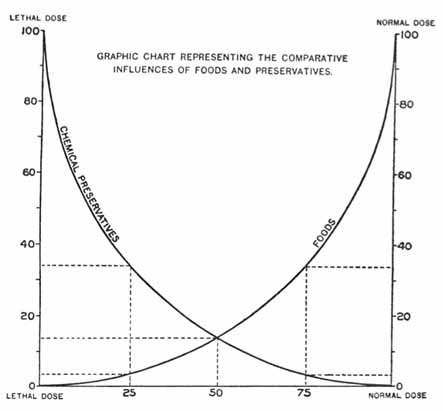
We will suppose that a normal dose of a drug in a state of health is nothing. We do not need it at all. Now, imagine that the lethal dose of a drug--that is, the dose that will kill--is 100; and then we go to work and measure at three points--at 75, at 50, and at 25. There are points at which we can measure. We can not measure up toward the right there, because the line almost coincides with the basic line, and the deviation is so slight that no method of measurement that we know of could distinguish them.
Then, if we use a little drug I can measure it here. I can measure it again here [indicating], and I can measure it again here [indicating]. Now from those three points I can construct a curve and calculate the lethal dose, which we will assume to be 100. That much drug would kill; no drug would not hurt at all.
The relative injury of a drug can be calculated mathematically from a curve constructed like that on experimental data, and I could tell you mathematically, by applying the calculus there, just what the hurtful value of that drug would be at an infinitely small distance from zero. You have doubtless, an of you, studied calculus, and you know how you can integrate a vanishing function. I used to know a good deal about calculus myself, and I could by integral calculus tell you the injurious power of a drug at an infinitely small distance from zero--that is, an infinitely small dose.
Now, see what a contrast there is between a food and a drug.
The lethal dose of a food is none at all. What kills you? You are starved to death. The normal dose is what you eat normally, 100. I starve a man, and I measure the injury which he receives at different points. I can mathematically plat the point where he will die.
That one chart shows to this committee in a graphic form, better than any argument could, the position of a drug in a food as compared with the food itself. They are diametrically opposite. The lethal dose of one is the normal dose of the other, and vice versa. Therefore the argument de minimis as far as harmlessness is concerned is a wholly illogical and unmathematical argument, and can be demonstrated by calculus to be so.
When the committee went into executive session to put this bill into its final shape, I was asked to sit with them. This is as near to being a member of Congress as I ever reached.
Thus ended the struggle for legislation controlling interstate commerce in foods and drugs. It had been going on nearly a quarter of a century. In the beginning the efforts were feeble and attracted very little attention. As the work continued more and more interest was taken in the problem. Many of the state authorities were keenly alive to the importance of national legislation. They felt that without some rallying point their own efforts in individual states would be lacking in completeness. The state officials who were most active in this crusade were Ladd of North Dakota, Sheppard of South Dakota, Emery of Wisconsin, Bird of Michigan, Abbott of Texas, Frear of Pennsylvania, Barnard of Indiana, Hortvet of Minnesota, Allen of Kentucky, and Allen of North Carolina. Many other food officials were interested and helpful, but these were the outstanding members of the state food commissioners who took the most active part in the matter. All the great organized bodies interested in the health of the people, namely, the American Medical Association, the American Public Health Association, together with the Patrons of Husbandry, and the Federated Labor organizations of the country were actively engaged in promoting this measure. Perhaps the greatest and most forceful were the Federated Women's Clubs of America and the Consumers League, They took up the program with enthusiasm and great vigor. Two of the leaders of this movement were Mrs. Walter McNab Miller, representing the Federated Women's Clubs, and Miss Alice Lakey, representing the Consumers League. Their services were extremely valuable.
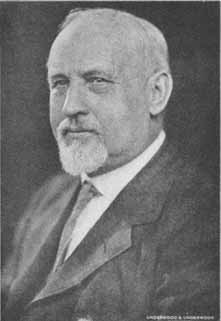
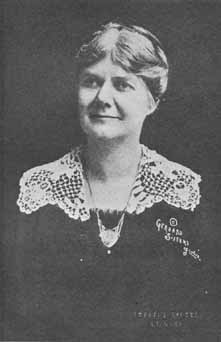
Finally the movement received the approval of President Roosevelt in a one-line sentence in his message to Congress at the opening of the fifty-ninth Congress in December, 1905. The stage was set for action. The force of the movement had passed beyond all restraining influences. The opposition of the vested interests had lost all momentum. Victory was in the air. People talked about the food bill on the streets, discussed it in clubs, passed resolutions in favor of it in their meetings. It was evident the day of success so long looked for and so eagerly awaited was at hand. It remained only for the Congress of the United States to compose the differences between the Senate and the House bills and put the final touches on legislation. It was a foregone conclusion that a measure so popular and so universally acclaimed would receive without hesitation the approval of the President.
The bill passed the Senate February 21, 1906, yeas 63, nays 4. The House passed a similar bill June 23, 1906, yeas 241, nays 17. The conferees agreed soon thereafter and President Roosevelt signed the bill June 30, 1906.
Confucius says:
"The commander of the forces of a large state may be carried off, but the will of even a common man can not be taken from him."
In the foregoing pages attention was called to the experiments making on healthy young men to determine the influence of preservatives and coloring matters on health and digestion. The general method of conducting these investigations was discussed. Altogether nearly five years were devoted to these experimental determinations, beginning in 1902 and lasting until 1907.
The total number of substances studied was seven, namely, boric acid and borax, salicylic acid and salicylates, benzoic acid and benzoates, sulphur dioxide and sulphites, formaldehyde, sulphate of copper, and saltpeter.
Reports of these investigations were published, with the exception of sulphate of copper and saltpeter, which were denied publication. In 1908 further investigations of this kind were allotted to the Remsen Board whose activities will be described in the following pages. The Bureau of Chemistry was "grievously wounded but not conquerered" by this transfer of its activities.
Anyone who has observed the occurrence of tornados, cyclones, and thunder storms, especially in the spring, has noticed their tendency to occur in groups. This is especially true of any particular locality and generally of those parts of our country in which these visitations, often destructive to life and property, are common. The storms which threatened the integrity of the food law were of this kind. They were different, however, from the caprices of the weather in the time of the year they occurred. The most threatening of them arose, not in the spring, but in the winter of 1907. The transfer of authority to execute the law from the Bureau of Chemistry to the Board of Food and Drug Inspection, and from that Board to the Solicitor, was a very good introduction to what occurred soon after January 1st, 1907. Even after the Bureau of Chemistry was deprived of its power of autonomy, it still retained intact its function of judging what was a threat to health.
Prior to the enactment of the food and drugs law it was evident from the increase in popular interest in this matter that the enlistment of organized bodies of men and women interested in securing this legislation would sooner or later become effective. It was considered the part of wisdom to prepare for this much wished-for consummation. Numerous attempts had been made before the Congress of the United States to change the wording of the proposed bill in such a way as to eliminate the Bureau of Chemistry as the active executive organization of the law when passed. All of these attempts had been almost unanimously negatived by the Congress as often as they were offered. It seemed, therefore, quite certain that when the law finally was secured the Bureau of Chemistry would be retained as its executive agent. As early as 1902 authority was obtained from Congress to carry on feeding experiments on healthy young men. The language of the law follows:
"To enable the Secretary of Agriculture to investigate the character of food preservatives, coloring matters, and other substances added to foods, to determine their relation to digestion and to health, and to establish the principles which should guide their use."
The object was to see if the preservatives and coloring matters added to foods would have any effect upon the digestion and health of these young men. Young men as a rule are more resistant to effects of this kind than children or older persons. They represent the maximum of resistance to deleterious foods. The deduction from this theory is that if the young men thus selected showed signs of injury other citizens of the country less resistant would be more seriously injured. Having received authority from Congress to proceed in this matter, a small kitchen and dining room were provided in the basement of the Bureau and a call issued for volunteers to join this experimental class. We asked chiefly employees of the Bureau. We had no difficulty in securing twelve healthy young men who volunteered their services and took an oath to obey all rules and regulations which should be prescribed for the experimental dining table. Their term of enlistment was made for one year. Up to this time no such extensive experiment on human beings had been planned anywhere in the world. It was not necessary to ask any publicity to this matter. It was a problem which interested not only newspaper reporters and editors, but the public at large. One reporter who was most constant in his attendance, and this was the beginning of his reportorial work, had the happy faculty of presenting the progress of the experiment in terms which appealed to the public imagination. He early designated this band of devoted young men as "The Poison Squad." There was rarely a day in which he did not visit the experimental table and write some interesting item in regard thereto. This cub reporter is now the celebrated author of the "Post-Scripts" in the Washington Post, George Rothwell Brown.
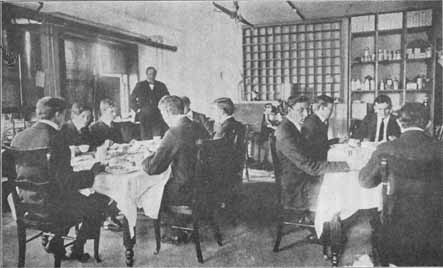
For five years these experiments continued and investigations of an extensive character were carried on with the preservatives which were in most common use. The chemical and physiological data accumulated were vast in extent and presented great difficulties in interpretation. Following the rule adopted by the Bureau, every doubtful problem was resolved in favor of the American consumer. This appeared the only safe ethical ground to occupy. Decisions against the manufacturers who used these bodies could be reviewed in the courts when the food law became established, whereas if these doubtful problems had been resolved in favor of the manufacturers the consumer would have had no redress. Without going into further detail in regard to these experiments it may be said that one of the common colors and all the common preservatives used in foods were banned from use by a unanimous verdict against them.
The greater part of these data was published as parts of Bulletin 84, Bureau of Chemistry. They comprise: Part I--Boric Acid and Borax; Part II--Salicylic Acid and Salicylates; Part III--Sulphurous Acid and Sulphites; Part IV-Benzoic Acid and Benzoates; Part V--Formaldehyde; Part VI--Sulphate of Copper; Part VII--Saltpeter.
When the data relating to benzoic acid were submitted, the Remsen Board had already been appointed. The Secretary, about to depart on vacation, sent for George W. Hill, Editor of the Department, and said:
"Publish what you like during my absence except that the bulletin on benzoic acid is not to go to the printer."
Mr. Hill misunderstood his instructions. He sent the benzoate bulletin to the public printer with instructions to hurry it through. When the Secretary returned the printing was finished. A reprint of it was promptly denied. The total number of pages in the parts of Bulletin 84 which have been published is 1500.
Vigorous protests from those engaged in adulterating and misbranding foods were made to the Secretary of Agriculture against any further publicity in this direction. As a result of these protests he refused publication of Parts VI and VII of Bulletin 84. Part VI contained a study of the effects on health and digestion of sulphate of copper added to our foods. The conclusions drawn by the Bureau were adverse to its use. The Remsen Board subsequently made a study of sulphate of copper and reached a like decision. The ban on copper was based on the work of the Remson Board and not on that of the Bureau, which preceded it by three years. During this interval the use of this deleterious product was unrestricted.
The seventh part treated of the use of saltpeter, particularly in meats. Owing to the well-known results of the depressing effects of saltpeter on the gonads, and for other reasons, the Bureau refused to approve the use of this coloring agent in cured meats. These two bulletins still repose in the morgue of the Department of Agriculture. They are not, however, deprived of companionship. In the testimony of the Secretary of Agriculture before the committee on expenditures in the Department of Agriculture (the Moss Committee), it is found that the following additional manuscripts prepared by the Bureau of Chemistry were refused publication, namely, Experiments Looking to Substitutes for Sulphur Dioxides in Drying Fruits, by W. D. Bigelow; Corn Sirup as a Synonym for Glucose, offered for publication in 1907; Sanitary Conditions of Canneries, Based on Results of Inspection, by A. W . Bitting, offered for publication in 1908; Reprint of Part IV of Benzoic Acid and Benzoates, asked for in 1909; Medicated Soft Drinks, by L. F. Kebler, offered in 1909; Drug Legislation in the United States, by C. H. Greathouse, offered in 1909; Food Legislation to June 30, 1909, offered in 1910; The Estimation of Glycerine in Meat Preparations, by C. F. Cook, offered in March, 1910; Technical Drug Studies, by L. F. Kebler, offered in 1910; Experiments on the Spoilage of Tomato Ketchup, by A. W. Bitting, offered in 1911; the Influence of Environment on the Sugar Content of Cantaloupes, by M. N. Straugh and C. G. Church, offered in May, 1911; A Bacteriological Study of Eggs in the Shell and of Frozen and Desiccated Eggs, by G. W. Stiles, May, 1911; The Arsenic Content of Shellac, offered June, 1911.
All of these publications are in the morgue. They were objected to by parties using preservatives and coloring matters and articles adulterated with arsenic, and these protests against publication were approved and put in force by the Secretary of Agriculture. In other words, all the principles which animated the Inquisition were used by the Department of Agriculture to prevent any further dissemination of the studies and conclusions of the Bureau in regard to the wholesomeness of our foods. The whole power of the Department of Agriculture was enlisted in the service of adulteration which tended to destroy the health of the American consumer. On the appointment of the Remsen Board further investigations by the Bureau were ordered to be suspended.
Further information regarding the activities of the Poison Squad were presented to the Committee of Interstate and Foreign Commerce during the final hearings on the Food and Drug Legislation. This information has the distinguishing tone of question and answer which adds much to its interest and value. Quotations from those hearings follow:
DR. WILEY: Now, I want to introduce the borax bulletin in evidence; not to have it copied, but simply to have it as an exhibit, because all of you have copies in your desks. That will answer the question which was asked me yesterday about the kind of work done by these young men. You gentlemen need only to glance through this book of 477 pages to see the amount of labor that has been put upon this investigation.
MR. TOWNSEND: When did you begin your investigation of boric acid?
DR. WILEY: In the autumn of 1902.
MR. TOWNSEND: How long were you experimenting on that?
DR. WILEY: We were from the 1st of October to the 1st of the following July.
MR. TOWNSEND: About nine months?
DR. WILEY: Yes, sir.
MR. TOWNSEND: How soon after that did you make a report?
DR. WILEY: On the 25th of June, 1904; just about a year after the close of the investigation.
MR. TOWNSEND: You did not publish it in 1903?
DR. WILEY: We published a synopsis--a preliminary report--in 1903.
MR. TOWNSEND: You said yesterday that you had not had time, as I remember it, or had not been able--I don't remember just exactly how you answered it--to report your investigation of benzoic acid, which had only occupied three months and which was completed in the fall, as I remember it, of 1902.
DR. WILEY: On benzoic acid?
MR. TOWNSEND: Yes; benzoic. acid.
DR. WILEY: The benzoic-acid investigation was not begun until the spring of 1904, and was completed before November, 1904.
MR. TOWNSEND: Are you sure about that? As I took it down yesterday in a note, it was begun in the fall of 1902.
DR. WILEY: Then you misunderstood me; it was not. I was referring to the time I commenced the first investigation.
MR. TOWNSEND: Then I misunderstood you. Who assisted you in making those investigations on borax and benzoic acid?
DR. WILEY: About twenty or twenty-five men besides the subjects.
MR. TOWNSEND: Were any of them of national reputation as scientists?
DR. WILEY: Dr. Bigelow, who is here, is a man of good reputation. He is the one who collaborated with me in, particular. The others are chemists in fair standing, but they are not men of great reputation in a personal way.
MR. TOWNSEND: Connected with the Department?
DR. WILEY: Connected with the Department of Agriculture here; yes, sir. I will explain the method of investigation briefly, because I know you gentlemen do not care to read this voluminous document.
The young men were selected mostly from the Department of Agriculture--I believe the first were all from the Department of Agriculture. They were young men who had passed the civil-service examinations, and therefore came to us with a good character, as is usual in such cases. These young men were volunteers. We explained to them fully the character of the work that we proposed to do, not particularly stating what we were going to give them, or how, but what our general purpose was, and that was to place in good wholesome foods certain quantities, which we were to select ourselves, of the ordinary preservatives and coloring matters used in foods, and to feed them on these foods with such materials in them.
MR. TOWNSEND: Exclusively with those materials?
DR. WILEY: Oh, no. I will explain, and you will understand how we did it. These men signed a pledge in which they agreed on their honor to carry out all the necessary regulations. They signed a pledge to eat nothing or drink nothing excepting what we gave them at the table. They signed a pledge to pursue their ordinary vocations without any excesses and to take their ordinary hours of sleep. They agreed that they would collect and present to us every particle of their secreta, so that none of it should be lost, and to follow out the rules and regulations necessary to carry out the conduct of the work.
MR. ESCH: Did you require any physical examination?
DR. WILEY: Yes, sir; we had a surgeon detailed from the Public Health Service, who examined all of these men physically and saw that they had no disease, and that they had had no disease within a year, or any sickness of any kind.
MR. TOWNSEND: They were allowed to live at their homes?
DR. WILEY: Yes, sir.
MR. TOWNSEND: How did you collect their perspiration?
DR. WILEY: Perspiration was not collected excepting in one case. We collected perspiration in one case to determine how much borax was exuded through the skin, but in no other.
MR. BARTLETT: You had a release if they died?
DR. WILEY: Yes, sir; from any injury that they might receive.
That was their preliminary work. The first thing which we did was to ascertain, by their own choice largely, the character of good wholesome foods to be used, absolutely free of adulterants, a natural diet which would keep their bodies in a state of equilibrium so that, neither the question of added weight or of losing weight--that is to say, in a fore period, which was a period of about ten days, the body was weighed every day, the amount of food which they ate was weighed, and if they gained a little we cut it off, and if they lost a little we added a little to it--so that by the end of ten days we could get their normal ration. Meanwhile their excreta were collected and analyzed, so that we had a complete check on the normal metabolic process by which the food was utilized in the body and the refuse matter excreted. You will understand that the only excretions that we got were the urine and the feces. All of the others were so small in proportion to the whole mass that they were neglected; in fact, it is impossible to get them; no one has ever attempted it. Then we began by adding to the food one of the common preservatives--borax was first. We had twelve young men, and to six of them we gave borax in the form of boracic acid, and to the other six borate of soda, to see if there was any difference in the effect of those two forms of borax attending the metabolic process.
MR. TOWNSEND: Did you explain that this was a dangerous process?
DR. WILEY: We told them that they might receive some injury from it.
MR. TOWNSEND: That is the reason you took a release?
DR. WILEY: We certainly would not ask the young men to submit to it without an explanation. We told them, of course, that there was no danger by poisons, but that there might be some disturbance to their systems.
MR. TOWNSEND: You thought that there was nothing; but you took a release because there was danger of losing life, in a sense.
DR. WILEY: Yes, sir; we kept nothing from them at all.
MR. TOWNSEND: Do you think that had any effect upon them?
DR. WILEY: We discuss that in the book. That has been one of the objections urged against this work, and it would be urged against any work of the same kind.
MR. CUSHMAN: Is that the bunch known to the public as the "poison squad"?
DR. WILEY: That is the one. I suppose it was the most widely advertised boarding house in the world.
Now, when we had established their normal diet, then they agreed to eat it every day whether they wanted it or not, because that was the important part of the experiment, that the food ingestion must be constant, otherwise you could not study the effect of the added substance on metabolism.
MR. TOWNSEND: Do you explain the effect in your book?
DR. WILEY: That is all explained in the greatest detail.
Now, of course, they did that as long as their digestion was not impaired. When it did become impaired they were released at once from any further administration of the drug. That was all we wanted to do--to get the first effects, never any more. We did not carry it to any extreme. Once a man was undoubtedly affected he was released. You may ask how we knew how any disturbance produced was due to borax, and I answer because we eliminated all the variables but that one. in the case of the man who had led the same life, pursued the same vocation, eaten the same food, and who did the same things, the only variable was the preservative; so that if the variations are those which would be expected to be produced by such a variable, we logically traced the result of those variations to that one variable, and especially so if when we withdrew it the disturbance was removed. Then the symptoms which had ensued would be removed, and that was additional proof. Therefore as far as possible we ruled out every influence excepting the one which we were controlling. Then we had what we called "periods" of five days, so that we studied them in periods of five days. We called it the first preservative period, the second preservative period, and so on, until we had usually the preservative periods lasting for about twenty days. That was the usual rule. That was followed by a period in which nothing but pure food was given for ten days, the object being if possible to restore the man to the normal state. I will say very frankly that ten days as a rule was not long enough to do that; but as they then had a holiday and rested for some time, it didn't make so much difference to us.
MR. TOWNSEND: What do you mean by a holiday?
DR. WILEY: We kept our table going all the time, but when a man had worked for about forty days on these experiments we then allowed forty days' rest, the same time that we had been working on him.
MR. BARTLETT: That is, you discontinued this character of food.
DR. WILEY: We gave him then nothing but pure food. We did not have to measure his food or collect his excreta; and he simply rested and got ready for another trial.
Now, in our first year's work we only fed six men at a time, so that we had constant observation--six men on holiday and six men on observation--but in subsequent investigations we found it much more convenient to feed all of the men at the same time and give them the holiday at the same time. That appears from the fact that the chemical work, so far as analysis of foods is concerned, is just as great for six men as it is for twelve, because we did not analyze each person's food, but the food which we gave all, so that we knew the composition of it. Therefore one analysis would do for a hundred men just as well as six. But the excreta that were turned in had to be analyzed separately--that is, every day, or the composite for a number of days, whichever seemed desirable.
MR. TOWNSEND: When you examined that excreta: did you examine for any other substance besides boric acid or benzoic acid?
DR. WILEY: In the digestion of food the process is of two kinds. We have what is called metabolized food and nonmetabolized food, which is found largely in the feces. Parts of the feces never enter the system at all; they are the refuse matter, and therefore we say that they are.nonmetabolized. We simply wanted to determine how much protein, how much fat, how much sugar, etc., had come out in the feces and had escaped digestion. Then we examined the urine, which contains the principal part of the degradation products of the metabolized food. When the food enters the system, after the process of digestion, it has two great functions, as you gentlemen know. One is to supply heat and energy. That food is all burned up and converted into water and carbon dioxide, just the same as you burn a piece of coal in the fire and convert it into carbon dioxide and into water. And the great mass of food which we eat is burned in the body and produces heat and energy. Of course the water and the carbon dioxide that come from the lungs and the skin we did not collect.
Then the food which goes to build the tissues, or enters into the tissue, pushes out the degradation products in the same quantity when the body is in equilibrium, just as you fill a tube full of marbles, and when you put one marble in it you will push out another at the other end. Now, if I feed you on nitrogen to-day or to-morrow, when I go to determine the nitrogen in your urine I do not determine the nitrogen that you have eaten to-day or yesterday, but if your body is in equilibrium the amount of nitrogen pushed out is exactly what you push in. That is what we call the balance, and in that way we can determine whether any substance added to the food disturbs the metabolic process and interferes with digestion. And you can only determine it in that way. The amount of disturbance is so slight that you will never notice it and yet so pronounced that our chemical balance will reveal it.
MR. BARTLETT: Doctor, I see in the bill of fare that you give here that some of the gentlemen took cranberries. What did you add to the cranberries, anything?
DR. WILEY: No, sir; we took cranberries without anything. We did not add any benzoic acid to those. I say that we used the ordinary foods, a plain ration, so that each man would eat on the same day the same number of calories, the same amount of nitrogen, the same amount of phosphoric acid, the same amount of sulphur. We gave an excellent food, the very best of the retailed canned goods. I will say that nearly all of our vegetables are canned vegetables. That shows our attitude toward canned foods, which has been said to be very hostile. We used them because they are more uniform in character, and when put up by reputable firms are apt to be better than the vegetables that you can buy in the open market. Our canned foods were canned to order, so that all that we used during the year were exactly alike. And so important was that fact in the eyes of an enterprising advertiser that he went to one of the firms that sold us these goods--we didn't buy all from one firm--and wanted them to pay him hundreds of dollars to write articles saying that we were using his canned foods. Of course, we promptly refused to allow his name to be used.
MR. LOVERING: Did these young men know when they were eating pure food or not, and in what proportion?
DR. WILEY: They did not know what it was, necessarily, or how much. That was our business. All they knew was the fact that they were using something.
MR. MANN: For a long time the daily papers published what they were being fed upon.
DR. WILEY: You can not always rely upon newspaper accounts of scientific investigations.
MR. MANN: I suppose the young men read the accounts, and if you did not tell them exactly what they were being fed they might have thought they were being fed on something else.
MR. RYAN: This so-called "poison squad" was selected from employees of the various departments.
DR. WILEY: Almost altogether from the Department of Agriculture. We had a few from the other departments, however, and a few from a medical school.
MR. RYAN: Did they receive additional compensation for entering into this?
DR. WILEY: Not those that were in our Department. Those that came from the outside were paid $5 a month in addition to the other. We had to give them some compensation; they could not serve in the Department under other circumstances, because it was illegal. We gave them a mere nominal sum so as to make their employment legal. We would not take anybody who was not in the Department in some capacity.
MR. BARTLETT: Did you use real butter or oleomargarine?
DR. WILEY: The butter was made to order, and contained neither salt nor coloring matter--pure butter.
MR. ESCH: How about milk?
DR. WILDY: The milk came from dairies inspected by the District authorities and by myself.
MR. ESCH: Did you at any time adulterate the milk?
Dim. WILEY: We sometimes put the preservative we used in the milk.
MR. BARTLETT: Formaldehyde?
DR. WILEY: Formaldehyde we did constantly, and borax part of the time.
MR. ESCH: How did the health of these men continue; have you any statistics on that?
DR. WILEY: That is all here; everything is recorded in full.
MR. CUSHMAN: Can you tell, in a general way, some of the symptoms, or would that be interrupting the effect of your remarks?
DR. WILEY: If you would like a résumé of the borax matter, I will give that in a few words. I will take the experiment where we gave a minimum quantity, such as you would ordinarily get if you ate meat and butter containing one-half of 1 per cent of borax, in the ordinary quantities of meat and butter and other preserved foods which a healthy man would eat. With the ordinary quantities of butter and meat preserved with borax there would be consumed about 7-1/2 grains of borax per day by each individual; and so we fed that for sixty days in succession, beginning with the preliminary period of ten days, then following sixty days in which we gave the borax.
MR. MANN: How much borax?
DR. WILEY: Seven and one-half grains a day. That was given in two doses. Part of the time in one dose, and part of the time we divided it and gave 3-3/4 grains at one time and 3-3/4 grains at another time.
MR. TOWNSEND: How did you give it?
DR. WILEY: In butter and in milk and in capsules. We tried all methods.
MR. BARTLETT: Did you give any tomato catsup with any of these meats?
DR. WILEY: I don't think we did.
Now, I want to say this, because I regard it as important. For fifteen or twenty days, or even longer in some cases, no visible effects were produced in what you would call "symptoms. " The young men had normal appetites and performed their work without any discomfort, and had no complaints. After that time they began to eat their ration with some little discomfort. They were under obligation to do it, but they often said: "I wish you could let this go; I don't want it." Their appetites began to fail. At the end every one of their appetites was very badly affected, and some of them were unable any longer to eat the full amount. Of course we never required anything that was impossible. They developed persistent headaches in most cases, followed by general depression and debility. It was extremely well marked in every instance.
MR. KENNEDY: Did they get nauseated and want to refuse the food with the preservative in?
DR. WILEY: They were occasionally nauseated. We had every variety of food that anybody commonly eats. We varied their menu every day.
MR. KENNEDY: Did the boys seem to get tired of it; did they want to refuse the food?
DR. WILEY: That is the reason we had to resort to capsules, because the very moment he found it in the milk or in the butter he didn't want to use the butter. I would say that this is all set out in here. We were led to the use of capsules because of the objections to which you refer. It may be all wrong, but that, of course, is a matter for you gentlemen to decide.
MR. ADA MSON: When they took the food, did it have some effect on the appetite?
DR. WILEY: It had a worse effect in the food when they knew it was in the food, because it became repugnant to them.
MR. KENNEDY: Don't you think this repugnance is nature's own method of correcting these things I I remember that out in our town two fellows made a wager with another fellow that he could not eat a quail a day for thirty days in succession. He did it, but it made him sick. That was because there was nothing wrong with the quail, but he was taking it too consistently.
DR. WILEY: There is a great difference between a quail and borax; the latter is a drug.
MR. KENNEDY: A man's life was imperiled by his trying to win that bet; he became very sick.
DR. WILEY: I will answer that by saying that it is the universal experience of physicians that the drug habit grows; the more drug you take the more you need to produce the effect, and the less its effect; so that it is just the opposite to the effect that you mention.
MR. TOWNSEND: Did you try the same experiment with benzoic acid?
DR. WILEY: Not for so long a time, but a shorter length of time.
MR. TOWNSEND: But on the same plan?
DR. WILEY: The same plan. That will be fully brought out in the publication.
MR. WANGER: Was there, at the end of the period of the administration of these preservatives, an immediate relief and restoration of the appetite, or was that a slow process?
DR. WILEY: Unfortunately the effects in some cases were very much prolonged. Some of the young men--the experiments ended in July, or in June, the end of the year--and some of the young men complained even through the summer, and it was late in the autumn before they recovered their full normal appetites.
MR. WANGER: That would furnish a strong presumption that it was not the mental idea connected with the daily use of the preservatives that caused the loss of appetite.
DR. WILEY: It might be that the mental attitude was a strong factor, but when you get used to a thing after three or four days the mental attitude becomes less important. And I got a beautiful illustration of that in our own investigation, because I realized that a very reasonable objection is made against experiments of this kind, against all pharmacological experiments, by reason of the mental attitude of the patient, and I give full credit to the objection in the book, which you will see. I discuss that fully and frankly, and give value to the objections.
But this strange thing happened when we came to salicylic acid. We had an almost new set of young men. We had a few that had come over from the borax period, but one year of this kind of life is as much as a young man wants. They enlisted for a year. So we had a new list. They must have had the same attitude toward salicylic acid that the first set had toward borax, and yet when we began to feed them salicylic acid there was an immediate improvement in the appetite; most of the young men seemed better, wanted more to eat, and it had exactly the opposite effect that borax had. Now, if it had been mental attitude in both cases the effect upon these men would have been the same. But we had the opposite effect. So I think that is the most happy proof. It came instantly, unexpectedly; we were not looking for it. The effect of the mental attitude, which must be considered, does not have the great importance that has been ascribed to it.
MR. TOWNSEND: These men made releases?
DR. WILEY: Yes, sir.
MR. TOWNSEND: How do you explain the effect of a drug--the fact that the constant use of it inures a person to it?
DR. WILEY: I think that is easily explained. As you get used to the effect of a drug you never improve in health. The man who forms the opium habit takes more and more of the drug, but his health goes down all the time. You can tolerate more of the drug, but your health is going all the time, and it takes more of the drug to produce a given effect.
MR. MANN: You say that in the experiments with borax the effects continued some time after the feeding of the borax to the young men, so that there is a cumulative effect of borax upon the system?
DR. WILEY: I referred to that yesterday, and I will restate it. Professor Rost, of the imperial board of health of Berlin, whose work I have here, criticized our work because we said that practically all of the borax was eradicated from the body after ten days. He contends that a lot of it remains in there for a longer time and comes out in the waste material a little at a time for weeks and months, so that his testimony is very much more in favor of the cumulative effects of those substances than our own.
MR. TOWNSEND: Have you tested for that?
DR. WILEY: We have made some tests on that during this last winter, but I have not as yet collated and studied the data.
MR. MANN: Does your report show that in your opinion the use of borax has a deleterious effect upon the organs of the body?
DR. WILEY: Of course you understand, Mr. Mann, the tests that we have made are not the same as those made upon animals fed for pharmacological experiments, because after a given time the animals are killed and their organs are examined, and the changes in the cells are studied by the microscope. We were precluded from doing that.
MR. MANN: Is that your conclusion?
DR. WILEY: My conclusion is that the cells must have been injured, but I had no demonstration of it, because I could not kill the young men and examine the kidneys.
MR. MANN: Your judgment was that the borax was excreted from the body; it did not remain, but that the effects did remain? How else could the effect remain excepting in some way affecting the organs of the body?
DR. WILEY: I think it must have affected the organs of the body. I think that is conclusive proof of it.
MR. ADAMSON: Is the process of resolving these foods into their original elements so difficult that scientists cannot furnish the people any practical method of safely separating preservatives from food when they get ready to use them?
DR. WILEY: It is quite impractical to separate the whole of any preservatives from food, though it probably can be done.
MR. MANN: Does it make any difference how borax is administered, whether administered by itself or administered in connection with foods, and is there a difference in the effect between the administration of a preservative in milk or in some kind of solid food, for instance?
DR. WILEY: The ideal way to administer substances of this kind would be in solution in the food. But that has such practical difficulties that in almost all pharmacological experiments like these which have been performed by the thousand in the world, the method which we finally adopted as the best has been adopted--that is, the introduction of the substance into the stomach in the form of capsules, where nature quickly mixes it entirely up with the contents of the stomach.
MR. MANN: Do not some scientists think that there is a difference in effect whether it is administered in one food or another?
DR. WILEY: That is the objection I have seen in scientific publications and in the public press urged against our work by Mr. H. H. Langdon, who has written a great many letters condemnatory of the work. Mr. Langdon, as I have learned, is employed by the borax company to do this work. He has called attention to that point in the public press.
Many poetic descriptions of the poison squad were published, among the best of which are the following by S. W. Gillilan and Lew Dockstader:
O we're the merriest herd of hulks
that ever the world has seen;We don't shy off from your rough
on rats or even from Paris green:We're on the hunt for a toxic dope
That's certain to kill, sans fail.But 'tis a tricky, elusive thing and
knows we are on its trail;For all the things that could kill
we've downed in many a gruesome wad,And still we're gaining a pound a day,
for we are the Pizen Squad.On Prussic acid we break our fast;
we lunch on a morphine stew;We dine with a matchhead consomme,
drink carbolic acid brew;Corrosive sublimate tones us up
like laudanum. ketchup rare,While tyro-toxicon condiments
are wholesome as mountain air.Thus all the "deadlies" we double-dare
to put us beneath the sod;We're death-immunes and we're proud as proud--
Hooray for the Pizen Squad!
If ever you should visit the Smithsonian Institute,
Look out that Professor Wiley doesn't make you a recruit.
He's got a lot of fellows there that tell him how they feel,
They take a batch of poison every time they eat a meal.
For breakfast they get cyanide of liver, coffin shaped,
For dinner, undertaker's pie, all trimmed with crepe;
For supper, arsenic fritters, fried in appetizing shade,
And late at night they get a prussic acid lemonade.(Chorus) They may get over it, but they'll never look the same.
That kind of a bill of fare would drive most men insane.
Next week he'll give them moth balls,
a LA Newburgh, or else plain.
They may get over it, but they'll never look the same.
After the enactment of the food and drugs law the necessary rules and regulations for carrying it into effect were prepared. The law provided that a period of six months should elapse and that the enforcement of the law should begin on the first day of January, 1907. In the preparation of these rules and regalations not only were the rights of the public at large to be conserved, but also a due regard for the ethical interests in the food and drug industries. The committee appointed to formulate these regulations held meetings in Washington, New York and Chicago. Extensive advertisements of these meetings were published and all interests involved were invited to appear and give their views.
Secretary Wilson named the Chief of the Bureau of Chemistry as his representative on the committee authorized by the law to draft the rules and regulations for the enforcement of the new act. The representative of the Treasury Department was Mr. James L. Gary; the representative of the Department of Commerce and Labor was Mr. S. N. D. North. The Chief of the Bureau of Chemistry was named chairman. My colleagues entered most enthusiastically into the discharge of the duties assigned to them. First of all they studied the act in all of its relations. We sat almost continuously every day, and always with cordial collaboration and mutual sympathy in the difficult task set before us.
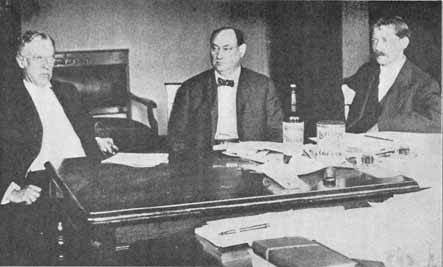
On the completion of our labors we each undertook to secure the signature of our respective secretary. The Secretary of Agriculture promptly signed our report; likewise the Secretary of Commerce and Labor. Mr. Gary had some little difficulty in securing the signature of the Secretary of the Treasury. He thought that the regulations were a little bit too severe upon some of the food industries. Finally, however, he affixed his signature without any amendment whatever to the rules and regulations as presented.
During the hearings accorded interested parties there appeared before the committee practically the same interests that had been active in opposing the enactment of the law. The same arguments with which the chairman of the board had been so long familiar were repeated. Pleas for recognition of the use of borax under the regulations were made by the fishing interests of Massachusetts; the interests engaged in the manufacture of catsup begged for recognition of benzoic acid. The manufacturers of syrups pleaded for permission to use sulphur dioxide and were joined in this plea by the interests engaged in drying fruits in California.
An interesting incident occurred in this connection. It was while the committee was sitting in New York that the advocates for the recognition of sulphurous acid and sulphites were heard. A particularly earnest plea was made by the representative of the California interests, in which we were told that failure to use sulphur dioxide would ruin the dried fruit industry of that state. Reporters were constantly present at these hearings and this story of the California interests got into the afternoon papers of this city. About seven o'clock that evening the card of the California advocate was brought up to my room. When he himself appeared he was considerably embarrassed. Finally he stated the object of his visit. He said:
"My wife read an account of my remarks in the afternoon papers. On my return to my apartment she chided me for what I had said. She urged me--almost commanded me--to come to see you in regard to the matter and here I am. My Wife does not allow any sulphur dioxide fruit to come onto our, own table. She is so firmly convinced of the undesirability of this kind of preservative that she will not allow me or any of my family to eat foods preserved with sulphur dioxide."
This confession on the part of the representative of the California interests I imparted to my colleagues the next morning before the hearings began.
It is hardly necessary to say that any regulation for carrying a law into effect shall not presume to ignore any function of that law. As it was provided in the law that the Bureau of Chemistry alone was to be the judge of what was an adulteration and misbranding any decision of that kind under the rules and regulations would be illegal.
The report of the committee after receiving the signature of the three cabinet officers authorized to make the rules and regulations was finally published on Oct. 17,1906.
Quite as important as the rules and regulations for carrying out the provisions of the law was dependable information respecting the methods of judging the quality of foods and drugs by standards which were legal and conclusive in their character. About the time of the beginning of the experimental work for determining the effect of preservatives and coloring matters upon digestion was originated the idea of establishing under proper authority standards of foods. Accordingly about 1902 a section was added to the appropriation bill of the Department of Agriculture, authorizing the Secretary of Agriculture to appoint a committee of this kind. Similar action was taken by the Association of Official Agricultural Chemists. When this authority was secured the following named representatives of Agricultural Colleges and Experiment Stations were selected for this very difficult and important work: Mr. M. A. Scovell, Director of the Agricultural Station of Kentucky, Mr. H. A. Weber, Professor of Agricultural Chemistry in the College of Agriculture of the State University of Ohio, Mr. William Frear, Assistant Director of the Agricultural Experiment Station of Pennsylvania, Mr. E. H. Jenkins, Director of the Agricultural Experiment Station of Connecticut, at New Haven, and Mr. H. W. Wiley, Chief of the Bureau of Chemistry of the Department of Agriculture, at Washington, D. C.
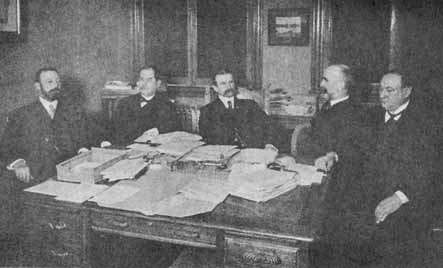
Left to Right: Prof. M. A. Scovell, Director, Agricultural Station of Kentucky, H. A. Weber, Prof. Agricultural Chemistry, University of Ohio, Dr. William Frear, Assistant Director, Agricultural Experiment Station of Pennsylvania, Dr. E. H. Jenkins, Director, Agricultural Experiment Station of Connecticut; Dr. H. W. Wiley, Chief of the Bureau of Chemistry, Department of Agriculture
This committee was enlarged subsequently by additional
members, but the five original members remained as its nucleus and principal
actors until the Secretary of Agriculture at the instigation of the Solicitor of
that Department abolished the committee by having the authority for its
continuance withdrawn from the appropriation bill. This, however, only
temporarily prevented its activities. Subsequently, after the Chief of the
Bureau resigned, it was reorganized and is still at work. The value of the
contribution made by these five original members is almost incalculable. We had
frequent meetings lasting for days at a time, usually held at the Department of
Agriculture, but in many cases we met in other cities where it was more
convenient for interested parties to attend. You may have some idea of the
extent of our investigations by seeing the official papers piled up on the table
before us, as shown in the illustration. The results of the deliberations of
this committee were published from time to time by the Department of Agriculture
as official documents. They have become the guide and director, not only of the
national food law, but also they have been approved and adopted by the various
states.
Before this committee also appeared practically the same interests which on the enactment of the food law appeared before the committee to establish rules and regulations to carry the law into effect. They continually presented their claims for indulgences before the Food Standards Committee. The character of this opposition has already been definitely illustrated. It was not based on ethical grounds but on individual and industrial interests without relation to the welfare of the consuming public.
The result of all these preliminary investigations shows the wisdom and timeliness of their inauguration. Had it not been for these fundamental investigations the Bureau of Chemistry would have been totally unprepared to have organized the machinery which immediately went into effect January 1, 1907.
It is hardly necessary to add. that all the conferences, indulgences and collaborations with vested interests which thereafter were resorted to as a means of defeating the purpose of the law have effectively nullified the efficiency of the standards originally established.
The Secretaries of the Treasury and Commerce cannot be blamed for affixing their signatures to these documents. They assumed that these decisions were intended to carry the provisions of the law into effect. The Secretary of Agriculture stood in a different position. He knew the exact purpose of putting the decisions of the Remsen Board into effect. He boldly proclaimed that the Board was created to protect the manufacturers. Leaving his Solicitor to interpret the law, he was firmly convinced that these restrictions were legal and binding. He gave himself wholeheartedly to the effective plan of prohibiting the Bureau of Chemistry from exercising its duty to enforce the law according to its letter and spirit. The food and drugs law became a hopeless paralytic. It still breathed but its step was tottering and its hand shaky. The clot on its brain has become encysted. There is no hope that it will ever be absorbed. Only a capital operation will restore it to health.
From June 30, 1906, the date the Food and Drugs Act became a law, until January 1, 1907, when it went into effect, numerous questions were propounded to the Bureau of Chemistry by interested parties respecting the scope and meaning of many of its requirements. The Bureau of Chemistry to the best of its ability interpreted, as the prospective enforcing unit, the intent of the law. Following the usual customs in such cases these opinions were taken to the Secretary of Agriculture for signature. The last Food Inspection Decision prior to 1907 was No. 48, issued Dec. 13, 1906.
For a few days after January 1, 1907, the Bureau of Chemistry was unrestricted in its first steps to carry the law into effect. Although all matters relating to adulteration or misbranding were now solely to be adjudicated by the Bureau, it was decided to continue to have these opinions, as heretofore, signed by the Secretary. The first decision under the new regime was signed by the Secretary Jan. 8, 1907. It discussed the time required to render decisions. It was prepared because many persons presenting problems were complaining of delay.
An open break in the plan of preparing decisions by the Bureau of Chemistry for the Secretary came in the case of F. I. D. 64, signed. by the Secretary March 29, 1907. The question was, "What is a sardine?" The Bureau prepared a decision that only the genuine sardine prepared on the coasts of Spain, France and the Mediterranean Islands was entitled to that name. The Secretary, due to protests from the Maine packers, referred this problem to the Fish Commission of the Department of Commerce. The Fish Commission, which had no function whatever in describing what was a misbranding, made a decision diametrically opposed to that reached by the Bureau. It was as follows:
Commercially the name sardine has come to signify any small, canned clupeoid fish; and the methods of valuation are so various that it is impossible to establish any absolute standard of quality. It appears to this Department that the purposes of the Pure Food law will be carried out and the public fully protected if all sardines bear labels showing the place where produced and the nature of the ingredients used in preserving or flavoring the fish.
The Fish Commission, being in the Department of Commerce, would consider any commercial process or practice as of more importance than the plain provisions of the food law looking to the protection of the public against misbranding. The Secretary of Agriculture ignored the protest of the Bureau of Chemistry to this decision, placing a trade practice above the plain precepts of the law. The Secretary of Agriculture said:
In harmony with the opinion of the experts of the Bureau of Fisheries, the Department of Agriculture holds that the term "sardine" may be applied to any small fish described above and that the name "sardine" should be accompanied with the name of the country or state in which the fish are taken and prepared and with a statement of the nature of the ingredients used in preserving or flavoring the fish.
The Ambassador of France earnestly indicated to me in a personal interview his feeling that the sardine packers in France would be subjected to a ruinous competition by permitting young sprats and young herrings to be prepared according to the manner of the French sardine and thus enter into direct competition therewith. I believe also the French Ambassador voiced his objection to this decision in a diplomatic way with a protest filed with the Secretary of State. Both this protest and the plain provision of the law that the Bureau of Chemistry should decide all cases as to whether or not the articles were adulterated and mi sbranded failed to have any effect whatever on the Secretary of Agriculture. This was the second official departure of the Secretary of Agriculture from the plain provisions of the law. His whisky decision, which Secretary Bonaparte turned down, was the first.
Soon after this incident the Board of Food and Drug Inspection was formed in the Secretary's office. Theretofore the Chief of the Bureau of Chemistry had not affixed his official signature to the Food Inspection Decisions which he had prepared and the only signature these decisions carried was that of the Secretary of Agriculture. After the organization of the Board of Food and Drug Inspection the Secretary required that all the decisions of that Board submitted to him for approval should be signed by at least two members of the Board. The first decision thus signed was Food Inspection Decision No. 69. The three members of the Board affixed their signatures to this and the Secretary of Agriculture approved it on May 14, 1907.
It so happened that when the decisions of this board were deemed of extraordinary importance the practice arose of having them approved, not by the Secretary of Agriculture alone, but by the three Secretaries authorized by law to make rules and regulations for the enforcement of the act. When these Secretaries therefore signed a Food Inspection Decision it became a rule and regulation. The first decision of this kind thus signed was Food Inspection Decision No. 76, concerning dyes, chemicals and preservatives in foods.
Some time prior to the issuance of this decision, and in fact long before there was any hint that the functions of the Bureau of Chemistry would be usurped illegally, questionnaires had been sent to three or four hundred prominent physiologists and dietitians in the United States as to their attitude in regard to the use of preservatives and coloring matters in foods. The questions propounded and the number of answers received, both negative and affirmative, are as follows:
1. Are preservatives, other than the condimental preservatives, namely, sugar, salt, alcohol, vinegar, spices and wood smoke, injurious to health? Affirmative, 218; negative, 33.
2. Does the introduction of any of the preservatives, which you deem injurious to health, render the foods injurious to health? Affirmative, 222; negative, 29.
3. If a substance added to food is injurious to health, does it become so when a certain quantity is present only, or is it so in any quantity whatever? Affirmative, 169; negative, 79.
4. If a substance is injurious to health, is there any special limit to the quantity which may be used which may be fixed by regulation of our law? Affirmative, 68; negative, 183.
5. If foods can be perfectly preserved without the addition of chemical preservatives, is their addition ever advisable? Affirmative, 12; negative, 247.
It is readily seen from this tabulation that the opinion of physiologists, hygienists, health officers and physicians in the United States to whom these questionnaires were sent is overwhemingly against their use. These opinions of distinguished experts were obtained before the Remsen Board was ever thought of. (Food Inspection Decision No. 76, Pages 5 and 6.)
Food Inspection Decision No. 87 is signed by the three Secretaries as a rule and regulation. It is neither. It was an opinion that the term "corn sirup" is a proper label for the substance commonly known as glucose. This opinion repealed the opinion of the Bureau of Chemistry, which, after a long argument, was endorsed also by the other two members of the Board of Food and Drug Inspection. Thus the three Secretaries authorized by law to make rules and. regulations usurped the function of the Bureau of Chemistry in regard to what was a proper label under the law.
Food Inspection Decision No. 102 was signed by the three Secretaries, legalizing the introduction into the United States of vegetables greened with copper. This was clearly another usurpation of the functions of the Bureau of Chemistry.
Food Inspection Decision No. 104 legalized the use of benzoate of soda and benzoic acid and was signed by the three Secretaries authorized by law to make rules and regulations for carrying out its purposes. It was directly contrary to the decision of the Bureau of Chemistry that these preservatives were illegal under the Act.
Food Inspection Decision No. 107 is the opinion of the Attorney-General that the Referee Board was appointed in a perfectly legal way. In making this decision Mr. Wickersham vetoed the decision of Assistant Attorney-General Fowler, holding that the Referee Board was illegally appointed. He adopted in the main the decision of Solicitor George P. McCabe that it was legally appointed. The Referee Board usurped many of the specific functions of the Bureau of Chemistry, committted to that Bureau by express wording of the Act.
Food Inspection Decision No. 113 as to the proper labeling of whisky and its mixtures, a function specifically confided to the Bureau of Chemistry by law, was signed by the three Secretaries, authorized to make rules and regulations for carrying the law into effect. It repealed the decision of the former Attorney-General, Mr. Charles J. Bonaparte, and all previous Food Inspection Decisions relating thereto.
Food Inspection Decision No, 118 is an extension of No. 113, just described, and of the same character.
Food Inspection Decision No. 127 is a decision of Attorney-General Wickersham in regard to the proper labeling of whiskies sold under distinctive names. It is also a complete reversal of the decisions in regard to proper labeling reached by the Bureau of Chemistry, and confirmed by many decisions of federal courts.
Food Inspection Decision No. 135, in regard to saccharin, is a direct assumption of authority granted specifically by law to the Bureau of Chemistry. It was signed by the three Secretaries authorized to make the rules and regulations for carrying the law into effect.
Food Inspection Decision No. 138 refers to the same subject and is signed by the three Secretaries.
On the publication of the report of the findings of the Moss Committee Mr. George P. McCabe retired from the Board of Food and Drug Inspection, and Mr. F. L. Dunlap was given an indefinite leave of absence. Mr. R. E. Doolittle was appointed in Mr. McCabe's place.
Food Inspection Decision No. 140, issued Feb. 12, 1912, was signed by H. W. Wiley and R. E. Doolittle and approved by James Wilson.
On Feb. 17, 1912, Mr. Dunlap, having returned from his vacation, signed together with H. W. Wiley and R. E. Doolittle Food Inspection Decision No. 141.
On Feb. 29, 1912, Food Inspection Decision No. 142, in regard to the use of saccharin in foods, was signed by two of the Secretaries, namely James Wilson and Charles Nagel, but the Secretary of the Treasury dissented. This was a function specifically committed to the Bureau of Chemistry by the law.
The last Food Inspection Decision which I signed was No. 141 as to the proper labeling of maraschino cherries. Mr. R. E. Doolittle was appointed as acting chief and took my place as Chairman of the Board of Food and Drug Inspection for the remainder of its hectic career.
Mr. F. L. Dunlap resigned from his position as Associate-Chemist at the time of the inauguration of President Wilson in his first term as President. Dr. Carl L. Alsberg, who had been appointed Chief of the Bureau of Chemistry in the place of R. E. Doolittle, became by that office the Chairman of the Food Inspection Board and became associated with Dr. W. D. Bigelow and Dr. A. S. Mitchell as the new Board of Food and Drug Inspection, the first decision of which was approved by James Wilson, Secretary of Agriculture, Jan. 24, 1913.
On March 15, 1912, having been convinced that it was useless for me to remain any longer as a Chief of the Bureau which had been deprived of practically all its authority under the law, I resigned.
Letter of Resignation of Dr. H. W. Wiley March 15, 1912.
In retiring from this position after so many years of service it seems befitting that I should state briefly the causes which have led me to this step. Without going into detail respecting these causes, I desire to say that the fundamental one is that I believe I can find opportunity for better and more effective service to the work which is nearest my heart, namely, the pure food and drug propaganda, as a private citizen than I could any longer find in my late position.
In this action I do not intend in any way to reflect upon the position which has been taken by my superior officers in regard to the same problems. I accord to them the same right to act in accordance with their convictions which I claim for myself.
After a quarter of a century of constant discussion and effort the bill regulating interstate and foreign commerce in foods and drugs was enacted into law. Almost from the very beginning of the enforcement of this act I discovered that my point of view in regard to it was fundamentally different from that of my superiors in office. For nearly six years there has been a growing feeling in my mind that these differences were irreconcilable and I have been conscious of an official environment which has been essentially inhospitable. I saw the fundamental principles of the food and drugs act, as they appeared to me, one by one paralyzed or discredited.
It was the plain provision of the act, and was fully understood at the time of the enactment, as stated in the law itself, that the Bureau of Chemistry was to examine all samples of suspected foods and drugs to determine whether they were adulterated or misbranded and that if this examination disclosed such facts the matter was to be referred to the courts for decision. Interest after interest, engaged in what the Bureau of Chemistry found to be the manufacture of misbranded or adulterated foods and drugs, made an appeal to escape appearing in court to defend their prac tices. Various methods were employed to secure this end, many of which were successful.
One by one I found that the activities pertaining to the Bureau of Chemistry were restricted and various forms of manipulated food products were withdrawn from its consideration and referred either to other bodies not contemplated by the law or directly relieved from further control. A few of the instances of this kind are well known. Among these may be mentioned the manufacture of so-called whisky from alcohol, colors and flavors; the addition to food products of benzoic acid and its salts, of sulphurous acid and its salts, of sulphate of copper, of saccharin and of alum; the manufacture of so-called wines from pomace, chemicals and colors; the floating of oysters often in polluted waters for the purpose of making them look fatter and larger than they really are for the purposes of sale; the selling of mouldy, fermented, decomposed and misbranded grains; the offering to the people of glucose under the name of "corn sirup," thus taking a name which rightfully belongs to another product made directly from Indian corn stalks.
The official toleration and validation of such practices have restricted the activities of the Bureau of Chemistry to a very narrow field. As a result of these restrictions I have been instructed to refrain from stating in any public way my own opinion regarding the effect of these substances upon health, and this restriction has interfered with my academic freedom of speech on matters relating directly to the public welfare.
These restrictions culminated in the summer of 1911 with false charges of misconduct made against me by my colleagues in the Department of Agriculture, which had it not been for the prompt interference on the part of the President of the United States (William Howard Taft), to whom I am profoundly grateful, would have led to my forcible separation from the public service. After the President of the United States and a committee of Congress, as a result of a searching investigation, had completely exonerated me from any wrong doing in this matter, I naturally expected that those who had made these false charges against me would no longer be continued in a position which would make a repetition of such an action possible. The event, however, has not sustained my expectations in this matter. I was still left to come into daily contact with men who secretly plotted my destruction.
I am now convinced that the freedom which belongs to every private American citizen can be used by me more fruitfully in rallying public opinion to the support of the cause of pure food and drugs than could the limited activity left to me in the position which I have just vacated. I propose to devote the remainder of my life, with such ability as I have at my command and with such opportunities as may arise, to the promotion of the principles of civic righteousness and industrial integrity which underlie the food and drugs act, in the hope that it may be administered in the interest of the people at large, instead of that of a comparatively few mercenary manufacturers and dealers.
This hope is heightened by my belief that a great majority of manufacturers and dealers in foods and drugs are heartily in sympathy with the views I have held, and that these views are endorsed by an overwhelming majority of the press and of the citizens of the country.
In severing my official relations with the Secretary of Agriculture I take this opportunity of thanking him for the personal kindness and regard which he has shown me during his long connection with the department.
In a supplemental statement to Secretary Wilson Dr. Wiley says:
In transferring the management of the Bureau of Chemistry to other hands I desire to direct your attention to a few matters in which I think you will be interested.
I have always been a believer in the civil service law and have endeavored to carry out both its spirit and its letter. For this reason I have strongly opposed, except in cases of extreme necessity, the appointment of any person in the bureau not secured from the civil service register.
It is also a matter of extreme gratification to me that in the twenty-nine years which I have been chief of this bureau to my knowledge there has never been a cent wrongfully expended and no officer or employe of this bureau has ever been accused of misappropriation of public funds.
Those whose memories carry them back As far as 1912 will recall that the resignation of the Chief of the Bureau of Chemistry created quite a commotion. Not only were the newspapers and magazines full of references thereto, but the caricaturists took up the fight. One of these cartoons in the Rocky Mountain News depicted Uncle Sam bidding adieu to the departing Chief of the Bureau. Another striking cartoon depicted Uncle Sam measuring the shoes of the departed chief. Among the hundreds of editorial comments perhaps the most interesting are those made also by the Rocky Mountain News., under the caption "The Borgias of Business."
"If the people exhibited the same persistence in looking after their interests that Illegitimate Business displays in looking after its interests, the things of which we complain would soon be brought to an end, and prosperity, like a tidal wave, would flood the land.
"For twenty years at least, the food poisoners of the country have waged warfare on Dr. Harvey W. Wiley, and since the passage of the Pure Food act in 1906 they have trebled efforts to have him discharged. These Borgias of business have won, for the circumstances attending Dr. Wiley's recent resignation make it, in practical effect, a dismissal.
"Dr. Wiley resigned because the fundamental principles of the Pure Food law have been strangled; because he has been powerless to punish the manufacturers of misbranded and adulterated drugs and foods; and because the powers of his position had been nullified by executive orders. * * *
"Dr. Wiley was only head of the Bureau of Chemistry, but there is every reason to believe that President Taft will find that Dr. Wiley gave the position an importance out of all proportion to its standing."
--From the Rocky Mountain News, March 21, 1912.
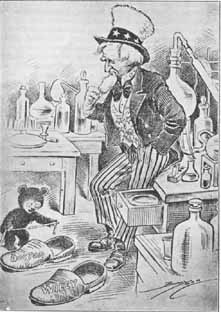
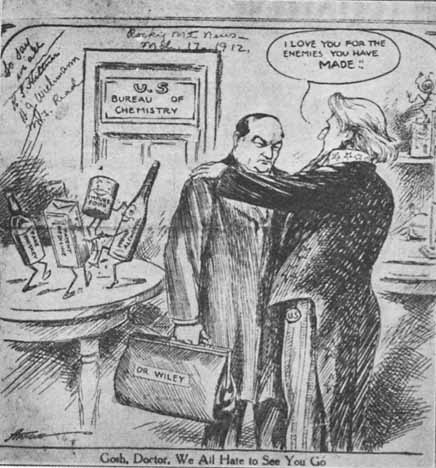
Whisky is a distillate, in a pot still, of the fermented mash of a cereal or mixtures of cereals, containing all the natural elements of the grain and the ethyl alcohol and its congeners, volatile at the temperatures of distillation. It contains also the coloring matters and other soluble products extracted from the wood (oak), in which it is stored and any new compounds arising during storage. Potable whisky is kept in storage for four years.
--Definition by Bureau of Chemistry.
Whisky is used extensively as a medicine. Physicians differ widely in regard to its medicinal value. The greater number of physicians think it has medicinal value. A very respectable number look upon whisky as unsuitable for any medicinal purpose whatever.
The ethyl alcohol in whisky, when taken in moderation, is oxidized and thus, to that extent, becomes a food product. The damaging effects of whisky, however, are so great as to render it impractical for food purposes. As a beverage whisky was used extensively in this country before it was prohibited by Constitutional amendment and the Volstead Act was passed regulating the enforcement of the Constitutional provision. At the present time whisky for beverage purposes can only be obtained illegally. The sources of all illegal alcoholic beverages are shrouded in mystery, and severe and often fatal results follow their illegal use. The Volstead Act prescribes the conditions in which they may be used for medicinal purposes.
In the fight for the food law the question "What is Whisky?" cut quite a figure. As early as 1898 the question of the character of distilled alcoholic beverages became quite acute. A heavy tax was laid on manufactured alcohol, both for beverage and industrial use. A great change had been made in the method of making pure alcohol. The continuous still, an implement which was continuously charged with a fermented mash and which continuously produced a very pure spirit revolutionized the process of distillation and made pure untaxed alcohol remarkably cheap. This method of making neutral spirit was entirely different from the manufacture of beverage whisky. The Congress of the United States had legalized the mixing of genuine whisky with this neutral spirit, and coloring and flavoring the mixture, by an Act defining rectifying. The so-called rectified product was placed on the market under the name and appearance of the genuine article. Existing law provided no penalties for this fraud.
In order that consumers might be able to protect themselves, certain precautions were provided in the law. When a genuine whisky was first made it was always placed in oak barrels for aging purposes. A stamp was placed on the package, giving date produced, distillery making it, and other data required for revenue purposes. When the package was tax paid and ready for consumption, an additional stamp was affixed. The double stamp was the consumer's evidence that no rectifier had handled that package. This assurance however, affected only the first owner. When he decided to put the contents on the retail market he was under no further obligation. He sold it by the drink at the bar or in small packages to carry away.
For the protection of the individual consumer, Congress, in 1898, passed the bottled in bond act. This law permitted dividing the product in fractions of a gallon, each package having a United States little green stamp pasted over each cork, showing the distillery where made, the size of the package, the date of manufacture, and a guarantee of freedom from rectification.
This guarantee followed a rigid investigation of the wiles of the rectifier, carried on in 1898, in which the Bureau of Chemistry took an active part. It was then learned that there was a radical difference between a genuine whisky at least four years old and the rectified product bearing the same name. Under the pending food bill the rectifiers clearly saw that the products they were making would have to bear labels showing just what they were. Their whole business was founded on fraud. They made heroic efforts to prevent the passage of the Act. After its passage they moved heaven and earth, or better, hell and earth, to nullify its provisions. In the following pages will be found the high lights of these efforts.
In the final hearings the rectifiers made every possible endeavor to kill the bill. Anticipating the probability of the passage of the bill, it was deemed advisable to study ab initio the whole question, historical and technical, of the manufacture of whisky in this and other countries. The investigations made by the Bureau of Chemistry covered fundamentally all angles of the problem. The results were collected in typewritten form and were the basis of all the testimony before the courts in the cases subsequent to the passage of the law. A witness to the sound conclusions drawn therefrom is the universal approval given by every Federal court before which the problem has been presented. No further publication of this brief has been made. I have, as one of my most precious documents, a copy, which, by the way, was the document called for by Judge Thompson of Cincinnati in the effort of the rectifiers to have Food Inspection No. 65 declared illegal.
In closing the discussion of the pending food bill before the Interstate and Foreign Commerce Committee in 1906, the following reference to whisky (page 322) was made:
Now we are ready, Mr. Chairman, for a short talk on whisky, if my assistants will bring the samples forward.
I will not call attention to the testimony of Mr. Hough, because he was not under oath; it is not expert testimony, but I want to say just this in regard to his contention: As you know, I was instructed last year, with a view of executing our food law respecting imported food products, to visit the manufacturers in Europe, as far as I could in the time I had at my disposal; and, especially, I was instructed by the Secretary to visit the distilleries in Scotland and Ireland, where Scotch and Irish whiskies are made. I may say that it was a very pleasant task to which I was assigned. [Laughter.] I was also instructed to visit the Charente to see how the real French brandy is made, and the Gironde to see how the real French wines are made, and the Rhine and Mosel to see how the real German wines are made. I spent three months in this very delightful task.
On my return I made a report to the Secretary of Agriculture, which he gave, in abstract, to the press, and which was published all over this country and in Europe. I stated that I had found that in Scotland whisky was made solely from pure barley malt, fermented in the proper way and distilled in a pot still, and that nothing else, in my opinion, was entitled to be called Scotch whisky except that product.
I stated also that in Glasgow and Edinburgh I found distilleries importing American maize, Indian corn--I was glad they were doing it; it is a good market for us--and making a spirit out of it, and that this spirit was mixed with the real Scotch whisky and sent to this country; and I doubted if there was a barrel--and that was about true, as events have shown--of real Scotch whisky in the United States.
I went to Ireland, and I found that whisky was made there exactly as it is in this country in Kentucky, just as Mr. Taylor (who is the only expert called on the question) has testified it was made. It is made there of barley malt and unmalted grain, just as in this country, the malt being used to convert the rest of the starch, and then it is fermented and distilled in a pot still and placed in the warehouse, just as it is in England and in Scotland.
In this country, too, we have great distilleries of spirits which make immense quantities of alcohol, and our law permits the mixing of different spirits, under what is known as the rectifiers' clause of the internal-revenue law, which says that anyone who "mixes without rectifying" these spirits and makes a spurious whisky or gin or brandy shall be deemed to be a rectifier and must take out a rectifier's license. So that the law specifically says in this country that every mixed whisky is a spurious imitation of whisky. That is the act of Congress of the United States, a pretty good authority when it comes to definitions of that kind.
I said to the Secretary that in my opinion, if I were enforcing the law about whiskies coming to this country--I am not; I have simply tried to get all the information I could, and I did not want to begin to enforce a law without knowing what I was doing--I believed I could exclude from this country, under our law, any of these rectified whiskies which were offered.
At that time, while I was in London, they were about to begin a great trial, which it was said would be the greatest trial that ever took place in that city in regard to a manufactured product, in which a publican had been cited under the English foods act for selling a bottle of whisky which was not of the character, quality, and kind demanded. That is the language of the English food act, and a very good one it is. That one sentence is the whole essence of the act.
This publican was cited to appear. He was defended by the greatest lawyer in England, Mr. Frederick Moulton, the leader of the English bar; and I was told that $50,000 (£10,000) had been raised simply to pay the legal expenses of the defense. This poor publican was worth nothing, but he was the man who was charged with this offense, and this great rectifying industry was behind him. They wanted to establish the fact that a rectified whisky was a Scotch whisky; and that was what this suit was brought for, to show that it was not. I was asked to go over there as a witness, and of course I could not go; but they introduced my report to the Court, which the judge promptly ruled out unless they produced me.
Yesterday, after I left the committee, I got this cablegram from London: "Wiley, Agricultural Department, Washington. Whisky defendants convicted." And it is the best news I have had across the ocean in my opinion, for a long time.
MR. MANN: Did you not see the account in the newspapers?
DR. WILEY: Yes, this morning; but this came yesterday.
Now, I want to say, Mr. Chairman, that I have not the least opposition to rectified whisky. I will admit, for the sake of argument, that it is better than the straight whisky. I. will admit it for the sake of the argument; I do not really think so, but I will say that it is better. That is what the magistrate said. I got the printed proceedings of the trial as they came off every week; they sent out a. bulletin, and they had expert witnesses to testify that the rectified whisky was less injurious, had less poisonous matter in it than the straight whisky, and the magistrate said: "Well, perhaps that is true. If so, why not say 'This is a rectified whisky'? because then you will get the trade."
MR. RYAN: But that was not the question at issue in that case, was it?
DR. WILEY: That was not the question at issue. The question was whether a spirit that had any Indian corn spirit in it was a Scotch whisky or an Irish whisky.
MR. RYAN: That was it?
DR. WILEY: Yes, sir.
MR. BARTLETT: It was sold as Scotch or Irish whisky?
DR. WILEY: It was sold as Scotch or Irish whisky.
MR. BARTLETT: And it turned out to be a rectified whisky.
MR. RYAN: The extract of corn is what they objected to?
DR. WILEY: Yes--spirit made from Indian corn. That covers this whole contention.
When Lloyd Bowers reached the opinion that a neutral spirit, even one made from grain, was not entitled to the designation of whisky, even if it should be colored and flavored, it is difficult to understand why he decided that this article which was not a whisky could be added to real whisky, and then the mixture could be called whisky, provided the characteristics of the real whisky would not be too greatly diluted. Especially is this true when he had before him, not only the decisions of the Federal Courts, but also the opinion of the father of President Taft to the effect that neutral spirit was an entirely different article from whisky. He also had before him the opinion of the English Courts contained in Bureau of Chemistry Bulletin No. 102, issued Dec. 20, 1906. 1 give here a synopsis of the decision of the English case:
A whisky claimed to be Irish on the one hand and a second sample which claimed to be Scotch on the other, was sold to a customer as the best Irish and the best Scotch whisky. On analysis it was determined that it contained not less than 90% of silent or neutral spirit made of maize. In passing sentence the magistrate said:
"The offence committed by both defendants is the same, and the same practically in degree. * * *
"It is time the fraud upon the public in the matter of the sale of whisky was stopped, and, though doubtless these prosecutions are very costly to those who engage in them, the information obtained and published in the course of the hearing of these two summonses is most valuable, and the result of this trial seems to me to afford ample justification for the prosecutions.
"Great blame attaches, in my opinion, to the 'blenders' who supplied Wells and Davidge with the articles they sold. I do not think much moral blame attaches to the defendants themselves, as I believe they trusted to those who sold the articles to them to supply them with that which they might fairly and honestly retail to the public as Irish and as Scotch whisky, respectively; but at the same time, in my judgment, it was careless of the defendants to sell what they, did as they did, and since they only are before me they must pay the penalty for their infringement of the law. * * * The defendants, Thomas Samuel Wells and James Davidge, will each pay a fine of 20s and 100 pounds costs or be imprisoned in default of distress for two months in the second division.
To continue the quotation from the final hearings:
"Now, I say that that is a business which is perfectly legitimate in this country. I am sorry that our laws are so hard on the man who makes a straight whisky, and so easy on those who make the mixed whisky; because you can not make or sell straight whisky except under a Government stamp, under Government supervision. You can add nothing whatever to it, not even coloring matter, except that when you take it out of bond and sell it you are permitted to reduce it with distilled water under the supervision of Government officials, to proof--that is, half alcohol and half water.
That is the only thing that can be done. Then, if it is in a barrel, it has the double stamp put on it to show that it is whisky right out of the distillery. It can be. sold in bottles; you can pay the tax on it and take it out of bond and put it up in any shape you please, or you can, under the law, if you want to, have it bottled in bond. Those are the three forms in which straight whisky can reach you. It can come in barrels, or it can be put up in any kind of a package you please after you pay your tax on it, it makes no difference what; or it can come bottled in bond, as this is. If any of you have never seen a bottle of whisky bottled in bond, this is one.
MR. RYAN: The fact that it is bottled in bond is no evidence of purity or quality?
DR. WILEY: It is evidence of quality; it shows that nothing has been added to it except what nature put in the distillate.
MR. RYAN: Do you believe that when a blender or a rectifier adds anything to whisky he is doing something deleterious to health ?
DR. WILEY: I do not think he intends to. He may do it unwittingly.
MR. RYAN: The blenders and the wholesale liquor dealers and rectifiers in New York, for instance, are very much disturbed about this. I will state that I have received some seventy or eighty telegrams since last evening in connection with this matter. They fear that this law will show to the public, or attempt to show to the public, or the public will assume, that whisky bottled in bond is the proper thing and will injuriously affect their business, when, as a matter of fact, it is no evidence of quality or purity that it is bottled in bond, as you state now yourself.
DR. WILEY: Oh, I do not think you have quite quoted me, Mr. Ryan. I said it was a guaranty of quality.
MR. RYAN: Of quality, yes.
DR. WILEY: But the word "purity" is used in two senses, unfortunately.
With regard to foods, I never use the word "purity" except in one sense. A pure food is what it is represented to be. It has nothing to do with its wholesomeness at all. A pure food may be unwholesome, as has been testified here. You will see in my manuscript there that in showing what things occur in nature in foods I show that hydrocyanic acid, the most violent poison, occurs in a great many food products. They are pure foods, but they contain poisonous matter."
The food bill became a law June 30, 1906. Immediately activities were began by the fake whisky interests to nullify its requirements. Rectifiers appeared by counsel or in person before the committee forming rules and regulations to carry the law into effect. They made no impression on that body. They then began to get in touch with the Secretary of Agriculture. These rectifiers were deeply in earnest. They wanted to know "just where they were at." They feared most of all the decisions of the Bureau of Chemistry. Here is one of the problems propounded:
Many letters are received by the Department making inquiries concerning the proper method of labeling blended whisky. Manufacturers are anxious to know the construction placed by the Department upon this particular part of the food and drugs act of June 30, 1906 and to ascertain under what conditions the words, "blended whisky" or "whiskies" may be used. The following quotation from one of these letters presents a particular case of a definite character:
"On account of the uncertainty prevailing in our trade at the present time as to how to proceed under the pure-food law and regulations regarding what will be considered a blend of whiskies, I am taking the liberty of expressing to you to-day two samples of whisky made up as follows:
"Sample A contains 51 per cent of Bourbon whisky and 49 per cent of neutral spirits. In this sample a small amount of burnt sugar is used for coloring, and a small amount of prune juice is used for flavoring, neither of which increases the volume to any great extent.
"Sample B contains 51 per cent of neutral spirits and 49 per cent of Bourbon whisky. Burnt sugar is used for coloring, and prune juice is used for flavoring, neither of which increases the volume to any great extent.
" I have marked these packages 'blended whiskies' and want your ruling as to whether it is proper to thus brand and label such goods.
"My inquiry is for the purpose of guiding the large manufacturing interests in the trade that I represent."
In a subsequent letter from the same writer the following additional statement is made:
"The reason for wanting your decision or ruling in this matter is just this: No house in the trade can afford to put out goods and run the risk of seizure and later litigation by the Government on account of the odium that would be attached. to fighting the food and drugs act."
To this a formal answer was prepared by the Bureau of Chemistry, and signed by the Secretary.
The question presented is whether neutral spirits may be added to Bourbon whisky in varying quantities, colored and flavored and the resulting mixture be labeled "blended whiskies." To permit the use of the word "whiskies" in the described mixture is to admit that flavor and color can be added to neutral spirits and the resulting mixture be labeled "whisky." The Department is of the opinion that the mixtures presented cannot legally be labeled either "blended whiskies" or "blended whisky." The use of the plural or the word "whisky" in the first case is evidently improper for the reason that there is only one whisky in the mixture. If neutral spirit, also known as cologne spirit, silent spirit, or alcohol, be diluted with water to a proper proof for consumption and artificially colored and flavored, it does not become a whisky, but a "spurious imitation" thereof, not entirely unlike that defined in Section 3244, revised statutes. The mixture of such an imitation with a genuine article can not be regarded as a mixture of like substances within the letter and intent of the law.
(Signed) JAMES WILSON,
Secretary of Agriculture.
Washington, D. C.,
December 1, 1906.
Early in January, 1907, in the very first days of the enforcement of the law it was discovered that the Secretary of Agriculture was very much perturbed in regard to F. I. D. 45. At that time the star of the Solicitor of the Department was rapidly increasing in brilliancy. The time was speedily approaching when the head of the Department became only the vehicle to carry the will of the Solicitor into action. I was cited to appear in the Secretary's office on the 22nd of February, 1907, for a conference on the whisky question. The birthday of Washington was used to perpetrate the first overt act against the food law. There were present at this conference the Secretary, and the Assistant Secretary of Agriculture, the Solicitor, Mr. George P. McCabe, and the Chief of the Bureau of Chemistry. The conference began by a statement by the Secretary that this conference should be behind closed doors and no report of it should be made in any way to the press.
I was first asked by the Secretary if the Bureau of Chemistry still held to the principles contained in F. I. D. 45. I replied in the affirmative. He asked the Assistant Secretary, Mr. Hayes, his opinion in the matter. Mr. Hayes promptly voted in favor of the Bureau's definition of whisky. He then asked the Solicitor his opinion. He replied, "Dr. Wiley's definition of whisky is absurd. Whisky is any alcoholic beverage made from grain, properly colored and flavored, according to the prevailing custom of the trade." The Secretary said, "I agree with my Solicitor." I immediately called his attention to the fact that there was only one body appointed by the Act to make an initial decision as to what constituted misbranding or adulteration of foods and drugs, namely, the Bureau of Chemistry. The only authority recognized by the Act to review this decision was a United States judge. I said, "The Bureau of Chemistry decision will therefore stand until over-ruled by a court of the United States." He replied, "I will not take your construction of the law, but that of my Solicitor; that is what he is here for, to interpret the law to me." This act of the Secretary and Solicitor constituted the first abrogation of the Food Law by executive authority and laid the foundation for a succession of similar violations.
As a matter of history I may say that I obeyed the Secretary's injunction to make no report of this matter to the press. Immediately on leaving his office I went to the Cosmos Club and called up Mr. Loeb, secretary to President Roosevelt. I related to him what had happened in the Secretary's office and asked him if he could come over to the Club and take luncheon with me. Loeb was immediately and greatly interested in this decision. I pointed out in detail all the circumstances which led to it. I felt certain that Secretary Wilson would go to President Roosevelt with this illegal decision.
I asked Mr. Loeb to acquaint the President of what had happened and to get a promise from him, if possible, that he would not give his approval to Secretary Wilson's decision until I had an opportunity to lay the whole matter before him. Later in the day Mr. Loeb called me over the telephone and said the President had agreed to this delay. Meanwhile the papers were full of this decision. It had been given to the press by some one of the four people who were present at the conference. I was not the one who gave it to the press.
The following day was one of rejoicing by the rectifiers all over the country. They felt assured that F. I. D. 45 would be repealed without carrying the matter to the courts. There was a slight error in their judgment. For two weeks subsequent to this event the newspapers were filled with accounts of pilgrimages, under the leadership mostly of United States Senators, of bodies of rectifiers to the White House. Senator Foraker conveyed the rectifiers from Cincinnati. Senator Lodge accompanied those from Boston. Senator Penrose led the Philadelphia delegation. Meanwhile I was patiently waiting word from President Roosevelt. One day while I was taking lunch at Harvey's a telephone message from my office said the President would see me at two o'clock. I had prepared a movable laboratory with all the elements necessary to manufacture ten year old Bourbon or Scotch in a minute. I carried with me samples of pure, refined alcohol from half a dozen different sources, namely from corn, barley, molasses, and fruits, all alike in character, and all of equal degree of purity. I carried an assortment of colors and flavors used by the rectifiers. When I drove up to the White House with this peripatetic laboratory, I encountered a dozen or more newspaper men who were eager to know what it all meant. I told them I had been invited to give a lecture to the President of the United States. One of the well-informed correspondents said to me: "You may think so, but you will find that the President will do the lecturing." I carried my laboratory into the President's office where I was politely received by the attendant and told that the President would soon be in. In five minutes my audience appeared, the President of the United States, and Mr. William Loeb, his secretary. For two hours I performed experiments showing the President how all kinds of rectified whisky, brandy and rum could be made in a minute. I received his undivided attention. If he interrupted me at all it was only to ask for more definite information on some points. At the close of this two hour lecture he came around to my side of the table and grasped my hand, saying to me, "Dr. Wiley, I have heard nothing but whisky for the last three weeks, and you are the first person who has ever given me a single idea that I can comprehend. Then turning to Mr. Loeb he said, "Send all these documents and samples, together with Dr. Wiley's brief to Mr. Bonaparte, and ask Mr. Bonaparte to advise me on this question." Mr Bonaparte did advise him. He sustained every single point that had been presented by the Bureau as to what is really whisky. President Roosevelt ordered the Commissioner of Internal Revenue and the Secretary of Agriculture, both of whom were friends of the rectifiers, to publish jointly a decision defining whisky in the light of evidence which had been presented. Thus ended the first attempt to violate the Food Law by a complete triumph of the law itself. The Secretary was convicted but not convinced. The breach thus made was never closed. The Secretary was irrevocably allied with the foes of the food law.
The decision of the Attorney-General was sent to the White House on April 10, 1907. President Roosevelt wrote a letter to Secretary Wilson in the following terms:
The White House,
Washington, April 10, 1907.My Dear Mr. Secretary:
In accordance with your suggestion,* I have submitted the matter concerning the proper labeling of whisky under the pure-food law to the Department of Justice. I inclose the Attorney-General's opinion. I agree with this opinion and direct that action be taken in accordance with it.
Straight whisky will be labeled as such.
A mixture of two or more straight whiskies will be labeled 'Blended whisky' or 'whiskies.'
A mixture of straight whisky and ethyl alcohol, provided that there is a sufficient amount of straight whisky to make it genuinely a 'mixture,' will be labeled as a compound of, or compounded with, pure grain distillate.
Imitation whisky will be labeled as such.
Sincerely yours,
(Signed) THEODORE ROOSEVELT.
Hon. James Wilson,
Secretary of Agriculture."*The President sent this problem to Bonaparte at his own suggestion as I have already stated, not by request of Secretary Wilson.
The full opinion of Attorney-General Bonaparte is printed as an appendix to Food Inspection Decision 65, issued April 12th, 1907. The Attorney-General's opinion is a blend of legal learning and charming sarcasm. Those who are interested in documents of this kind will do well to read the opinion in full.
As an illustration of the keen satire used by Attorney-General Bonaparte I quote the following closing paragraphs of his decision:
" The following seem to me appropriate specimen brands or labels for (1) "straight" whisky, (2) a mixture of two or more "straight" whiskies, (3) a mixture of "straight" whisky and ethyl alcohol, and (4) ethyl alcohol flavored and colored so as to taste, smell, and look like whisky:
(1) Semper Idem Whisky: A pure, straight whisky mellowed by age.
(2) E Pluribus Unum Whisky: A blend of pure, straight whiskies with all the merits of each.
(3) Modern Improved Whisky: A compound of pure grain distillates, mellow and free from harmful impurities.
(4) Something Better than Whisky: An imitation under the pure food law, free from fusel oil and other impurities.
In the third definition it is assumed that both the whisky and the alcohol are distilled from grain."
It is hardly necessary to add that the rectifiers who had been engaged for many years under Government license in the manufacture of compounded and imitation whiskeys failed to avail themselves of the method of labeling suggested by the Attorney-General. After having secured the support of Secretary Wilson for continuing their frauds upon the consumers of whisky, they were dumbfounded by their failure to have F. I. D. 45 repealed. They were still more greatly disturbed by having F. I. D. 65 substituted in its place. They were defeated and discouraged, but not eliminated.
They immediately took steps to secure Court decisions for the purpose of declaring both F. I. D. 45 and F. I. D. 65 illegal and void. To this end they were wise in selecting the courts before which they proposed to bring their petition.
They filed their first petition before the Federal District Court, sitting at Cincinnati, Hon. A. C. Thompson being the presiding judge. Cincinnati was the great center of the rectifying industry. For years the rectifiers had been making in that city compounded and imitation whiskies designated by high-sounding names and sold under claims of great age. This product was derisively known locally as "Nigger whisky." The income from these spurious whiskies was too large to be given up without a struggle. Some of the most influential citizens of Cincinnati were engaged in the rectifying industry. They were also supporters of the dominant political party. For this reason the court of Cincinnati was considered the most favorable one in which to secure a judgment declaring these standards of whisky illegal. The filing of this suit was not made known to me until the Saturday previous to the hearing of the case on the following Monday. I received an S. 0. S. telegram from the United States District Attorney asking for my immediate presence in Cincinnati. I had only time to secure a copy of the brief which I had left with President Roosevelt, and which he had forwarded to Attorney-General Bonaparte, and take the train on Sunday afternoon. The train was late and I did not reach the District Attorney's office until 15 minutes before ten o'clock on Monday morning. The District Attorney was utterly helpless in this matter. He knew nothing of the case and it was impossible to instruct him in fifteen minutes. I told him the only hope was to obtain from the judge a postponement of the trial, in order that we might secure proper witnesses and that he should have opportunity to understand the case properly. When Court opened the District Attorney promptly moved for a postponement of two weeks. The attorney for the rectifiers, Mr. Warwick M. Hough, vigorously opposed any postponement. The Judge also seemed reluctant to grant the District Attorney's petition. Finally, however, he consented to an adjournment of one week. At the end of the week the District Attorney was fully acquainted with the nature of the proceeding and a number of competent witnesses were on hand to defend the Government's position. Judge Thompson was acknowledged to be one of the best District judges on the Federal Bench. He was held in high esteem, not only for his legal ability, but as a citizen, always interested in what was right and proper in regard to civic duty. At the beginning of the trial he announced that it must be completed on that day, including an hour granted to each side to make arguments before the court. He also declared that each side should have an equal time for presenting the views of witnesses. The matter for the state was forcibly presented, particularly by Dr. Joseph P. Remington of Philadelphia, and Dr. John Uri Lloyd of Cincinnati. Competent chemical testimony was also presented by the Bureau of Chemistry before the Court.
After the arguments were made and the trial was over, all the witnesses for the Government congregated in the office of the District United States Attorney. We were speculating as to what the verdict would be. The Judge had taken the matter under consideration and we knew there would not be a decision on that day. The District Attorney was very hopeful of securing a favorable verdict and based that hope largely on the testimony of Dr. John Uri Lloyd, who was not only a most eminent pharmaceutical chemist but a very personal friend of the Judge himself. We of course realized that the Judge's opinion would not in any way be influenced by personal friendship, and this was particularly the case because some of the most prominent rectifiers of Cincinnati were also intimate friends of the Judge.. While we were discussing these probabilities a messenger came from the Judge's chambers with a note to the District Attorney asking that he be furnished with a copy of the brief of Dr. Wiley which had been offered in evidence in the court. We all felt that this was an important request, believing that if the Judge would read this report in full he would not be inclined to support the contention of the rectifiers. Our fondest hopes in this matter were justified. When Judge Thompson issued his report in about three weeks subsequent to the trial, it was found to be a complete vindication of F. I. D. 45 and F. I. D. 65.
Not at all discouraged by their failure, the rectifiers appealed to other Federal Courts in other localities. Among these localities were Springfield, Illinois; Covington, Kentucky; Indianapolis, Indiana; Buffalo, New York; Baltimore, Maryland; and San Francisco, California. In each case the opinions of the Court were entirely in harmony with the original opinion of Judge Thompson. Meanwhile the Bureau of Chemistry, shackled by the Board of Food and Drug Inspection, deemed it inadvisable to bring any cases against rectified spirits masquerading as whisky as long as the matter was still before the courts. It was known that finally the decision would have to be made by the courts anyway and any punitory steps might prove to be entirely futile.
Mr. H. Parker Willis in an article published at this time made the following comment on this procedure under the heading, "The Public Will Not Buy Whisky Labeled 'Imitation.'"
"The new regulations, and the cases brought under them, developed one particularly interesting fact in the situation: the distillers and rectifiers could not dispose of their goods for drinking, either as alcohol or as 'imitation whisky.' The actual name 'whisky,' without modification, was necessary to disposal of their product, notwithstanding that it was precisely the same article under another name. This was clearly brought out when the Western distilleries applied to Judge Van Fleet of the Northern District of California for an injunction restraining the marking of alcohol as ordered by the Bureau of Chemistry, alleging that they had been obliged to shut down their plant through inability to dispose of their product when marked 'alcohol.'
"Because of the hostile attitude of the courts, whisky manufacturers resolved to turn their attention in other directions. They had hoped to secure an easy victory through the judicial machinery of the Government; but having been defeated there, and knowing that there was nothing to expect from Congress, they now turned again to the Executive. The new rules, with the requirement that whisky be branded as 'imitation' when it consisted of neutral spirits primarily, had gone into effect July 1, 1908, although prior to that date the distilling interests had accumulated as large stocks as possible under the old regulations for marking in order that they might continue to send out their goods as 'rye,' 'Bourbon,' or 'copper distilled' whisky, instead of being compelled to use the term 'imitation.'
"Pressure upon the Roosevelt administration for action designed to 'relieve' the rectifiers now became acute. Congressman Longworth, son-in-law of President Roosevelt, and friend of representatives of the Cincinnati distilling district, exerted himself in behalf of the rectifiers, and a simlar position was taken by numerous other members of Congress. Representative Perkins of New York, now chairman of the Foreign Relations Committee of the House and a historian of some reputation, had already devoted himself to securing a favorable ruling in the interest of Duffy's Pure Malt Whisky. An interesting correspondence passed between Mr. Perkins and the Department of Agriculture, in the course of which Mr. Perkins noted for the benefit of Secretary Wilson that 'the Duffy Malt Whisky Company * * * is controlled by our most prominent and leading citizens, and I trust matters can be adjusted in such a way as not to injure a long-established industry.' Other statesmen wrote that the Duffy Company 'controlled considerable political influence.' Not to be outdistanced in his efforts for the rectifying interests was Representative Sherman, now Vice-President.
"During the winter a committee of rectifiers and spirit distillers, represented by A. J. Sunstein and others, visited Washington, and sought to persuade the administration of the great harm that was being done to the rectifying interests. The President finally harkened to the representations of the rectifiers, and appointed a 'Whisky Commission,' consisting of Secretary of Agriculture James Wilson, Dr. F. L. Dunlap, Associate Chief of the Bureau of Chemistry, and John G. Capers, head of the Bureau of Internal Revenue of the Treasury Department. Secretary Wilson and Commissioner Capers were already known as advocates of the views of the rectified whisky interests, while Dr. Dunlap had shown a strong disposition to dissent from the existing rulings of the Government. There was a good deal of mystery about this Commission. Although the Associated Press sent out a frank statement by President Roosevelt to the effect that such a Commission had been appointed, Secretary Wilson took occasion to assure newspaper men that the Commission did not exist as such, and that the President had merely asked for a little advice. Commissioner Capers admitted the existence of the Commission, but Dr. Dunlap said nothing.
"After several weeks of discussion and inquiry, the three advisers reported to the President in favor of allowing liquor made from neutral spirits to be designated as whisky. Mr. Sunstein and his committee had said that they would be satisfied if they could, be allowed to brand their liquor as 'redistilled whisky,' 'rectified whisky,' or 'neutral whisky.' The three commissioners, or conferees, now advised that some such plan be followed, telling the President that this was substantially the verdict that had been arrived at by the Royal Commission. on Whisky, which had been sitting in England, and which, they stated, had decided that any spirits made from grain was whisky. In a letter written on behalf of the Commission, Dr. Dunlap said, 'It is my opinion that the term 'whisky' should not be denied to neutral spirits diluted with water to a proper strength and colored with caramel,' though he recommended the use of some qualifying name, such as 'rectified whisky.'
The approval of President Roosevelt of Attorney-General Bonaparte's definitions of whisky created a curious environment in the Bureau of Chemistry. The Secretary of Agriculture, the associate chemist, Dr. Dunlap, the solicitor, Mr. George P. McCabe, together with the chief of the Bureau of Internal Revenue, Mr. John G. Capers, were all on the other side of the question. The President, Attorney-General Bonaparte, and the Chief of the Bureau of Chemistry were all agreed on the definitions.
It was hard, however, to get Court action. Attorney-General Bonaparte was very insistent that cases be brought in order to test the accuracy of his definitions. Cases could only be brought, under the existing conditions, when a majority of the Board of Food and Drug Inspection would initial requests either for criminal action or seizure of goods. There was much hesitation on the part of two members of the Board of Food and Drug Inspection in regard to this matter. It was not until the Secretary of Agriculture ordered them to proceed that they joined me in bringing actions before the Court. All effort to bring a criminal action, however, was negatived. We did bring a number of cases of seizure of goods; that is, action in rem. In every ease of this kind which reached the courts, unanimous approval of the Attorney-General's opinion on whisky was obtained. In all seven cases were finally brought to the bar of justice out of hundreds recommended by: the Bureau.
CASE 1. Notice of Judgment 15. The United States of America, Libelant, vs. 93 Cases, containing 12 bottles each, of alleged Whisky, C. Person's Sons, Defendants, before the Western District Court of New York, Case No. 79. Judge, the Hon. John R. Hazel.
This Whisky was adjudged adulterated and misbranded and, under the law, the seized liquor was ordered to be destroyed or, after proper branding, delivered to the claimants under a bond of $2,000 that it would not be sold in contravention of the existing law. Date of judgment, August 27, 1908.
CASE 2. Notice of Judgment 45. United States vs. 4 Barrels of Liquid Purporting to be Whisky. This case was brought in the District of Columbia, Case No. 790. The libel alleged that the product was, 4 'colored and mixed by the addition of coloring matter, in a manner whereby inferiority is concealed and in order to imitate old mature whisky and whereby the said product does imitate and appear to be old mature whisky."
The Judge who issued the decree of condemnation was the Hon. Thomas H. Anderson. Date of the Judgment, March 13, 1909.
CASE 3. Notice of Judgment 68. United States of America vs. Fifty Barrels of Whisky, Labeled "Bourbon Whisky," Manufactured in New Orleans from fermented molasses. The presiding Judge was the Hon. Thomas J. Morris of Baltimore. The decree of condemnation was in the same terms as those already reported. In his decision Judge Morris was particularly luminous. This was a jury trial. After the evidence had been given and the counsel for the defense had addressed the jury, Judge Morris said: "I will not call upon the counsel for the United States to reply. The case as it is presented to the jury is a very clear one. I reject the only prayer offered by the defense. Really, that prayer concedes the misbranding of the liquor, and asks me to say to the jury that if they shall find that this was done under the control- and by the agents of the United States, the United States is estopped from proceeding to condemn these goods and forfeit the goods from misbranding." The examination of this whisky by the Bureau of Chemistry disclosed that it was distilled from fermented molasses, and was called Bourbon Whisky. Date of Judgment, May 14, 1909.
CASE 4. Notice of Judgment 112. United States vs. 10 Cases of Quinine-Whisky, Case No. 10142, the Hon. Kenesaw M. Landis, United States District Judge. The goods were ordered destroyed or to be released on a bond of $1,000. Not to be sold contrary. to the Food and Drugs Act as is usual in such cases. Date of Judgment, November 20, 1909.
CASE 5. Notice of Judgment 349. United States vs. H. A. Thierman & Co. of Louisville, Ky. Seizure of five barrels of whisky transported from Kentucky to Indiana. The name of the Judge in this case is not disclosed. The decision was not rendered until after the advent of the administration of President Taft, and the notice of judgment carried this statement: "This decree was rendered prior to the issuing of Food Inspection Decision 113, which revoked Food Inspection Decisions 45, 65, 95. In other words, the Secretary of Agriculture, under the law, was forced to, regard the opinion of this Court although it had been-determined that the Bonaparte decision, which was the one which had been supported by all of these decisions, was soon to be revoked by the action of the United States itself, thus nullifying the Court's decision to the effect that the Bonaparte opinion was wholly legal. Date of Judgment, May 17, 1910.
CASE 6. Notice of Judgment 353. United States vs. the Hannis Distilling Co. of Philadelphia, Pa. The usual course was followed and the decision rendered, but the name of the Judge is not given. The date of the decision is May 17, 1910. It has the same notice in regard to decision 113 as carried by the former case.
CASE 7. The final case is Notice of Judgment 361. United States vs, Davis & Atkins of Richmond, Va. The name of the Judge is not given, but the whisky was condemned in the same manner as those just preceding. This also contains the same notice in regard to decision No. 113 as the two preceding cases.
This makes seven cases in the Federal Courts supporting the validity of the opinion of Attorney-General Bonaparte, and in not a single instance did any United States Court before which the matter was presented, nullify that decision. Nevertheless, in spite of all these Court decisions the opinion of the Attorney-General Bonaparte was revoked by executive authority and a diametrically different opinion supporting all the contentions of the rectifiers substituted in its place. Thereafter, no mention of any case against whisky is found in the Notices of Judgment. It was not necessary because the United States authorities, in plain violation of Court decisions, had decided that the Bonaparte opinion was all wrong.
I never was able, even in the two years that intervened from the time of the decision of Attorney-General Bonaparte to the close of the Roosevelt administration, to get the Board of Food and Drug Inspection to approve of any criminal case against any dealer who was an offender of the law. I have all the correspondence in which Attorney-General Bonaparte urged that his decision be taken before the Courts, and in every instance when it did reach the Court he was sustained. In all the attempts of rectifiers to nullify his decision by bringing Court cases themselves, and this they did in eight separate cases, the rulings of the Court were always against them.
To show the attitude of the Board of Food and Drug Inspection in this matter, I made determined efforts to bring a case against Duffy's Pure Malt Whisky, either to seize the whisky or to bring a criminal action against the manufacturers. Every move in this direction was blocked by my collegues on the board. Under date of October 3rd, 1908, the following note in regard to this matter was made:
"Doctor Dunlap states that he initialed the first named seizure under a misapprehension, thinking that the Duffy Malt Whisky hearing was to be held here instead of in Buffalo, although it had been signed by the Secretary. I understood from Doctor Dunlap that the matter was held up by the Solicitor and that it would not be sent to the District Attorney until after the report of the hearing at Buffalo had been received. In regard to the seizure of October 3, he refused to initial the recommendation on the ground that it would not be proper to do so until the hearing of the Buffalo case had been received. I stated to him that the cases were entirely distinct, the Buffalo case being a criminal action recommended several weeks ago and the seizures are actions to be brought at the time mentioned, namely September 30 and October 3, 1908, a and if not seized without delay the goods would escape. I stated that Duffy's Malt Whisky was one of the most gigantic frauds of the age and a flagrant violation of the law, and that there was no necessity that we delay at all in the matter. He still, however, refused to initial."
This sufficiently illustrates the determined efforts of my colleagues to protect Duffy's Pure Malt Whisky from being molested either by seizure or bringing any criminal case against the maker. The few cases that were brought against rectified whisky were at the direct request of the Attorney-General, followed by the order of Secretary Wilson to proceed as the Attorney-General requested.
On the 3rd of October, 1907, 1 addressed the Solicitor of the Department of Agriculture, as follows:
"In a recent conversation with me the Attorney-General urged that cases be prepared as soon as possible in the whisky case. Fortunately, acting under the direction of the Secretary, we had already secured a great many cases. I have prepared three of these typical cases to be sent to the Attorney-General according to his request, with the least delay possible. They represent types of mixture which might well be seized under the law for a test case. The Attorney-General informed me that he believed Mr. Hough was trifling with him and it was not possible to secure any agreement and that he proposed to go ahead at once if such an agreement as dictated by him should not be acceptable. These cases are all ready for seizure and I urge that they be sent to the Attorney-General as requested without delay."
Following this, I cited to the Solicitor fifteen localities in the City of Washington where illegal whisky was on sale, describing each one minutely.
On November 6, 1907, the Attorney-General addressed a letter to the Secretary of Agriculture, in which he informed him that he bad been unable to come to any agreement on a statement of facts, and, therefore--"it will be appropriate for you to proceed with the enforcement of the law relating to the subject of labeling whisky in accordance with the procedure prescribed by law."
In the midst of these discussions the Secretary of Agriculture received a letter from John G. Capers, Commissioner of Internal Revenue, looking to a reopening of the questions decided by Attorney-General Bonaparte which it appears was due to the express desire of President Roosevelt. The letter dated Dec. 17, 1907, is as follows:
"I have the honor to acknowledge receipt of your letter of December 13, written following the conference between you, Mr. McCabe of your Department, and Assistant Secretary Winthrop and myself of this Department. In conformity with the suggestions made by you at that time and the suggestion made in your letter of December 2, the Secretary of the Treasury has referred the matter to the Attorney-General for an opinion upon the matter of labeling whisky, etc., under the pure food law in its application to internal revenue laws, as well as to the Department of Agriculture as set out in his opinion approved by the President and addressed to you April 10 last.
"This action by the Secretary is also taken in view of the expressed desire of the President in a communication addressed to the Secretary December 8, that the matter be taken up by the Treasury Department. The Attorney-General has been requested to render an opinion as early as possible."
I referred to this movement on the part of the President in a letter which I wrote to Dr. James H. Shepard of Brookings, S. D., Jan. 4, 1908, which I quote:
"I cannot tell you much about the present status of the whisky case except this: The rectifiers, through Senator Hopkins and other influential senators, made a proposal to the President that they would withdraw all suits to set aside the present regulations if the present regulations could be modified so as to suit their views, or in so far as this could be. I understand the President appointed a commission consisting of Commissioner Capers, the Secretary of Agriculture, and Dr. Dunlap, to make the necessary revision of the regulations. In so far as I know the revision is to be made on a brief submitted by the rectifiers. I do not think that anyone who is in favor of maintaining the present regulations requiring imitation and compound whiskies to be so marked has been invited to appear before the Commission. Commissioner Capers has said in at least two printed interviews that he was going as far as he could to meet the requests of the rectifiers, even if possible to open up the question of like substances. I don't know what attitude either the Secretary or Dr. Dunlap will take in this matter but I would like to wager you a peanut that I could guess.
President Roosevelt communicated to Attorney-General Bonaparte the protests that had been made against his decision, and their plea for a rehearing. On May 29, 1907, Attorney-General Bonaparte filed with the President his reasons for not re-opening the case in which he made the following statements:
"The President,
The White House.SIR: In accordance with your instructions, I gave a hearing on Wednesday, May 15, to persons desiring to submit to the Department criticism or other comment on my opinion of April 10 last past, as to the construction of section 8 of the act approved June 30, 1906, and generally known as the Pure-Food Law. About thirty persons appeared on this occasion and a number of oral arguments were presented; some critical and some approbatory of the opinion in question. At the conclusion of this argument I announced my willingness to receive and consider any matters in writing which might be submitted to me touching its subject-matter, and, in response to several requests for a further hearing, stated that I would give these requests due consideration and announce later whether I saw any sufficient reason to comply with them. As heretofore stated to you verbally, I do not think any useful purpose would be served by another oral argument, and, with your approval, I have, therefore, announced that, in this respect, the matter must be considered closed. I received a large number of written communications from various persons commenting on the opinion in question, and I have carefully considered all of them. I find no reason to withdraw the said opinion, or to modify it in any respect, and I respectfully report that, in my judgment, this opinion correctly states the law on the subject to which it relates."
(Signed) Charles J. Bonaparte.
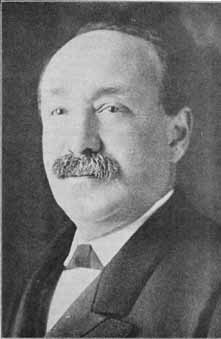
CHARLES JOSEPH BONAPARTE
Attorney-General, who wrote the answer to "What Is Whisky?"
while Roosevelt was President
Attorney-General Bonaparte issued three short state papers on the subject "What is Whisky?" The first of these papers bears the date April 10, 1907. In this paper the question of what is whisky was answered in harmony with the provisions of the food and drugs act. The points covered in this paper were so distasteful to the rectifying interests as to call for numerous requests for rehearing. The Attorney-General granted them a rehearing. On May 29th, 1907, he gave his new opinion in which he stated that he found no reason to modify in any respect the opinion of April 10th. Toward the close of the Roosevelt Administration, the rectifiers made a last desperate effort to have the Attorney-General's opinion changed. This has been thoroughly set out in the quotations from the article of H. Parker Willis. The new effort was evidently inaugurated by the President who often referred to Dr. Dunlap, Associate Chemist of the Bureau of Chemistry, as "my chemist." In the light of Dr. Dunlap's career in the Bureau no one will likely dispute Roosevelt's often repeated claim to proprietorship. The Committee having in charge this matter was thoroughly devoted to the rectifying interests. It is only natural therefore that the report they brought in, which was written by Dr. Dunlap, would be favorable thereto. The gist of Dr. Dunlap's report is as follows:
"Under the Pure Food Law as administered now, neutral spirits, diluted to proper strength and colored with caramel, must be marked 'imitation whisky.' The spirit distillers request that this name be not forced upon them, but that they may use in its place one of the three names, 'neutral whisky,' 'rectified whisky,' or 'redistilled whisky.' * * * It is my opinion that the term 'whisky' should not be denied to neutral spirits diluted with water to a proper strength and colored with caramel. I believe that the use of the term 'whisky' on such a product should be qualified by some term which will carry notice to the consumer of the nature of the product. For this purpose the term 'neutral whisky,' 'redistilled whisky,' and 'rectified whisky,' have been suggested."
Mr. Bonaparte proceeds to comment on this suggestion of Dr. Dunlap's with rare sarcasm for which lie was distinguished. He says:
"It seems obvious, from the juxtaposition of these extracts from my two opinions and those from Dr. Dunlap's letter, that the Associate Chemist of the Department of Agriculture suggests that, on the question of the construction of a statute, a very carefully considered and reconsidered opinion of the Attorney-General should be disregarded. He bases this recommendation upon certain conclusions which he says have been reached by the English 'Royal Commission on whisky and other potable spirits,' in what is described as an 'interim report.'
"He describes this Commission as composed of 'eminent scientific men,' but it does not appear from his letter that the said Commission consists of lawyers, or that they have had under consideration the construction of the Act of Congress generally known as the Pure Food Law. I am, therefore, unable to recognize their conclusions as entitled to weight in determining the above mentioned question of statutory construction, and I may add that I am unable to see how these conclusions, in so far as stated by Dr. Dunlap, have any bearing upon the question considered in my two opinions.
"It appears to me that these 'eminent scientific men,' in these conclusions, made suggestions as to what legislation on the subject should contain. They do not assume to construe legislation already enacted. Especially they do not express any opinions as to the construction of an American law dealing with American conditions.
"Inasmuch, however, as I cannot fail to recognize in Dr. Dunlap's recommendation a challenge of the correctness of my conclusions as announced in the two opinions heretofore rendered you, I think it is but proper that I should call your attention to certain judicial decisions rendered upon the questions discussed in his letter subsequently to the date of the said two opinions. In the case of Levy vs. Uri, the Court of Appeals of the District of Columbia, speaking by Mr. Justice Robb, says on this question:
'Each kind of whisky mentioned has its own peculiar flavor and character and is sought after as a beverage because of that flavor and character. Neutral spirits, on the contrary, as the term suggests, is a colorless liquid, has neither flavor nor character, and is not a beverage at all. It may be produced from any fermented substance, such as corn, potatoes, and sugar beets.
'Formerly it was used exclusively in the arts, but with the advent of cheaper methods of production it has been palmed off on the public as a beverage by mixing it with something to give it flavor and character. Since it costs far less to produce than rye whisky, it is apparent that its use by the distiller increases his profits in proportion as the public is deceived. * * *
'As before stated, neutral spirits is not a beverage, has none of the distinguishing characteristics of rye whisky, and is, therefore, matter of another kind."
Mr. Bonaparte then proceeds to quote the decision of Judge Thompson of the Southern District of Ohio and also the opinion of the District Court of the Southern District of Illinois, and refers to other Court decisions in which his definitions of whisky had been unanimously supported. He then says:
"It thus appears that the correctness of the conclusions reached by this Department in the two opinions to which I have referred has been tested in at least four decisions by competent courts upon the precise question discussed in Dr. Dunlap's letter; and the decision in every instance has been that what he advises is forbidden by the true construction of the Pure Food Law. So far as I am aware, there has been no decision by any court to the contrary. * * * At present, however, in so far as informed by the decisions heretofore made on this question, I can only advise you that the conclusions announced in the opinions of April 10th and May 29th, 1907, are sound, and that to give effect to Dr. Dunlap's suggestions would be to violate the Pure Food Law."
The action of President Roosevelt in again sustaining the Attorney-General received universal press support. Mr. Louis Ludlow, then President of the National Press Club and now member of Congress elect described the event in the Indianapolis Star under date of February 23rd, 1909. He says:
" The President indorses and makes public an order of Attorney-General Bonaparte, which declares the position of the rectifiers and the conclusions of the commission to be in error. Dr. Wiley's views on whisky are thus upheld."
In the same publication under date of Feb. 24, 1909, is an editorial, "A Victory for Wiley," from which I quote the following:
"For the third time Attorney-General Bonaparte has decided that neutral spirits diluted with water to a proper strength and colored with caramel is not whisky, but 'imitation whisky' and must be labeled as such. This was the ruling of Dr. Wiley. * * * It is evident that the authorities have no intention of weakening the Pure Food Law any further at the present time. The benzoate of soda ruling is enough for the present time. It is realized, of course, that there will always be pressure to have the law construed favorably to those who want to evade it. Probably it will gradually be much weakened. One concession will be made, and then another. The people will be less watchful, and at last we may find that we have virtually no law at all."
This prophetic disaster has long since been realized.
In view of the positive character of Mr. Roosevelt to stand by his own decisions, at first it was thought that this investigation was not at his suggestion. A letter written by H. Parker Willis, published in Collier's Weekly of April 6, 1912, throws additional light upon this matter. Mr. Willis says in his letter:
Secretary Wilson was now in a position of peculiar strength. He had full charge of the Food and Drugs Act; he understood the precedents that had been established during the past four years; the matter had been referred to the Department of Justice by his own assent; he had nothing to do but apply the law vigorously. But it was well known that neither he nor his Solicitor approved the decision in the whisky case. The politicians were more and more active. Mr. Perkins of New York brought strenuous pressure to bear upon the Department of Agriculture in behalf of Duffy's Pure Malt Whisky, which would have to be labeled 'imitation' under the new rules. He was strongly seconded by Vice President Sherman. President Roosevelt finally designated Secretary Wilson, Dr. P. L. Dunlap, and John G. Capers, the head of the Bureau of Internal Revenue, as a Whisky Commission. Secretary Wilson was thus given full power to shape the decision as he pleased. A report from him would have settled the situation once for all. No such report was forthcoming. Secretary Wilson even denied in conversation that any such commission existed, and finally the three men rendered a report in favor of allowing liquor made from alcohol to be branded as 'rectified whisky,' thus giving the use of the word whisky to the interests that had been demanding it."
There is no longer any doubt that the new committee to inquire into the accuracy of the opinions of Attorney-General Bonaparte was appointed by the President. Dr. Dunlap, in submitting the report of this committee under date of February 19, 1909, says:
"In accordance with the request of the President, I have continued the consideration of the labeling propositions submitted to him by the spirit distillers."
The Secretary of Agriculture in a letter to the Hon. W. W. Armstrong, member of the State Senate of New York, under date of December 17, 1908, says:
"Pursuant to my conversation with you of yesterday in regard to a proposed hearing on the 21st instant concerning 'Duffy's Pure Malt Whisky,' I beg to inform you that this hearing will be postponed pending the report of the gentlemen appointed by the President to take up questions in connection with the labeling of products such as you manufacture."
On December 13, four days prior to the writing of this letter by the Secretary of Agriculture, the Washington Post carried this editorial under the caption "Keep the Ginger in the Pure Food Law!"
"It is good to read a direct denial of the report that the President has reopened the whole subject of what is whisky. The story was that he has selected the Commissioner of Internal Revenue and one of the officers of the Agricultural Department to take up the existing regulations and revise them with the Secretary of Agriculture. * * *
"Above everything, the President has not reopened the main question. * * * At the instance of Dr. Wiley that query has been answered with a loud 'NO.' Any other answer would have jeopardized the whole * * * regulations governing 'compounded' and 'imitation' whisky. To the outsider those regulations would seem to be already sufficiently considerate.
A few days before the Washington Post had carried the story of the appointment of the above commission. It printed another news story as follows:
"The uncertainty caused some of the large distilleries of the country to present the matter to the President to-day. They were introduced to him by Senator Hopkins and Representative Graff, of Illinois. Secretary Wilson and Mr. Capers were present."
Although the President repudiated the report of his own commission and again sustained the opinion of Attorney-General Bonaparte, the activities of the Board of Food and Drug Inspection in protecting the interests of Duffy's Malt Whisky and Canadian Club Whisky were continued right along just as if nothing had happened.
On June 12, 1908, after a large number of shipments of Canadian Club whisky had been seized by the officials of the pure-food law, the following order was issued:
"By direction of the Secretary, no more seizures of imported whiskys are to be made until further orders. There have been twenty-one cases reported and, in the Secretary's opinion, that number is sufficient for the present. Please cause the necessary instructions to be sent to the Inspectors.
Very respectfully,
(Signed) G. P. McCabe
Acting Chairman,
Board of Food and Drug Inspection."
The reason for suspension of seizures is probably the following incident which occured at the hearing accorded Duffy's Malt Whisky representative. I quote from this hearing:
"Senator Armstrong urged that the Bill of Libel against carloads of goods shipped to Boston be dismissed, stating that the Company had stopped shipment. Dr. Wiley suggested that if they would stop interstate shipments of this material, it would be very proper to grant them additional time until after election. Mr. Perkins, Mr. Armstrong and Mr. Duffy raised vigorous objections, stating that the firm had been in business for fifty years, had spent millions of dollars in advertising, had built up a trade, and that it ought not to be interfered with."
Following this hearing came the order of suspension of further seizures.
These official data show that the President appointed this commission, that the commission considered the subjects referred to it, that it made its report through Dr. Dunlap on the 19th of February, 1909, and that the Attorney-General most decidedly and emphatically repudiated the findings of this commission and the President thereupon approved the Attorney-General's report.
An unconfirmed rumor current at the time was the effect that Bonaparte told the President that would immediately resign if his report did not again receive approval.
Mr. H. Parker Willis says:
"Attorney-General Bonaparte was now in an embarrassing position. He had already rendered his opinion with reference to the nature of whisky, and the proper methods of branding it under the existing law of the United States. President Roosevelt had sent Mr. Bonaparte the report of the Whisky Commission, which had just been transmitted to the White House, with a request for the Attorney-General's opinion.
" Two questions presented themselves to Mr. Bonaparte--whether he should reverse himself and accept the findings of Messrs. Wilson, Capers, and Dunlap, or whether he should stand neutral and idle, in case President Roosevelt should see fit to put into effect his Commission's recommendations. Mr. Bonaparte decided both of these points negatively. In a rather scathing letter to President Roosevelt, he pointed out that the Whisky Commission had based its suggestions almost entirely upon work that had been done in England by a body not known to American law,--the British Royal Commission,--while he had found it his duty to guide himself by the laws of the United States. He could not, therefore, as a matter of law, consent to the proposal now made. Noting that 'the assistant chemist of the Department of Agriculture suggests that on the question of the construction of a statute (the Pure Food Law) a very carefully considered and reconsidered opinion of the Attorney-General should be disregarded,' he went on to say that he could not 'fail to recognize in Dr. Dunlap's recommendation a challenge of the correctness of' his conclusions. He therefore called attention to the interpretations of the Food Law, in line with the views of the Department of Justice that had lately been handed down by the courts. It was stated by officers of the Government that he had privately conveyed to the President the intimation that although only about a week remained before his termination of office as Attorney-General, he should feel compelled to resign, in the event that the President saw fit to overrule his decision in the whisky matter. The President had been largely animated by his own sense of fair play in giving the rectifiers every opportunity to set forth their ideas; and he now made his own stand evident by approving Mr. Bonaparte's views, and continuing the existing methods of marking and branding liquors."
In the Washington Herald of Feb. 27, 1909, is an editorial from which I quote:
"VICTORIOUS MR. BONAPARTE Our good right hand, palm up, to Mr. Charles Joseph Bonaparte in warm congratulation extended! 'Whisky is whisky, and nothing else is whisky,' says the Attorney-General; and so sayeth his Chief, the President of the United States! * * *
"We regard this as -a great victory for the common people, and we trust they appreciate fully its momentous significance. Heretofore every old thing that could assume the most remote whisky-like disguise has labeled itself whisky, and posed in the open market as the real, genuine, simon-pure article. * * *
"Mr. Bonaparte need not fear that it is not the people's tremendous applause he hears ringing in his ears! It is just that very thing. Pat with him they stand. 'Whisky is whisky, and nothing else is whisky.'"
If the rectifiers had only been endowed with prophetic vision, they would not have made a continuous fight for two long years against the Attorney-General and the President and the Food Law. They would not have commenced numerous actions in Federal Courts, all of which they lost with monotonous regularity. They would not have spent hundreds of thousands of dollars in retaining great advocates like Mr. Choate, and others of the same character as mentioned in the article by H. Parker Willis. They would simply have waited. This final rebuff by President Roosevelt occurred on the 19th of February, 1909, thirteen days. before the advent of the new administration. On the morning of the 5th of March the storm clouds which had darkened the sky of the rectifiers for two long weary years broke asunder. The rays of victory shot through the rift, and the full sunlight of triumph shone forth. The principles which had guided the Roosevelt administration were eternal and just. The law was not altered, but its interpretation was radically changed in the interest of the rectifiers of whisky and other alcoholic distilled beverages.
When the last of these cases was finally decided in the District Courts, President Taft came into the White House. A very remarkable event is now to be recorded. He ordered a rehearing of the whisky problem. A classmate of President Taft, Mr. Lloyd Bowers, had been made Solicitor of the Department of Justice. President Taft first requested Mr. Capers to conduct the new hearings on whisky. This was equivalent to instructing the jury to bring in a verdict. Owing to the protests of the straight whisky interests President Taft finally appointed his Solicitor-General, Lloyd Bowers, to hold these hearings. They have been printed under the title "Proceedings Before and By Direction of the President Concerning the Meaning of Whisky." They cover 1328 printed pages. Following is the order of the President constituting this tribunal:
In the Office of the Solicitor-General,
Thursday, April 8, 1909.These proceeding are had pursuant to an order of the President of the United States, reading as follows:
EXECUTIVE ORDER A number of distillers and importers of spirits and whisky, represented by Lawrence Maxwell, Esq., Hon. Joseph H. Choate, Alfred Lucking, Warwick M. Hough, and Hon. W. W. Armstrong, having appealed to the President for a hearing with respect to the order issued by the Commissioner of Internal Revenue, known as Order No. 723, pursuant to the rules and regulations for the enforcement of the food and drugs act and food and inspection decision No. 65, promulgated and made by the Secretary of Agriculture under date of May 14, 1908, claiming that the provisions of said order are in violation of the terms of the said act in that they require to be branded as imitations or compounds, or otherwise, whiskies which have well-settled names in the trade, and which it was not the intention of Congress by the said food and drugs act to require to be described by any other designation; and certain distillers of whisky having appeared by Edmund W. Taylor and the Hon. John G. Carlisle, after consideration the matter is hereby referred to Hon. Lloyd W. Bowers, Solicitor-General of the United States, to take testimony and report to the President his opinion upon the following points, namely:
I.What was the article called whisky as known (1) to the manufacturers, (2) to the trade, and (3) to the consumers at and prior to the date of the passage of the pure food law?
II.What did the term whisky include?
III.Was there included in the term whisky any maximum or minimum of congeneric substances as necessary in order that distilled spirits should be properly designated whisky?
IV.Was there any abuse in the application of the term whisky to articles not properly falling within the definition of that term at and prior to the passage of the pure food law, which it was the intention of Congress to correct by the provisions of that act?
V.Is the term whisky as a drug applicable to a different product than whisky as a beverage? If so, in what particulars?
The Solicitor-General will from time to time determine the extent and character of the hearing and will report with his opinion the evidence taken by him pursuant hereto.(No. 1061, Apr. 8, 1909.)
(Signed) WM. H. TAFT.
Quoting further from the article by H. Parker Willis:
"When President Taft entered the White House, on the 4th of March, 1909, the rectifying interests were by no means inclined to let the whisky question rest. They knew that, while Secretary of War, he had been decidedly friendly to their views at the time when the subject had originally come up before the Cabinet for settlement. It was determined to make a fresh and vigorous effort to secure a reversal of the Roosevelt rulings that would permit the rectifiers to continue placing their neutral spirits on the market under the name of whisky. Consequently, shortly after the President took office, he was approached by all the original interests that had urged a change in the methods of marking whisky and, yielding to their pressure, he consented to reopen the question and to hear argument in person.
"Early in April a distinguished array of counsel appeared at the White House. Straight whisky interests had employed ex-Secretary John G. Carlisle to coöperate with Edmund W. Taylor, the original representative of the straight whisky distilleries, while for the rectifying interests appeared Joseph H. Choate, former ambassador to England, Senator Armstrong of New York, Lawrence Maxwell, Esq., and Warwick M. Hough, the high-priced lawyer who had been sent to Washington as a representative of rectified interests and of the wholesale liquor trade. Mr. Alfred Lucking also appeared in behalf of the Canadian Club whisky interests, which had found themselves hampered by the rulings of the Government, and in whose interest the powerful offices of Ambassador James Bryce had been enlisted with President Roosevelt to secure the admission of the Canadian product without the imitation label."President Taft listened to the arguments on both sides, and showed a strong disposition to refer the matter directly to Commissioner Capers, the head of the Bureau of Internal Revenue. Mr. Capers, however, had long been associated with the work of the Bureau of Internal Revenue, under the old regulations which permitted the marking of rectified spirits as whisky; and he was known to be favorable to the retention of the old system of markings, having shown this feeling when, in conjunction with Secretary Wilson and Dr. Dunlap, he had recommended the changes demanded by the rectifying and blending interests. The President's disposition to throw the question back into adverse hands at once called forth a protest from the straight whisky men, based upon the ground that Mr. Capers was somewhat prejudiced, and President Taft. necessarily recognizing the justice of this claim, directed Solicitor-General Bowers to serve in place of Mr. Capers.
"The points that Mr. Bowers was to take up included an inquiry as to the true definition of the term 'whisky' at the time of the passage of the Pure Food Law, and an inquiry into the chemical constituents whose presence necessarily designated a liquor as being unmistakably whisky. He was further called upon to determine whether, as urged by the 'Duffy's Pure Malt Whisky' interests, whisky as a drug was a different product from whisky as a beverage. The old controversy burst forth afresh, and, beginning April 8, (1909), Mr. Bowers conducted almost continuous hearings, lasting nearly a month. More than twelve hundred pages of printed testimony were taken. At times the room in which the meetings were held resembled a chemical laboratory more than it did a courtroom, while at others, as the witnesses sat about a table, freely tasting the various samples that had been submitted for examination, it was strongly reminiscent of a German drinking club.
At the completion of the testimony and the arguments of the attorneys the Solicitor-General made his report to the President on May 24, 1909. This report is found in the Whisky hearing above referred to beginning on page 1243. Mr., Bowers' opinion, summarized is as follows:
"1. A neutral spirit derived by distillation from any thing else than grain has not been known to the consumer as whisky, whether or not it was colored or flavored or both colored and flavored; and a neutral spirit derived by distillation from grain, but lacking a substantial amount of by-products (other than alcohol) which are derived by distillation from grain and give distinctive flavor and properties, has not been known to the consumer as whisky, whether or not it was colored or flavored or both colored and flavored.
2. A neutral spirit derived by distillation from grain, but lacking a substantial amount of by-products derived by distillation from grain and giving distinctive flavor and properties, was not at or prior to the passage of the Pure Food law, and has not since been, whisky.
3. There was included in the term whisky a minimum of congeneric substances as necessary in order that the distilled spirit should be properly designated as whisky, viz., such substantial amount of those congeneric substances as is requisite to give to whisky distinctive flavor and properties, differing from the flavor and properties of alcohol and of other distilled spirits. There was no maximum of such congeneric substances, however, except as potability might demand.
4. There were many abuses in the trade. The evidence, however, has not been such as to make possible, or to justify an attempt at, enumeration of the particular abuses, beyond saying that they included the application of the term 'whisky' to spirits distilled from other substances than grain, or to mixtures of such spirits with whisky, or to neutral spirits derived from grain but not whisky within the description of it given in answer to question II, or to such mixtures of neutral spirits and whisky as do not fall within the description of whisky given in answer to question II.
5. The term whisky as a drug is not applicable to a different product than whisky as a beverage."
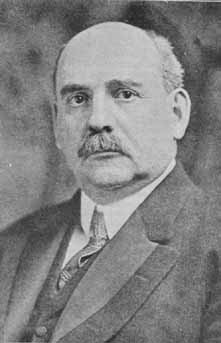
LLOYD BOWERS
Solicitor-General, who conducted the re-hearing of "What Is Whisky?"
On page 404 of my brief on whisky (unprinted) I draw the following conclusions:
"FIRST: The principle enunciated in Food Inspection Decision No. 45 is correct, and no modification of this decision should be made.
"SECOND: When Neutral spirits are diluted with water and artificially colored and flavored, the resulting product should not be called whisky. Under the ruling of the Internal Revenue such a product may be called imitation whisky if not sold as a genuine whisky, or spurious if it be sold as a genuine whisky.
"THIRD: If whisky be mixed with neutral spirits and colored and flavored, it forms that well-known class of bodies called compounds, and should be marked 'Compound of whisky and neutral spirits' or some similar appellation.
"FOURTH: If two or more whiskies be mixed together, the resulting mixture should be marked 'blend,' 'A mixture of two or more whiskies' or some similar appellation.
Perhaps no public decision ever issued received such unanimous condemnation as Bowers' report. Everybody was dissatisfied. Warwick M. Hough and Lawrence Maxwell objected to it because it denied to neutral spirit the name of whisky. Joseph H. Choate and Alfred Lueking objected on behalf of Canadian Club whiskies for the same reasons. John G. Carlisle and Edmund W. Taylor objected on behalf of the straight whisky producers because it permitted the addition of alcohol to whisky provided the congeners which gave the whisky its character were not too greatly diluted. Wm. W. Armstrong objected to it on behalf of Duffy's Malt Whisky. J. D. Rouse objected to it because it denied alcohol made from molasses to be called whisky. The Columbus Distilling Company objected to it for the same reason. The Michigan Chemical Company objected to it because alcohol to be mixed with other whisky must be made out of grain. All appealed to the President of the United States for help. The President appointed a hearing which was held in the Executive Mansion on June 28, 1909. There were present the President of the United States, presiding; Hon. George W. Wickersham, Attorney-General of the United States; Hon. James Wilson, Secretary of Agriculture; Mr. Warwick M. Hough, Mr. Lawrence Maxwell, Mr. Joseph H. Choate, Hon. John G. Carlisle, Mr. Edmund W. Taylor, Mr. William W. Armstrong, Mr. J. D. Rouse, Mr. Bullitt, Mr. Youngberg, Mr. Brangier, Mr. Smith, Mr. Thompson, and others.
THE PRESIDENT: We are here this morning to hear the exceptions to a report, and I believe that the report has the first indication of correctness in that there are exceptions from every side.
MR. CARLISLE: Nobody satisfied.
THE PRESIDENT: Nobody satisfied.
President Taft, after considering the protests made by the rectifiers in the decision of the Solicitor-General on the whisky question, disapproved the most important of these findings of his own Solicitor-General and adopted in toto many of the principles presented to him by the rectifiers. However, he suggested a method of labelling which was in some respects distasteful to the rectifiers.
DECISION OF PRESIDENT TAFT OVERRULING
ATTORNEY-GENERAL BONAPARTE AND THE
HONORABLE LLOYD BOWERS"It is undoubtedly true that the liquor trade has been disgracefully full of frauds upon the public by false labels; but these frauds did not consist in palming off something which was not whisky as whisky, but in palming one kind of whisky as another and better kind of whisky. Whisky made of rectified or redistilled or neutral spirits and given a color and flavor by burnt sugar, made in a few days, was often branded as Bourbon or Rye straight whisky. The way to remedy this evil is not to attempt to change the meaning and scope of the term 'whisky,' accorded to it for one hundred years, and narrow it to include only straight whisky; and there is nothing in the Pure Food Law that warrants the inference of such an intention by Congress. The way to do it is to require a branding in connection with the use of the term 'whisky' which will indicate just what kind of whisky the package contains. Thus, straight whiskies may be branded as such and may be accompanied by the legend 'aged in wood.' Whisky made from rectified, redistilled, or neutral spirits may be branded as whisky made from rectified, redistilled, or neutral spirits, as the case may be.
"With this result, the question arises what ought the order to be so that the purpose of the Pure Food Law can be carried out. The term 'straight whisky' is well understood in the trade and well understood by consumers. There is no reason, therefore, why those who make straight whisky may not have the brand upon their barrels of straight whisky with further descriptive terms as 'Bourbon' or 'Rye' whisky, as the composition of the grain used may justify, and they may properly add, if they choose, that it is aged in the wood.
" Those who make whisky of 'rectified,' 'redistilled,' or 'neutral' spirits can not complain if, in order to prevent further frauds, they are required to use a brand which shall show exactly the kind of whisky they are selling. For that reason it seems to me fair to require them to brand their product as 'whisky made from rectified spirits,' or 'whisky made from redistilled spirits,' or 'whisky made from neutral spirits,' as the case may be; and if aged in the wood, as sometimes is the case with this class of whiskies, they may add this fact. * * *
"This opinion will be certified to the Secretary of the Treasury, the Secretary of Agriculture, and the Secretary of Commerce and Labor to prepare the regulation in accordance herewith, under the Pure Food Law; and to the Secretary of the Treasury and the Commissioner of Internal Revenue to prepare the proper regulation under the Internal Revenue Law.
(Signed) WILLIAM H. TAFT.
The White House,
December 27, 1909.
President Taft in revising the opinion of his Solicitor-General that neutral spirits or alcohol, even when carrying flavor, were not entitled to be defined as whisky, also revised the opinion of his distinguished father, Alphonso Taft, who rendered an opinion, as Attorney-General, on the 21st of August, 1876, as follows:
"I agree with my predecessor's opinion that the shipment of alcohol under the name of whisky (the offense charged), is a violation of section 3449, Revised Statutes, notwithstanding 'the trade,' generally may have fallen into such a practice. Alcohol and whisky are, unquestionably, different articles, in contemplation of law, as they are in fact, having different qualities and different values. It appears, also, that they are placed by common carriers under different rates in their freighting schedules; * * *
"When the act prescribes how spirits may be stored or bonded, it must be presumed that it means spirits that have been lawfully distilled.
"This being patent, it is obviously important that there should be an absolute agreement in character of all the acts which together go to make up the act of shipping; and I must believe that the law intends to secure this. * * * This would be difficult or impossible if shippers, carriers, consignees, etc., were permitted to use one name for another, at their pleasure, or for any purpose."
Very respectfully,
(Signed) Alphonso Taft,
Attorney-General.
Accordingly the three Secretaries, who under the authority of the law were empowered to make rules and regulations for carrying the law into effect, prepared the definitions which did not, however, follow President Taft's directions above.
Food Inspection Decision No. 113 is as follows:
" Under the Food and Drugs Act of June 30, 1906, all unmixed distilled spirits from grain, colored and flavored with harmless color and flavor, in the customary ways, either by the charred barrel process, or by the addition of caramel and harmless flavor, if of potable strength and not less than 80° proof, are entitled to the name whisky without qualification.* If the proof be less than 80°, i.e., if more water be added, the actual proof must be stated upon the label and this requirement applies as well to blends and compounds of whisky.
"Whiskies of the same or different kinds, i.e., straight whisky, rectified whisky, redistilled whisky and neutral spirits whisky are like substances* and mixtures of such whiskies, with or without harmless color or flavor used for purposes of coloring and flavoring only, are blends under the law and must be so labeled. In labeling blends the Act requires two things to be stated upon the label to bring the blended product within the exception provided by the statute: First, the blend must be labeled, branded or tagged so as to plainly indicate that it is a blend, in other words that it is composed of two or more like substances, which in the case of whisky must each be of itself a whisky and Second, the word 'blend' must be plainly stated upon the package in which the mixture is offered for sale. A mixture of whiskies, therefore, with or without harmless coloring or flavoring, used for coloring and flavoring only, is correctly labeled 'Kerwan Whisky. A Blend of Whiskies.'*
*All three of these statements are not in harmony with Taft's decision.
"Since the term whisky is restricted to distillates from grain, and distillates from other sources are unlike substances to distillates from grain, such distillates from other sources without admixture with grain distillates are misbranded if labeled whisky without qualification, or as a blend of whiskies. However, mixtures of whisky, with a potable alcoholic distillate from sources other than grain, such as cane, fruit or vegetables, are not misbranded if labeled compound whisky, provided the following requirements of the law are complied with: First, that the product shall be labeled, branded or tagged so as to plainly indicate that it is a compound, i.e., not a mixture of like substances, in this case whiskies; and, Second, that the word 'Compound' is plainly stated upon the package in which the mixture is offered for sale. For example, a mixture of whisky, in quantity sufficient to dominate the character of the mixture, with a potable alcoholic distillate from sources other than grain and including harmless color and flavor is correctly labeled 'Kerwan Whisky. A compound of whisky and cane distillate.' Unmixed potable alcoholic distillates from sources other than grain and including harmless color or flavor, are not misbranded if labeled 'Imitation Whisky.'
"When an essence or oil is added to a distillate of grain, which without such addition is entitled to the name whisky, and the effect of such addition is to produce a product which simulates a whisky of another kind different from the kind of whisky to which the essence is added, the mixture is an imitation of the particular kind of whisky which is simulated, e.g., if rye essence be added to a highly rectified distillate of corn, the mixture is misbranded if labeled rye whisky. Such a mixture is not misbranded if labeled 'Whisky--Imitation Rye.'
"Nothing in the Food and Drugs Act inhibits any truthful statement upon the label of any product subject to its terms, such as the particular kind or kinds of whisky, vended as whisky or as blends or compounds thereof, but when descriptive matter, qualifying the name whisky, is placed upon the label, it must be strictly true, and not misleading in any particular. The law makes no allowance for seller's praise upon the label, if false or misleading, and the product is misbranded if a false or misleading statement be made upon one part of the label and the truth about the product be stated upon another part. Similarly a product is misbranded if the label is false or misleading through the use of a trade-marked statement, design or device. The fact that a phrase, design or device is registered in the U. S. Patent Office gives no license for its deceptive use. All descriptive matter qualifying or particularizing the kind of whisky, whether volunteered or required by the law to be stated, as in the case of blends and compounds, must be given due prominence as compared with the size of type and the background in which the name whisky appears, so that the label as a whole shall not be misleading in any particular.
Food Inspection Decisions 45, 65, 95 and 98 and all rulings in conflict herewith, are hereby revoked.
(Signed) Franklin MacVeagh,
Secretary of the Treasury.James Wilson,
Secretary of Agriculture.
Charles Nagel,
Secretary of Commerce and Labor.Washington, D. C., February 16, 1910."
This decision directly contrary to the findings of many Federal Courts, promulgated by the three Secretaries charged with the duty of making rules and regulations for carrying the law into effect, is the most astonishing exhibition of illegality ever perpetrated. No higher flight of open contempt of judicial findings has ever been made by any one whose duty it is to follow the courts' decisions. It would have been bad enough as an attempt at construing the meaning of a law prior to judicial opinions. In the face of the facts it is a flagrant contempt of Court.
The regulations made by the three Secretaries are most remarkable. In the first place they attempt to decide what is an adulteration or misbranding, a function which was never committed to them but was specifically given to the Bureau of Chemistry.
In the second place, they utterly failed to include the fundamental principles of branding laid down by President Taft in the above extract from his letter. There is absolutely no trace in this decision of requiring whisky to be labeled neutral spirit whisky, or a blend of that whisky and a whisky made from neutral spirits. Those were the fundamental principles which President Taft laid down for correct labeling. These two phrases were highly objectionable to the rectifiers. Under the very nose of the President the rectifiers so controlled the action of the three Secretaries that neither one of these phrases was incorporated into the necessary labeling of whiskies made from neutral spirits. Not only was every decision of the courts violated by this order, but President Taft's specific directions for labeling were also disregarded. It is very strange that the President himself did not make a protest against the utter disregard of the fundamental principles upon which his labeling order was based.
On publication of this food inspection decision in which the rectifiers gained everything they had lost in the decisions of the Federal Courts, their petitions of appeal to the Circuit Courts were in all cases withdrawn. By executive proclamation they had obtained what the courts had denied them. All the interests which were engaged in adulterating and misbranding foods were greatly heartened by this victory of the rectifiers. If one class of misbranders and adulterators could receive immunity by executive order, why not apply the same principle to all forms of adulteration and misbranding?
I am very strongly of the opinion that this approval of neutral spirits colored and flavored as whisky and this, of course, would apply to gin and rum, and all other distilled spirits, including brandy, and by implication also, to adulterated and misbranded beer and wine, was one of the principal causes which enabled the doctrine of prohibition to achieve such a sweeping victory a few years afterward under the stress of promoting the public welfare during the period of the world war. At least in so far as I was concerned I had spent many years of hard labor in trying to have all kinds of distilled spirits as well as fermented beverages comply with ethical requirements and pure food laws. The dikes that held the swelling floods of adulterations and misbranding of our beverages were broken down and waves of food adulterations swept over and devastated the country.
On the morning after the President issued his proclamation Mr. Lloyd Bowers called me over the telephone. He said: "Have you read the President's decision?" I said, "I have, with great astonishment." He asked, "What do you think about it?" I replied, "I feel as if I had been spanked," to which he replied, "So do I." This was the last time I heard Lloyd Bowers' voice. The next morning the newspapers carried the notice that the Solicitor-General had left Washington for a few weeks' rest. About three weeks after that I saw, with great regret, a notice of his death. Thus passed a great lawyer and a great jurist. I think I was right in thinking that probably his premature death was due to a broken heart. Nobody was satisfied with the laborious effort which he had made. Upon the whole my deep sympathy was with Lloyd Bowers. I was impressed with the conviction that he was earnestly seeking the truth. Three-fourths of his, decision was in harmony with my own views, so that I believe that he was at least three-fourths right.
On the evening after the President Is decision was published Mr. Charles H. Butler, reporter of the Supreme Court, entertained the Supreme Court at his residence, 1535 Eye St., N. W. I was one of the invited guests at this function. Among other members of the Supreme Court who were there was Justice Harlan of Kentucky. Accosting me he said, "Come over here, my boy, where there are not so many people. I would like to talk to you." Retiring to a secluded spot somewhat distant from the punch bowl we sat down upon a sofa. Justice Harlan said to me, "What is this I hear about holding Supreme Court in the White House?" I replied, "You know as much about it as I do, Mr. Justice, you have read the newspapers." To which he replied, "Things are coming to a pretty pass in this country. The question of 'What is whisky?' was on its way to my Court and now it will never reach there."
What a pathetic void in classic Supreme Court decisions was caused when Justice Harlan was denied this opportunity of writing the opinion of the Supreme Court on this case!
Fortunately the rectifiers did not have many years to enjoy the fruits of their great victory. The enactment of the Prohibition Amendment and the Volstead Act placed all dealings in beverage alcoholic drinks outside of the law. The question now is not "What is whisky?" but "Where is whisky?" The adulterations of the bootleg brand are now more deadly than were the combinations of the rectifiers in the old days. These illegal decisions that permit alcohol to masquerade as whisky have never been repealed. They remain sonorous witnesses of the triumph of the unholy.
All of these disasters would have been prevented if the food law had been administered as Congress enacted it. One of the most amazing events in the recital I have just made is to see the three Secretaries who were authorized to make rules and regulations for carrying out the food law attaching their signatures to a decision which clearly prevented the law from being enforced. This misconception of the law has continued until the present day and has been the cause of all the crimes committed against it.
BOARD OF FOOD AND DRUG INSPECTION AND
REFEREE BOARD OF CONSULTING SCIENTIFIC EXPERTS
It has often been said that, to make discoveries, one must be ignorant. This opinion, mistaken in itself, nevertheless conceals a truth. It means that it is better to know nothing than to keep in mind fixed ideas based on theories whose confirmation we constantly seek, neglecting meanwhile everything that fails to agree with them. * * *
"Men who have excessive faith in their theories or ideas are not only ill prepared for making discoveries; they also make very poor observations. Of necessity they observe with a preconceived idea, and when they devise an experiment, they can see, in its results, only a confirmation of their theory. In this way they distort observation and often neglect very important facts because they do not further their aim. This is what made us say elsewhere that we must never make experiments to confirm our ideas, but simply to control them; which means, in other terms, that one must accept the results of experiments as they come, with all their unexpectedness and irregularity.
"But it happens further quite naturally that men who believe too firmly in their theories, do not believe enough in the theories of others. So the dominant idea of these despisers of their fellows is to find others' theories faulty and to try to contradict them. The difficulty, for science, is still the same. They make experiments only to destroy a theory, instead of to seek the truth. At the same time, they make poor observations, because they choose among the results of their experiments only what suits their object, neglecting whatever is unrelated to it, and carefully setting aside everything which might tend toward the idea they wish to combat. By these two opposite roads, men are thus led to the same result, that is, to falsify science and the facts."
From Experimental Medicine, by Claude Bernard, pages 37 and 38.
In the enactment of the Food Law the Congress plainly provided the mechanism of its enforcement. There was no provision in the law for any additional machinery. It was evident that the Bureau of Chemistry was the dominant factor in bringing offenders of the law before the Courts. Those who "felt the halter draw" had "no good opinion of the law" as the poet has pertinently and wittily said. The elimination of the Bureau was therefore the thing of prime importance. The President of the United States seems to have taken the initiative in this matter.
President Roosevelt wrote to the various universities to secure a chemist, not to replace me, but to be placed in such a position as to counteract all my activities. Accordingly on the recommendation of President Angell of Ann Arbor the President issued an order permitting Dr. Frederick L. Dunlap to be appointed, without Civil Service examination, as associate chemist in the Bureau of Chemistry without being subject to the orders of the Chief of that Bureau, but reporting directly to the Secretary. (Moss Committee, page 921.)
In order to make this point perfectly clear I quote the following from page 849, Moss Committee:
MR. MOSS: " It is also stated in the record that a board of food and drug inspection was organized to advise the Secretary of Agriculture on matters concerning which the Pure-food law says he must make a decision."
SECRETARY WILSON: "That is substantially correct."
MR. MOSS: " These two boards were created by executive order?"
SECRETARY WILSON: "Yes."
MR. MOSS: "Then the powers and the duties of either one of the boards were fixed by executive order and not by statute?"
SECRETARY WILSON: "That is right. I do not think there was any special order sent to me to do that, but President Roosevelt appealed to the presidents of the big universities to get an additional chemist put on there and that brought Dr. Dunlap from Ann Arbor. So I doubt if I had a special order, although there was a very clear understanding what was to be done."
MR. MOSS: "The question I had in mind was that the Board of Food and Drug Inspection was not created by statute but was created by executive order."
SECRETARY WILSON: "That is what I was doubting. It was not created by statute. I created it for the purpose of getting information and all that, but of the three gentlemen on the board, two were in the Department, and in bringing in Dr. Dunlap, an additional chemist, made the third one, so technically there was no general order of the President to do that, but there was a clear understanding that it would be done. "
We should not forget that in the legislation of Congress specific duties are often assigned to particular units of administration of a character which does not permit of executive interference. I may cite in this connection the activities of the Comptroller of the Treasury. To the Comptroller of the Treasury is assigned by Congress certain specific duties. Even the President of the United States can not legally interfere with the Comptroller's prerogatives. The story is told of a case in the Grant administration where the decision of the Comptroller was particularly objectionable to certain citizens. They went to the President and asked him to rescind the comptroller's opinion. President Grant, who believed in obeying the law, replied that he could not legally alter a comptroller's decision. He said:
"If I thought it was a very bad decision I might change comptrollers and get one who would decide the way I think he should. In this case there does not seem to be any exigency demanding any such action."
The Bureau of Chemistry had specific duties assigned to it. Theoretically these duties could not be repealed by executive order. Practically in this case they were, but, of course, illegally. The proper way was to follow the suggestion of Grant, and remove the Chief of the Bureau and put Dunlap in his place.
Soon after the episode of the whisky conference, on February 22, 1907, was ended the Secretary of Agriculture walked into my office one morning in company with a young man whom I had never before seen, and introduced him as Professor F. L. Dunlap, your associate.
I said:
"Mr. Secretary, my what?"
He said:
"Your associate. I have appointed an associate in the Bureau of Chemistry who will be entirely independent of the Chief and who will report directly to me. During the absence of the Chief he will be acting chief of the Bureau."
I was astounded and dumbfounded at this action. He handed me at the same time the letter in which he had established this office and described the duties of the officer. Whatever qualification Dr. Dunlap had for the office to which he was appointed does not appear. In the first place he was to take the office of Acting Chief in my absence, a position which was filled most ably by Dr. W. A Bigelow, my principal assistant in the Bureau. Dr. Bigelow had rare judgment and discrimination. I depended upon him largely for the control of the personnel of the Bureau. He was efficient, firm, just and capable. He had grown up in the Bureau from a humble position to be, for several years, my first assistant.
There was no one else so capable as he to discharge the duties of Chief in my absence. This action of the Secretary was a direct insult to one of the most able men with whom I have ever worked. At the same time he put in charge of the Bureau during the absence of the Chief a person who knew nothing of its personnel, nothing of its activities, nothing of its duties either under the food law or otherwise, and wholly unskilled and untrained in the control of a large Bureau of several hundred members, as was the Bureau of Chemistry at that time. This was an astounding action. At the same time I was informed that the Secretary had organized a Board of Food and Drug Inspection. Such a board was not authorized by law nor by any action of Congress, nor by any appropriation made by Congress. Its purpose was to take away from the Bureau all its power and activities under the Food Law. This body was composed of the Chief of the Bureau as Chairman, with Dr. F. L. Dunlap and Mr. George P. McCabe as its other two members. As long as Dr. Dunlap acted with Mr. McCabe--and that was always--all decisions in regard to food adulteration, placed by law in the hands of the Bureau of Chemistry, were approved or disapproved by the other two members of the Board. This was a complete paralysis of the law. This Board was appointed by General Order III, on April 25, 1907. The time that elapsed from February 22d, when the whisky case was erroneously decided by the Solicitor, to April 25th, 1907, was only a little over two months. This order was issued before the final decision on the whisky question by the Attorney-General was published. The order reads as follows:
United States Department of Agriculture,
Office of the Secretary,
Washington, D. C., April 25, 1907.There is hereby created in the Department of Agriculture a Board of Food and Drug Inspection. The members of this board will be Dr. Harvey W. Wiley, Chief, Bureau of Chemistry, chairman; Dr. Frederick L. Dunlap, associate chemist, Bureau of Chemistry; and Mr. George P. McCabe, Solicitor of the Department of Agriculture. The board will consider all questions arising in the enforcement of the food and drugs act of June 30, 1906, upon which the decision of the Secretary of Agriculture is necessary, and will report its findings to the Secretary for his consideration and decision. All correspondence involving interpretations of the law and questions arising under the law not theretofore passed upon by the Secretary of Agriculture shall be considered by the board. The board is directed to hold frequent meetings, at stated times, in order that findings may be reported promptly.
"In addition to the above duties, the Board of Food and Drug Inspection shall conduct all hearings based upon alleged violations of the food and drugs act of June 30, 1906, as provided by regulation 5 of the rules and regulations for the enforcement of the food and drugs act approved October 17, 1906.
(Signed) JAMES WILSON, Secretary of Agriculture.
(Expenditures in Department of Agriculture, Hearings July-August, 1911, page 429.)
First you will note that this Board was created in the Department of Agriculture and not in the Bureau of Chemistry.
The result of the appointment of a board of Food and Drug Inspection was that the functions of the Bureau as defined by the law were entirely paralyzed. The Solicitor of the Department was made, by General Order No. 140, the supreme arbiter in all cases. In all of the decisions which he rendered, without exception, the Secretary of Agriculture supported him.
Encouraged by the success of the first effort to evade the provisions of the law through the appointment of the Board of Food and Drug Inspection, the time was propitious to push the matter further. The services of President Roosevelt in securing the appointment of a chemist who would sympathize with the efforts to defeat the purpose of the law had made that result possible. There was still needed some further encouragement to attack the activities of the Bureau in the matter of what was injurious to health. Up to this time the decisions of the Bureau on these points had been respected. To eliminate the Bureau completely, some plan had to be devised to counteract the decisions reached. A remarkable incident made it possible to use the President of the United States in the accomplishment of this purpose. As an eye and ear witness of the event about to be described I am able now to set down exactly what occurred.
Adulterators of our foods who were using benzoate of soda particularly in ketchup, and saccharin particularly in canned corn, had visited President Roosevelt and urged him to curb the activities of the Bureau of Chemistry in its opposition to these practices. They had spent the greater part of the day in the President's office. He promised to take these matters into consideration the very next day and asked these protestants to stay over. He invited the Secretary of Agriculture and the Chief of the Bureau of Chemistry to come to his office at ten o'clock on the day following and listen to the protests of the gentlemen mentioned above.
At the appointed hour we all met in the President's office, or as I recall, in that part of his office where Cabinet meetings were usually held. When all were assembled he asked the protestants to repeat in the presence of the Secretary of Agriculture and the Chief of the Bureau of Chemistry the demands which they had made upon him the day before. The three chief protestants were Curtice Brothers of Rochester, N. Y., Williams Brothers of Detroit, Michigan, and Sherman Brothers of New York, represented by James S. Sherman, M.C., who was near his election as Vice-President of the United States in 1908. There were a number of lawyers and others closely related to the protestants, making a very goodly number in all. They were loath to repeat the charges but Mr. Roosevelt insisted that they should do so. Whereupon the representative of the ketchup industries spoke. He told the well-known "sob" story of how the business of putting up ketchup would be utterly destroyed if the decisions of the Bureau banning benzoate were carried into effect. It was a touching and pathetic recital of the ultimate confiscation of hundreds of thousands of invested capital. There was no way in which this disaster could be diverted except to overrule the conclusions of the Bureau. The Chief of the Bureau was dramatically set forth as a radical, impervious to reason and determined to destroy legitimate business. After this recital was completed, Mr. Roosevelt turned to Mr. Wilson and said: "What is your opinion about the propriety and desirability of enforcing the rulings of your Chief of Bureau?" Mr. Wilson replied:
" The law demands that substances which are added to foods for any purpose which are deleterious to health shall be forbidden. Dr. Wiley made extensive investigations in feeding benzoated goods to healthy young men and in every instance he found that their health was undermined."
The President then asked me what I thought of this ruling. I replied as follows:
"Mr. President, I don't think; I know by patient experiment, that benzoate of soda or benzoic acid added to human food is injurious to health."
On hearing this opinion the President turned to the protestants, struck the table in front of him a stunning blow with his fist, and showing his teeth in the true Rooseveltian fashion, said to the protestants:
"This substance that you are using is injurious to health and you shall not use it any longer."
If matters had rested there the crowning blow to the food law would have been prevented. Mr. Sherman, however, took the floor and said:
"Mr. President, there was another matter that we spoke to you about yesterday that is not included in what you have just said about the use of benzoate. I refer to the use of saccharin in foods. My firm last year saved $4,000 by sweetening canned corn with saccharin instead of sugar. We want a decision from you on this question."
Unfortunately I did not wait for the President to ask the customary questions. I was entirely too precipitate in the matter. I addressed the President without his asking me, which is considered an offense to royalty or to a President. In the presence of rulers, we should always wait until we are spoken to before joining in the conversation. Had I followed this precept of respect the catastrophe which happened might have been avoided. I immediately said to the President:
"Every one who ate that sweet corn was deceived. He thought he was eating sugar, when in point of fact he was eating a coal tar product totally devoid of food value and extremely injurious to health."
This answer was the basis for the complete paralysis of the Food Law. Turning to me in sudden anger the President changed from Dr. Jekyll to Mr. Hyde, and said:
"You tell me that saccharin is injurious to health?" I said, "Yes, Mr. President, I do tell you that." He replied, "Dr. Rixey gives it to me every day." I answered, "Mr. President, he probably thinks you may be threatened with diabetes." To this he retorted, "Anybody who says saccharin is injurious to health is an idiot."
This remark of the President broke up the meeting. Had he only extended his royal Excalibur I should have arisen as Sir Idiot. That distinction has not departed from me to this day. The thing which hurts most is that in the light of my long career I fear I deserved it. The next day the President issued an order establishing the Referee Board of Consulting Scientific Experts. In order that his favorite sweetener might have fair hearing he asked Dr. Ira Remsen, who held a medal given him by the Chicago Chemical Society as the discoverer of saccharin, to be chairman and to select the other members. According to the ordinary conception of a juror Dr. Remsen would not have been entitled to sit on the subject of saccharin. Such little matters as those, however, were not dominating with the President of the United States. As Milton describes the episode in the Garden of Eden--
"Of man's first disobedience and the fruit
Of that forbidden tree whose mortal taste
Brought death into the world and all our woe"
the creation of the Remsen Board of Consulting Scientific Experts was the cause of nearly all the woes that subsequently befell the Pure Food Law. Joined to the creation of the Board of Food and Drug Inspection there was little left of the method prescribed by Congress for its enforcement.
From this time on all the interests seeking to paralyze the enforcement of the food and drugs act acted as one body under the leadership of the Department of Agriculture. The rectifiers were perhaps the best organized of the enemies of the pure food and drugs legislation. The interests that supported and demanded the use of benzoate of soda represented only a minority of the manufacturers of ketchup. Those who demanded the free use of sulphurous acid and sulphites were confined to the manufacturers of cane molasses and of dried fruits. Those who demanded the use of saccharin were only a very small part of the interests engaged in the canning and preserving of our foods. The people who were anxious to use alum, however, represented a great majority of baking-powders. Those manufacturers who made baking powder out of phosphates and tartrates were not so numerous and did not do so big a business as the makers of alum powders. The whole body of adulterators and misbranders of our foods who were depressed by the results of the decision of the question of what is whisky were restored to optimism and tremendous activity by the appointment both of the Board of Food and Drug Inspection and of the Remsen Board. By this time, however, public sentiment which had been so unanimously in favor of food and drug legislation was awakened to the danger which came from the betrayal of the cause of pure foods by these executive proclamations. The daily, weekly, and monthly press of the United States were almost solidly opposed to these illegal activities of the executive officers in charge of the pure food and drugs legislation. Not a day passed without numerous attacks upon this laxity of administration appearing in all parts of the country.
I will return to this condition of affairs later on. The Secretary of Agriculture was perfectly acquainted with the incident just described in regard to the origin of the Remsen Board. Nevertheless, in the following statements to the fruit growers of California he ascribed the origin of the Remsen Board to a totally different cause. I quote from page 847 of the Moss Committee on Expenditures in the Department of Agriculture:
I went out to the Pacific Coast, I think it was in 1907 to look at the forests which had just come to our department. Telegrams began to come all around me, and finally reached me that something was seriously the matter at San Francisco, and I wired back that I would be there at a certain day, and I went there. I found the mayor, the bankers, the business men and the farmers in a very great commotion. They wanted me to talk. I said, "I do not know what to say, I will listen; you talk, gentlemen." "Well," they said, "we have a $15,000,000 industry here in the growing and drying of fruits. These dried fruits are contracted for by the big eastern merchants. Our people borrow money from the banks, and when the fruit is sold everything is straightened out and things go on, but you people in Washington say we can only use 350 milligrams of sulphur to the kilo, and the eastern men who have contracted for our fruit will not make their contracts good; they are afraid it will not keep."
After listening to these good people all day I said, "I see the condition you are in, gentlemen. I do not think the American Congress in making this law intended to stop your business. We have not learned quite enough in Washington to guide your business without destroying it; we will know better by and by, but I will tell you what to do. Just go on as you used to go on and I will not take any action to seize your goods or let them be seized or take any case into court until we know more about the number of milligrams to the kilo, and all of that. In the meanwhile I shall send a chemist from our Bureau of Chemistry out here, and I want to get the best chemist in your state at your State University at Berkeley, put the two together and try to get the facts," and we did that. They worked that summer; and before I think they completed all they would like to have done the Referee Board came * * * I think that about answers the question why the Board was created.
When the chemists made their report, Secretary Wilson promptly refused to have it printed because they had found a harmless substitute for sulphur fumes.
The hearings accorded the users of saccharin, after the report on saccharin by the Referee Board had been published, developed the following curious incident.
The President selected the alleged discoverer of saccharin as Chairman of the new committee to revise the findings of the Bureau of Chemistry. This committee entirely reversed President Roosevelt's decision that benzoate of soda was a harmful substance. They did not, however, agree with him entirely in regard to the harmlessness of saccharin. In their report they permitted the use of a sufficient amount of saccharin to sweeten foods, but they were of the opinion that if one consumed over 3/10th of a gram of saccharin at any one time it might prove injurious and that also as a sweetener it was a fraud. The manufacturers of saccharin asked for and secured a hearing on this point. The hearing was held before Secretary Wilson and Secretary Nagel. Addressing the saccharin manufacturers, Secretary Wilson (Page 908, Moss Committee) made the following statement:
I want to say frankly to you gentlemen that the Referee Board was organized and put in action for the very purpose of conserving the interests of the manufacturers, by insuring them a sane hearing, and, that being the case, it is the best the Government can do.
To the users of burning sulphur he promised complete immunity until the Remsen Board made its decision. In point of fact, that came only after many years. It was never published by the Department of Agriculture. The indulgence has continued for twenty-two years and bids fair to go on forever. Now to the makers of saccharin he says the Remsen Board was created to be sure manufacturers get a "sane hearing." The plain inference is that the hearing specified in the Act is not "sane."
Of course Secretary Wilson was right in so frankly stating the purpose for which the Referee Board was created. Manufacturers of adulterated goods were never shut out from a full and fair hearing. That was always available before the Courts when they were cited to appear as violators of the law. The Referee Board was an effective buffer for all this class of manufacturers. It prevented a full and fair hearing of the case before a jury and a United States Court. It was the most baleful influence toward the degradation of the food supply of our country that ever existed. The Referee Board has passed away, but the evil effects of its activities will be felt for all time to come. Its decisions and its activities are still regnant in the mal-administration of the pure-food law. The only hope of the future lies in the possibility of some day getting a Secretary of Agriculture who with one stroke of his pen will erase forever from the records of the Department every decision of the Referee Board and every regulation made in conformity therewith, and remove every administrative officer who willingly carries these decisions and regulations into effect.
The officials, paid experts and aides of the low-grade manufacturers realized very keenly their unpopularity as reflected in the notices of their activities which appeared in the newspapers and magazines. This sensibility caused Dr. Remsen at the end of his testimony before the Moss Committee to express his feelings which have been recorded in another place. Prior to this he was keenly sensitive to what the newspapers were saying about him and his Board. On Feb. 11th , 1910, in a letter to the Secretary of Agriculture, (Moss Committee, Page 366) he said:
"A representative of our principal newspaper brought me yesterday an inflammatory article which had been sent by the Washington correspondent. The object of the article was to discount the reports of the Referee Board on the sulphur question. It was venomous and inflammatory to the last degree. It also took up the benzoate question with the object of showing how entirely unreliable the work of our Board had been. Our bombastic friend, C. A. L. Reed* of Cincinnati, was held up as a great and good man and a high authority. I presume this attack has been sent all over the country. I made some comments on it and the newspaper to which it was sent here declined to publish it. I have no doubt as to the source of that article. It was altogether the worst thing that I have seen."
*Eminent surgeon and Past-President of the American Medical Association. Died in 1928.
The curious thing about all this is that the Secretary of Agriculture and his aides, the Remsen Board and their followers were continually insinuating that there was some one in Washington who inspired all these criticisms of the Remsen Board. They were never bold enough to come out openly and say who this person was. It is perfectly plain who was in their minds. The report of Dr. Bigelow, who was the chemist sent to California, not by Secretary Wilson, but by myself, was refused publication when it was completed and has never yet seen the light of day. Dr. Bigelow in this report showed how by dipping the freshly cut fruits in a weak solution of common salt and then drying them a product was produced equal in color to the sulphured article and far more palatable, wholesome, and desirable in every way.
Large quantities of dried fruits made by this process were shipped to Washington, submitted to dealers and pronounced a far superior product in every way to the ordinary sulphured article. Also attention should here be called to the fact that the meat inspection law specifically denies the use of sulphur dioxide and sulphites in the preparation of meats on the ground that a preservative of this kind is injurious to health. Its use had been discarded practically before the regulation forbidding it was made by reason of the scandal of embalmed beef which stirred this country deeply during the Spanish War. In other words the use of any sulphur dioxide or sulphites in meat was an adulteration, but in dried fruits it was necessary to prevent the destruction of the dried fruit business, in the eyes of the Secretary of Agriculture.
Further questioning of the Secretary threw additional light on this point:
MR. FLOYD: You, personally, as Secretary, were made responsible, but President Roosevelt acted in harmony with you in establishing this referee board?
SECRETARY WILSON: We have to obey the President of the United States when he indicates what he wants.
MR. FLOYD, I understand. The President, sanctioned this board?
SECRETARY WILSON: Oh, yes. He wrote to the presidents of the great universities and got them to recommend men, and when the men came that he wanted he ordered me to appoint them, and I appointed them.
MR. HIGGINS: Mr. Secretary, in your observation of the enforcement of this law, is it your opinion, based upon that observation, that it was a wise thing to have a referee board?
SECRETARY WILSON: It certainly was my judgment that we should have a referee board.
MR. HIGGINS: Is that confirmed by your experience with it?
SECRETARY WILSON: I have no reason to conclude that it was not wise.
MR. HIGGINS: Are you familiar with the character of the gentlemen who make up that board and their scientific attainments?
SECRETARY WILSON: By reputation only; I did not know them personally, any of them.
MR. HIGGINS: Have you ever imposed any restrictions on them as to the methods of investigation?
SECRETARY WILSON: No. I told them frankly when they began that nobody had any business to interfere with them anywhere; that they were to find us the facts with regard to what we submitted to them; and I did not impose any restrictions and nobody else had any right to, unless it was the President, and I did not think he would.
MR. MAYS: Did you have any doubt in your mind as to the legality of their appointment at the time?
SECRETARY WILSON: Never.
MR. FLOYD: Now, Mr. Secretary, how many of these great questions have been submitted to the referee board?
SECRETARY WILSON: I suppose I could count them on my fingers.
MR. FLOYD: The chairman tells me that that is in the record.
SECRETARY WILSON: Very likely it is in the record.
MR. FLOYD: Now, under the pure-food law, as I understand it, Mr. Secretary, the work of the Bureau of Chemistry is preliminary to a prosecution?
SECRETARY WILSON: Oh, surely.
MR. FLOYD: And no prosecution can be instituted against anyone in a criminal procedure until the Bureau of Chemistry has made an adverse finding and you have so certified to the district attorney?
SECRETARY WILSON: That is the way it is done.
MR, FLOYD: Now, I am going to ask you a question that I would ask other witnesses as to the effect of the decision of the referee board. In case the Bureau of Chemistry should make a finding adverse to the use of a certain commodity on the ground that it was deleterious to health and that should be referred to the referee board and the referee board should make a contrary decision, is there any way, under the regulations, to your knowledge, that the question at issue between the Bureau of Chemistry and the referee board could be taken into the courts and be settled by the courts?
SECRETARY WILSON: Of course, I can not state intelligently with regard to how a thing might get into the courts, but the department would enforce the decision of the referee board. They would do that, I suppose
MR. FLOYD (interposing) : If the decision of the referee board was adverse to that of the Bureau of Chemistry the effect of enforcing the decision of the referee board would be to prevent the prosecution of anyone using that commodity?
SECRETARY WILSON: Well, it would depend on--yes, I see your point; yes, it would.
The unanimous decision of the committee investigating the expenditures of the Department of Agriculture completely exonerated the accused officials and censured their accusers.
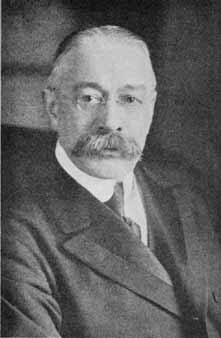
ATTORNEY-GENERAL WICKERSHAM
Who certified to President Taft that Dr. Wiley was worthy of "condign
punishment."
The activities of two Presidents, three cabinet officers, and one Attorney-General in promoting the efforts to exclude the Bureau of Chemistry from any efficient steps looking to the enforcement of the Food and Drugs Act created a veritable storm of protest, as has already been indicated, in the press of the country. This protest was voiced most effectively by the attitude of The World's Work under the able editorship of Walter H. Page. In the issue of that magazine for September, 1911, the following editorial comment is found, under the title, "The Fight on Dr. Wiley and the Pure Food Law."
There is no better illustration of the difficulty of really effective government than the obstructions that have been put in the way of Dr. Wiley, the head of the Bureau of Chemistry at Washington. So long as the Pure Food and Drugs Act ran foul of only small violators, it was easy to enforce it; but, as soon as it hit the vested interests of the rich and strong, the most amazing series of successful. obstructions were put in the way--so amazing and so successful that the story will be told with some fullness in the succeeding numbers of this magazine.
Here is a man--Dr. Harvey W. Wiley--who has given his whole working life to the protection of the people from bad and poisonous food and drugs. There is no more unselfish or devoted public servant. He has time and again declined offers of lucrative and honorable private work. He has lived and labored for this one purpose.
It is to him that we owe the law and the agitation for its enforcement. It is to him that we owe the education of the public which has brought state laws and municipal ordinances for pure food and drugs. It is to him that we owe such an important advance in more careful living and such a quickening of the public conscience as we owe to hardly any other living man; and the whole people are his debtors. He is the direct cause of a wider and safer public knowledge and of more healthful habits of life.
Still the Pure Food and Drugs Act is not yet enforced against the great offenders. Dr. Wiley has had his hands tied from the time of its enactment. The Board, whose duty it is to report violations of the law, consists of Dr. Wiley, Dr. Dunlap, a chemist, and Mr. McCabe, the solicitor of the Department of Agriculture. But out of the thousands of cases of adulteration and fraud that have been discovered, practically no cases against the strongest corporations and groups of law-breakers have been brought to trial. Dr. Wiley is a man of scientific distinction, of accuracy, and of responsibility. Yet his two associates on this board, men, to say the most for them, of far less ability and less distinction, have been permitted to check almost every move that he has made. The aged Secretary of Agriculture has given his confidence and his support to them and withdrawn it from Dr. Wiley.
More than this--the Attorney-General, reversing an opinion prepared by one of his own subordinates and accepting an opinion by Mr. McCabe, declared that the referee board of distinguished chemists (the Remsen Board) was authorized by the law--a very dangerous and very doubtful construction of a plain statute; and this Board has been used to prevent the enforcement of the law against the use of benzoate of soda. This Remsen Board has never declared that benzoate of soda is a permissible preservative. It has never been asked whether it can be or is extensively used to preserve rotten food. It was asked only if it proved injurious to the health of strong young men when taken for a time in small quantities. They found that it did these young men no appreciable harm. Then this declaration was used to permit the canners and packers of rotten fruits and vegetables to continue to put them up in benzoate of soda. Even if benzoate of soda does no harm to health, its use in disguising rotten food brings it within the proper prohibition of the law.
This incident is a good illustration of the way in which Dr. Wiley has been balked and hindered. Influences, legitimate and illegitimate, have been used to prevent the enforcement of the law in its most important applications.
Inside the Government and outside, the manufacturers of dangerous and unwholesome food and drugs have carried on a continuous and effective campaign against Dr. Wiley and his work. He has been practically without power to put the law into effect against strong offenders. He has been humiliated by being overruled by his subordinates. He has suffered from an inefficient administration of the Department of which his bureau is a part; for the venerable Secretary of Agriculture is too old vigorously to administer his great Department. Yet Dr. Wiley, purely for patriotic reasons, has suffered this hindrance and humiliation till some change might come which should unshackle him.
On the outside the bad food and drug interests--or some of them--have maintained a lobby in Washington, have kept "syndicate" newspaper writers in their pay to write about the unfairness and the injustice of the law and the unreasonableness and "crankiness" of Dr. Wiley. One such organization--or pretended organization--some time ago sent a threatening letter to all the most important periodicals, saying that large advertisers would withdraw their patronage if they published articles favorable to the law!
There has been an organized fight, therefore, against the law and the man. And, although the man's official power has been curtailed, he has won--won such a victory for the people as will insure the continuance, with new vigor, of the campaign for pure food and drugs, by national law and by local laws.
The "charge" against Dr. Wiley that provoked this popular outburst of approval, is not worth explaining. He made an arrangement to pay Dr. Rusby, a distinguished specialist, a higher rate for work per day than the law specified for per them payments, but less than the law permitted as a yearly salary. By this arrangement the services of Dr. Rusby to the Government were secured for less than if the letter of the law had been followed and he had been paid the yearly salary that the law specified--since he gave and was to give only a small part of his time to the work. This technical violation of the letter of the law--if it were a violation of its real meaning--has long been customary in many departments of the Government; for it has common sense and economy to commend it.
When the Attorney-General wrote that this offence deserved "condign punishment,"--the Attorney-General--what shall be said of him with respect? Surely it was a narrow and silly recommendation. He put a greater value on a microscopic legal technicality than on the incalculable service of a man whose work is worth more to the health and happiness of the people than the work of many Presidents and Attorneys-General. Dr. Wiley's "offence" was instantly forgotten by the public, which has some common sense if not much legal knowledge. But the accusation was important for this reason: it showed the determination of those who brought it to get rid of him.
Now, if Dr. Wiley deserves dismissal for any sufficient reason, it is proper and it is the duty of somebody to present such a reason. But to propose "condign punishment" for saving the public money by following a common custom of paying for professional service-that shows a personal and private purpose to be rid of him.
The upshot of it all is that Dr. Wiley has been made a sort of popular hero. Now popular heroism has decided disadvantages and even dangers. It is fair to Dr. Wiley to say that he has not sought such a place on the stage. He has his vanities (who hasn't?) and the popular appreciation of his work is of course welcomed by him, as it ought to be. But mere personal popularity and a personal "fight" are likely to obscure the main matter at stake. The main matter is the Pure Food and Drugs Act--not only nor mainly Dr. Wiley and his personal vindication, but the firm and permanent establishment of this fact and purpose: that no opposition of interested law-breakers, no personal jealousies, no departmental feuds, no infirm and feeble administration of any Department, no narrow legal technicalities, shall longer hinder the execution of the law that guards the health of the people. This is of far greater importance than anybody's tenure of office or than anybody's official "face" or dignity.
It has been made plain that the administration of the Agricultural Department is feeble. Feuds and cliques are not permitted to obstruct the laws in well-administered institutions. And it has again been made plain by the Attorney-General that this is a "legal" administration; and, again, that the President's amiable qualities lead him to patch-up and smooth-over troubles that become worse with every patching and smoothing and can then be removed only after public discussion and possible scandal. The incident ought and seems likely to bring big results in rallying public opinion to the support of the law and of its author and zealous and useful guardian. The investigation by the Congressional Committee that has the subject in hand will bring out facts that are likely to make the law far stronger than it has ever been.
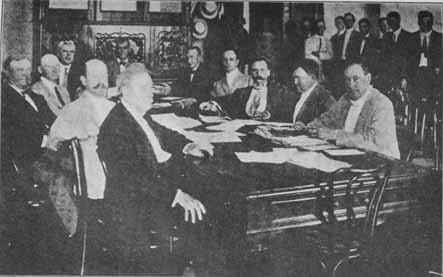
Committee on Expenditures in the Department of Agriculture, 1911, investigating charges preferred against Dr. H. W. Wiley, Representative Ralph W. Moss, presiding. At the right of Mr. Moss are the three of the Democratic members of the Committee, namely, Hon. J.C. Floyd, Hon. R.L. Doughton, Hon. D.H. Mays; Henry E. Davis and Hon. W.P. Hepburn, attorneys for Dr. Wiley. On the left of Mr. Moss are the Hon. Edwin W. Higgins, Hon. Burton L. French, and the Hon. Charles H. Sloan, the stenographer and H.W. Wiley.
The editor of The World's Work did not have to wait long to know the conclusions reached by the committee investigating the expenses of the Department of Agriculture. The report was issued early in 1912. It was a complete vindication of the Bureau of Chemistry and a complete reversal of the penalties which the personnel board had inflicted, or tried to inflict on the Chief of the Bureau and his assistants. Before the committee's report was published, however, the President of the United States, who had been asked to approve the dismissal of the Chief of the Bureau, wrote the following letter to the Secretary of Agriculture (Page 2 of the Report):
"The truth is, the limitations upon the bureau chiefs and heads of departments to exact per diem compensation for the employment of experts in such cases as this is of doubtful legislative policy. Here is the pure-food act, which is of the highest importance to enforce and in respect to which the interests opposed to its enforcement are likely to have all the money at their command needed to secure the most effective expert evidence. The Government ought not to be at a disadvantage in this regard, and one can not withhold one's sympathy with an earnest effort on the part of Dr. Wiley to pay proper compensation and secure expert assistance in the enforcement of so important a statute, certainly in the beginning, when questions arising under it are of capital importance to the public."
Other high lights of the report of the committee are summarized below:
"The committee on expenditures in the Department of Agriculture beg leave to submit the following report of the recent hearings commonly referred to as the "Wiley Investigation." This inquiry was instituted on information that an alleged conspiracy had been entered into between certain high officials of the Bureau of Chemistry and Dr. H. H. Rusby whereby Dr. Rusby was to be paid a compensation for his services at a higher rate than authorized by law. * * * In the discharge of its duties under the rules of the House, your committee made a patient and careful investigation of the whole controversy. * * * Your committee regards the "Wiley Investigation," so-called, only an incident in its broader inquiry into the organization and administrative routine of the Bureau of Chemistry and the Referee Board. * * * We failed to find from the evidence in the whole case that there existed any secret agreement or that the terms of compensation or rates to be paid Dr. Rusby were withheld from the Secretary designedly or otherwise. * * * We therefore find from the evidence adduced that the charges of conspiracy have not been established, but, on the contrary, that the accused officials were actuated throughout solely by desire to procure for the Bureau of Chemistry an efficient assistant in the person of Dr. H. H. Rusby under terms and conditions which those officials believed to be in entire accord with the law, regulations, and practice of the Department of Agriculture. * * *
"The record shows that three members of the Referee Board were in attendance at the trial at Indianapolis, Indiana, in the capacity of witnesses at the instance and on behalf of the plaintiffs in the suit to which Curtice Brothers and Williams Brothers, who are interested in the sale of food stuffs to which soda benzoate has been added as a preservative, and that the expenses of these witnesses were paid by the Department of Agriculture. In the opinion of your committee the payment of these expenses by the Department of Agriculture was wholly without warrant of law. * * *
"Your committee does not question the motives or the sincerity of the Secretary of Agriculture, whose long service as the head of the Department of Agriculture has been of signal service to the American people. From the beginning, however, the honorable Secretary has apparently assumed that his duties in the proper enforcement of the pure-food laws are judicial in character, whereas in fact they are wholly administrative and ministerial. This misconstruction of the law is fundamental and has resulted in a complex organization within the Department of Agriculture, in the creation of offices and boards to which have been given, through Executive order, power to overrule or annul the findings of the Bureau of Chemistry.
"The statute created the Bureau of Chemistry as an agency to collect evidence of violations of the food and drug act and to submit this evidence duly verified to the Department of Justice for judicial action. The Secretary of Agriculture is the officer whose duty it is to transmit this evidence from the Bureau of Chemistry to the Department of Justice. Added to this simple duty is the more responsible obligation delegated to him by the three Secretaries to review the findings of the Bureau of Chemistry by granting a hearing to parties from whom samples were collected and in the light of these hearings, of deciding whether or not the findings of the bureau are free from error.
"This construction of the law, which, in the opinion of your committee, is the correct one, places the judicial determination of all disputes in the courts, where the standard of purity in foods must finally be established. It also makes it the imperative duty of district attorneys to proceed against all violators of the law on receipt of certified record of cases prepared by the Bureau of Chemistry; but if we accept this construction of the law in its full meaning, it is apparent that at the time of the taking effect of this law the prompt prosecution of every infraction, whether of major or minor importance, was an impossibility, as such a course would have utterly congested the business of the courts. * * *
"Thus the administration of the law began with a policy of negotiation and compromise between the Secretary and the purveyors of our national food supplies. * * *
"The strength of the statute and the jurisdiction of the courts cannot be affected by the executive orders of the Secretary of Agriculture, though they be issued in obedience to the suggestion of the President of the United States.
These respective duties of the Secretary and Bureau are enumerated separately in the statute and whatever other duties either may be charged with in the administration of the Act come by virtue of the rules and regulations established by the Secretary of Agriculture, the Secretary of the Treasury, and the Secretary of Commerce and Labor. * * *
"The Act of Congress approved March 4, 1907, contains this provision, 'and hereafter the Secretary of Agriculture is hereby authorized to make such appointments, promotions, and changes in salaries, to be paid out of the lump sum of the several bureaus, divisions and offices of the Department as may be for the best interest of the service.' In view of these provisions of law your committee is of the opinion that there may be authority under the law for the creation and maintenance of such Board (Referee Board) to aid the Secretary in the discharge of any duty enjoined on him in his official capacity; but raises the question as to its legality on the sole ground that the determination of the general questions submitted by the Secretary to the Referee Board is not enjoined upon him under the law.
"We have here presented the very crux of the controversy which has been waged over the terms of the pure-food law, and which, fortunately for your committee, has been recently discussed (by the Supreme Court) in a decision of the United States vs. Morgan, et al. * * * The weight of this decision clearly denies to the Department of Agriculture any judicial authority. * * * We have thus presented another weighty question to be considered in this connection as to the necessity, wisdom, or sound policy of maintaining such a board at a heavy expense to the Government when the work done by it is largely a duplication of work performed, or which might be performed by the Bureau of Chemistry. The functions of this board as at present constituted are purely advisory. Their decisions have no legal or binding effect upon any body. The Secretary can follow or ignore their recommendations as he sees fit. * * * The Honorable Secretary of Agriculture seems to have regarded the findings of this board as conclusive in all cases over the opinions and findings of the Bureau of Chemistry, the tribunal which by express terms of statute is vested with authority to determine the questions of adulteration and misbranding within the meaning of the act. In the practice of the Department, the Bureau of Chemistry has been restrained from examining any specimens of foods and drugs under any general subject which is submitted to the Referee Board during the time of examination of such questions by such Board; and if such general subject is submitted to the Referee Board before the Bureau of Chemistry has made any examination of specimens to determine the question of adulteration and misbranding, then the Bureau is not permitted by the Secretary to make any such examination until the Board shall have made its report.
"It has resulted in another remarkable situation, namely, that under the practice of the Department the decisions of the Bureau of Chemistry, if in opposition to the findings and opinions of the Referee Board cannot be referred to the Courts and thus permit a judicial decision to be made as is comprehended under the plain provisions of the law. It would thus happen that if the Bureau of Chemistry were right and the Referee Board were in error that violations of the law would receive protection through the proposed enforcement of the law; because the effect of such a policy is to give this advisory Board, created by Executive order paramount authority over the Bureau of Chemistry and lodges in the personal advisers of the Secretary the power to annul the decisions of the Bureau within the Department of Agriculture which was created by law."
These luminous opinions of the committee investigating the expenditures of the Department of Agriculture show that not a dollar of the money expended by the Referee Board was legally expended. At the time this investigation took place the total expenditures made by the Referee Board of the money appropriated by Congress to enforce the Food and Drugs Act amounted to over $175,000. Every dollar of this money was expended in protecting and promoting violations of the law. It seems strange in view of these findings which were approved by the House of Representatives that no effort was made to impeach the Secretary of Agriculture and the President of the United States who had thus perverted money appropriated for a particular use to activities totally repugnant to the purpose of the appropriation. The following violations of law were permitted and protected by this crime, namely, the use of benzoate of soda as a preservative of foods, the use of sulphur dioxide and sulphites as bleaching agents and food preservatives, the use of saccharin as a sweetener in foods up to an amount not exceeding three-tenths of a gram, and the free and unrestricted use of alum in food products. It is a striking comment also on the attitude of Congress and the people at large that no steps have ever been taken from 1911 to 1928 to correct these outrages on the Americaia people and to attempt to restore the law to its power and purpose as enacted. Administration after administration has come and gone and these abuses still persist.
After considering all the evidence adduced over a period of six weeks the House committee on expenditures unanimously declared the Referee Board to be an illegal organization. It had a very good reason for doing so even before the evidence was considered. The matter had been decided by an assistant to Attorney-General Wickersham in a report from the Department of Justice dated March 31, 1909. This was fully two years and more before the decision of the investigating committee was rendered. This report of the Department of Justice was signed by J. A. Fowler, assistant to the Attorney-General. It is printed in full in the proceedings of the committee, pages 205 and following. Attorney-General Fowler called attention to the fact that at the time the committees of the House and the Senate met for final conference on the food and drugs bill, the House bill contained a provision authorizing the appointment of a committee of five experts to consider questions of deleterious or injurious substances in foods, and to establish food standards. The Senate bill did not contain a provision of this kind but did contain a statement of the duties of the Bureau of Chemistry to perform these functions. The Senate conferees insisted on the elimination of the House provision for a special board and this was acceded to by the conferees from the House. When the conference report was presented to the two houses Mr. Mann, manager for the House made the following statement in answer to a question by Mr. Pollard:
MR. POLLARD: Was there any change made in the provision of the House bill wherein we provided that a board, of five inspectors should be selected to pass upon the wholesomeness or deleteriousness of the foods?
MR. MANN: That provision was in Section 9, directing the Secretary of Agriculture to determine standards and the entire section goes out. As I stated in the House when the bill was before the House, it is the courts which must determine in the end as to the question of the wholesomeness or the deleteriousness of preservatives or of any article of food. * * * The Senate conferees were unalterably opposed to that provision and as it was not an essential provision of the law we gave way on that provision in order to save the rest of the bill practically intact as the House had enacted it. (Record 59th Congress, First Session, Page 9738, Expenditures in the Department of Agriculture, page 269.)
MR. FOWLER: "This statute authorizes the prescribing of such regulations as are consistent with law, and for the reason above stated I regard the appointment of this Board of Referees as inconsistent with law.
Senator McCumber also commented in the Senate on this same subject, as follows:
"Now what have we eliminated from this bill? Senators will remember that the House measure provided for the fixing of standards and it called to the assistance of the Secretary of Agriculture certain experts who were to aid him in determining what the standards should be and also provided that the standards so established by them should be for the guidance of the court. The Senate has always contended that the power to fix standards should not be given to any man and the House conferees receded from that portion of the House amendment and it goes out."
In spite of this clear intention of Congress the Solicitor of the Department of Agriculture wrote an opinion to the effect that the appointment of the Referee Board was legal and this opinion was adopted by Attorney-General Wickersham as a choice between the opinion of the Solicitor of the Department of Agriculture and the opinion of his own assistant in the Department of Justice.
With the promulgation of the opinion of the Attorney-General, the effacement of the Bureau of Chemistry from any further participation in the enforcement of the food and drugs act was completed. Even the Board of Food and Drug Inspection was deprived of its office of confirming or overturning the decisions of the Bureau of Chemistry. Under General Order No. 140 the Solicitor of the Department was made the sole arbiter of the recommendations which should go to the Secretary in regard to whether or not an article was misbranded or adulterated. General Order No. 140 is found on page 10 of the report of the committee. The committee expressed the following opinion thereon:
"Under the terms of this order all the evidence in all cases examined in the Bureau of Chemistry, together with such summaries as the solicitor may prescribe is referred to the solicitor to determine whether or not a prima facie case has been made. * * * We are at a loss to understand what favorable results can come from the preparation of such summaries in the Bureau of Chemistry and their further study in the solicitor's office."
The committee realized that this was the consummation of the plan of the solicitor. It totally disregarded the provisions of the food law as to the methods of its execution. It placed the solicitor, not mentioned nor recognized in the law, in the place of the Bureau of Chemistry as the sole arbiter of all processes looking to the enforcement of the act. With this final blow at the vitality of the law its enforcement passed entirely into the hands of the enemies of the law. The public which it was intended to protect was left without any redress. The result was a wild orgy of adulteration and misbranding, paid for by the money of tax-payers appropriated for the enforcement of the law. The members of the Referee Board became experts paid by the Government to protect the interests of adulterators and misbranders. Their eff orts in this direction were put into effect by the Solicitor of the Department. All the fruits gained by the victory in the enactment Of the legislation were thus sacrificed by the direct negation of the law's demands. The fai-reaching effects of this crime against law I have tried to set down in as small a space as possible to do justice to the story.
If an expert dietitian and physiologist should take up for study a report on metabolism made by a scientific authority, he would expect first of all that the composition and weight of food ingested should be accurately stated. Without knowing the amount of intake, data respecting the outgo have no significance. In Bulletin 84, Part 4, Benzoate of Soda, containing the experimental data of the Bureau of Chemistry, it will be noticed that careful analytical examinations were made of all the foods ingested and the quantities of each kind of food for each subject is accurately stated. The data in this investigation therefore obtained by the examination and analyses of the feces and urine have a direct significance. In the experiments on the same subject conducted by the Referee Board no attempt was made to have complete analyseg of the foods administered nor the quantities thereof eaten. It was all left to the experimentees themselves. This is forcibly brought out by the statement of Dr. Chittenden on page 17 of Report No. 88 of the Referee Board. He says:
First, the subjects were not restricted to a limited dietary, but on the contrary were allowed reasonable freedom of choice, both as to character and quantity of the daily food. 1n other words, there was no interference with the normal desires of the individual but each subject was allowed full latitude in the exercise of his personal likes and dislikes. To be sure each day a definite menu was arranged for all three meals, but this was sufficiently generous in character to admit of choice; further' after a short time sufficient knowledge was acquired of the special tastes of the subjects, so thdt a daily dietary could easily be provided quite satisfactory to all. By this method of procedure there was no violation of that physiological good sense so essential in experiments of this character.
In the experiments of the Bureau of Chemistry no such latitude was permitted. In the fore period in each case sufficient quantities of the diet prescribed, which was a thoroughly wholesome and well-balanced one, were used to establish an even daily weight of each one. This quantity was given to the subject each day, during the experimental administration of the drug. If during the administration of the benzoic acid the subject would not feel like eating his whole meal, the amount he did not eat was weighed and deducted. This failure of appetite, if no other cause could be found for it, was an indication of the effects produced by the administered preservative. I suppose this method of procedure would be designated by members of the Referee Board as "physiological" nonsense.
The records printed in Report No. 88 indicate the wildest riot in diet ever recorded in a physiological investigation. Enormous differences in the amount of food consumed are recorded in that report. In the evidence before the court in the Indiana case, page 33, this matter was brought to the attention of Dr. Remsen in the following question:
Now, Doctor, in order to conduct an examination of that. kind, an investigation that was of any very great value, oughtn't every article of food that was given to the subject to be analyzed, some part of it, so as to know what it contained?
A. I suppose there are other ways of getting at that besides analyzing it. You can often form generally an opinion of the character of the food you are giving or examining without analyzing.
Q. Are there not variations, for instance in breads?
A. There are variations, undoubtedly.
Q. And they are variations of wide extent, are they not, doctor?
A. Well, wide--depends on the meaning of the word wide. That is a technical question that I should want to refer to the experts of this Board.
Q. You would not be prepared to say what would be a normal range in the quantity of nitrogen that would be found?
A. Not I, no. I could get the information very readily. One moment--my impression is that there were analyses of some foods made--very many.
Some time in the remote future when all personal matters have passed away and an expert chemist and physiologist calmly reviews the data obtained by the Bureau of Chemistry and the data obtained by the Referee Board on the same subject, they will show a comparison of values of the two investigations which I am quite content to leave to the judgment of the unbiased future.
As has been clearly illustrated, the Remsen Board was appointed to protect manufacturing interests. The Chief of the Bureau of Chemistry under his oath was trying to protect the neglected American consumer. One would have thought that in selecting five eminent scientific men that at least some one of them might have revolted from the purpose to which he was assigned. The quotation from Claude Bernard discloses most emphatically the proper psychological attitude of the true investigator when he undertakes his task.
The Supreme Court has ruled that the user of a deleterious product in foods must justify that use. Prof. A. J. Carlson* sees a scientific reason therefor:--
Modern chemistry has opened up another avenue of poisoning the human system through the field of food preservatives and food substitutes. We have the problem of the harmfulness or the harmlessness of the various baking powders, of benzoic acid as a permissible food preservative, of saccharin as a substitute for sugar, etc. Many of the experiments purporting to prove the permissibility or harmlessness of the substance or preservative, even those carried out by competent scientists, seem to me wholly inadequate. I have in mind, as an example, the experiments and finding of the Remsen Consulting Board, on the question of saccharin in foods. Under the direction of this board, composed of leading biochemists and chemists, varying quantities of saccharin were fed to a small number of healthy young men, daily, for periods up to nine months. The board concluded that the daily ingestion of this food substitute below a certain quantity (0.3 gram per day) is without injurious effects; above this saccharin produces injury. This conclusion became guide to federal legislation and regulation. Was the above conclusion warranted by the experiments performed? We think not. All the experiments proved was that the substance (saccharin) when taken by healthy young men over this period did not produce any injury that the commission could detect by the tests used. Society is composed of individuals other than healthy young men, and nine months is a short period in the span of human life. There are many deviations of physiological processes that can not be detected by body weight, food intake, or the chemical examination of the urine. Most of the organs in the body can be injured a great deal before we become actually sick. It would seem a safer principle for governments and society to insist that the burden of proof of harmlessness falls on the manufacturer or the introducer of the new food substitutes rather than on society, and the test of the harmfulness or harmlessness should involve all phyidological processes of man.
*Prof. A. J. Carlson, Science, April 6, 1928, page 358.
One of the most remarkable episodes in the activities of the Remsen Board was in connection with the Convention of State, Dairy and Food Officials in their annual meeting in Denver, in 1909. The previous meeting of this official body was held at Mackinac Island in 1908. At this meeting vigorous protests against the mutilation of the food law by the creation of the Remsen Board were voiced in the resolutions adopted by the convention. These resolutions reflected severely upon the attitude of the Secretary of Agriculture and other officials of the Department in accepting the decisions of this Board which were held to be contrary to law. The Secretary of Agriculture was indignant at this feature of the meeting in 1908. It is evident that he did not want a repetition of it to occur in 1909. Previous to the date of the meeting George P. MeCabe, Solicitor, made an official trip to the Central West, which, according to the testimony given, was for the purpose of interviewing prospective delegates to Denver and urging them to vote to support the policies of the Department of Agriculture. As related in the testimony in the Moss Committee on the expenditures of the Department of Agriculture, Mr. McCabe was somewhat hazy as to the purposes of this trip and as to exactly when it was made. Only two years had passed, but they seemed to have had a remarkable effect upon his memory. Under the urgent questioning of members of the Committee and in a burst of loyalty to his chief he finally told the whole story.
To strengthen still further the administration lines in the forthcoming convention, the Secretary of Agriculture requested the members of the Referee Board also to attend this convention. In addition to this urgent request of the Secretary, the President of the forthcoming convention, the Hon. J. Q. Emery, Food and Drug Commissioner of Wisconsin, invited the members of the Referee Board to attend the convention and justify, if they could, the conclusions already reached in the benzoate of soda question. It was particularly desirable, also, to hear their opinions on the saccharin question, inasmuch as that was the chief motive of the appointment of the Remsen Board. The attitude of Dr. Remsen, the Chairman of that Board, and the part played by it in the Denver convention are luminously set forth in the testimony of the Moss committee which follows. The memory of Mr. McCabe, as I have said, was somewhat short, andthis seemed to be the case with the memory of Dr. Dunlap. He was specially sent by the Secretary of Agriculture to acquaint Dr. Remsen with his plans for controlling the Denver convention. Dr. Dunlap's memory in regard to the plan which he discussed with Dr. Remsen was quite as hazy as was Mr. McCabe's memory in regard to his trip to interview the delegates to the Denver convention. One of the most striking features in connection with this event was the fact that special commissions were issued to the members of the Remsen Board to cover their expenses in connection with this trip. It was shown by the questioning of the committee that there was cloubt as to the legality of these expenses under the general proclamation establishing the Remsen Board. That no question might arise with the disbursing officers, this special dispensation was given. The reading of the testimony will be sufficient to illustrate the other points in regard to the appearance of the Remsen Board at Denver. Following this are quotations from the Denver press at the time the meeting was in session. The pages of the testimony are given in each selection.
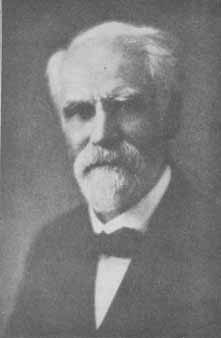
HON. J. Q. EMERY
Page 257.
MR. FLOYD: What is saccharin, Doctor?
DR. REMSEN: I can explain that if you want a scientific lecture. I happen to be the discoverer of that substance. I could not explain it in a few words very well.
MR. FLOYD: Did you say you were the inventor of saccharin?
DR. REMSEN: No; I would not say I was the inventor. The substance was discovered in the laboratory under my direction in an investigation carried out way back, over 30 years ago. A young man was associated with me in the work, and his name is generally connected with "saccharin." That man is Mr. Fahlberg.
MR. FLOYD: Is it a patent?
DR. REMSEN: He patented it. I did not. Incidentally he made a good deal of money out of it. I did not.
MR. FLOYD: For what reason, if to your knowledge, was saccharin referred to your board for investigation?
DR. REMSEN: I have no idea why it was referred except the general idea that in every case it was desired to know whether the substance mentioned in the reference is or is not harmful That is the main point.
MR. FLOYD: When used in food?
DR. REMSEN: When used in food; yes.
MR. FLOYD: Is saccharin a food within itself or is it a preservative used in foods? I do not want you to go into a long scientific explanation, of course.
DR. REMSEN: It is not a food; it is to a slight extent a preservative. But the purpose for which it is used is as a sweetening agent. It is about 500 times sweeter than ordinary sugar and can be made at a rate which renders sweetness per unit very much cheaper than ordinary sugar.
MR. MAYS: Is it harmful?
DR. REMSEN: That was the question.
MR. MAYS: And have you decided it?
DR. REMSEN: Yes; we have made our report.
MR. FLOYD: Their opinion is printed in the record.
DR. REMSEN: I may say also that it is used as a medicine in diabetes. I believe it is very useful in that disease, as diabetic patients cannot take sugar, but can take saccharin and thrive under it.
MR. FLOYD: Do you know whether any members of the board selected by you previous to their appointment had taken any special interest in or expressed any opinion of chemical preservatives of food?
DR. REMSEN: I can not answer that question fully, but I can give an answer to the best of my knowledge. They had all been interested in the general problem of the use of preservatives. Two of them--possibly only one; I know Dr. Chittenden was interested in the effect of saltpeter on meat and was engaged in an investigation on that subject until quite recently. He also, I believe, although I am not sure about that--I have seen this in the newspapers and have not followed it in detail otherwise--was interested at one time in the investigation of the effects of borax* or boracic acid as a preservative. I think Dr. Long was on that same committee that investigated saltpeter. I am not sure.
*Dr. Chittenden appeared before a legislative committee and declared borax a harmless preservative.
MR. FLOYD: Did you attend the convention of State and National dairy and food departments at Denver, in 1909?
DR. REMSEN: Yes, sir; on the way back from California I stopped there.
Page 262-263.
MR. FLOYD: Did you attend on your own volition, or were you directed by the department to attend?
DR. REMSEN: I was not directed; I was requested.
MR. FLOYD: You were requested to attend?
DR. REMSEN: Yes.
MR. FLOYD: How long did you remain at Denver during that convention?
DR. REMSEN: Two or three days; I am not sure just exactly how long.
MR. FLOYD: What was the purpose of that convention, and what were the questions discussed there? Did they relate to pure foods?
DR. REMSEN: Well, I do not know much about the association. I do know that I was asked by the president of the association to give an address on the subject of the work of the referee board, I think, or, at least it had reference to the benzoate question, and after finding I could stop there conveniently on the way from California and that the other members of the board could do the same, I accepted the invitation. The association discussed all sorts of questions pertaining to things of which I have no knowledge, but I do know that they took up this benzoate question in rather an active way, and I suppose it was felt by the Secretary that it was desirable to have some one there to explain what it all meant. They seemed to be going on the wrong track, so far as we could gather. They got some wrong impressions of the thing and the nature of the work, or what we were appointed for, or what we were doing, and it did seem wise not to let them go too far that way without some explanation from us, which we gave in a dignifled way, I think I can safely say.
MR. FLOYD: And the expenses of yourself and the other members of the board for this trip to California and this trip to the convention in Denver were paid by the department?
DR. REMSEN: Yes. Of course, the trip to the convention amounted to very little. That was simply stopping over.
MR. FLOYD: You state that you addressed the convention yourself. Did any of the other members of the board address the convention, and if so, who?
DR. REMSEN: Dr. Chittenden, Dr. Long and Dr. Herter all addressed the convention, at the request of the president of the association, Mr. Emery.
MR. FLOYD: I will ask you to state if in the address you made before the convention on the question of benzoate of soda you made a defense of the use of benzoate of soda?
DR. REMSEN: No, sir.
MR. FLOYD: You just discussed the findings?
DR.. REMSEN: I discussed the general method of procedure which we had followed. I have nothing to do with the use of benzoate of soda. We were not asked to decide whether it was,a good thing to use or not, and we have never expressed ourselves upon that point.
THE CHAIRMAN: Your expenses at Denver were also paid by the Department of Agriculture?
DR. REMSEN: We went, as I said yesterday, to California for an important purpose, looking into the sulphuring process, and on our way back we stopped there. We did make a little effort to time our trip back so that we could attend the meeting, because we had been asked to give addresses. We were asked by the president of the association. We stayed there possibly three days. I am not sure whether it was two or three, but not more than three. The slight expense of the board during that period in the way of traveling expenses was paid by the--
THE CHAIRMAN (interposing): You gave an address there?
DR. REMSEN: Yes.
THE CHAIRMAN: And the purpose of that address was to explain and defend the report you had made to the Secretary of Agriculture?
DR. REMSEN: I did not defend the work. I didn't think that was my business. The report had been made. But I did do this: I explained, somewhat as I have explained to this committee, how the board came into existence, and very little else. I don't think that the address was ever published. Then, I may say, that after that the work of the board was attacked very violently by Dr. Reed, of Cincinnati, which was most astonishing to me. After that attack I felt it my duty to respond, which I did in measured manner, and I didn't say anything I would not repeat. I will add that to what I said yesterday, because I made really two addresses there. The other members of the board I think did not answer the attack. I think they were satisfied with my answer.
THE CHAIRMAN: In making either one of those addresses did you go beyond the official work of your board and defend the use of benzoate of soda as a preservative of food?
DR. REMSEN: No, Sir.
Dr. Reed's address was solely in the interest of public health. The criticism he made of the Remsen Board was for its open support of adding benzoate of soda and saccharin to foods. If it was "violent" it was because of Dr. Reed's indignation that a law passed, as the Supreme Court has said, for the protection of public health, was so flagrantly flouted by the Remsen Board in the two cases then decided, namely, benzoate of soda and saccharin.
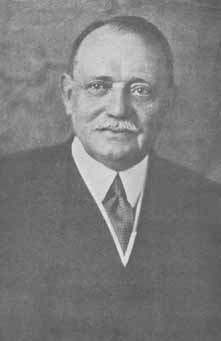
DR.
C. A. L. REED
Who led the fight against the Remsen Board at the Denver Convention
Page 292-293.
MR. HIGGINS: Did you desire to make any other statement that has not been covered by the questions that have been asked?
DR. REMSEN: There is just one point that I should like to refer to, that has not been brought out in the examination. This board has been aware for some time that there is some influence at work to undermine it and discredit it. We do not pretend to know and have not discovered what the source of that influence is; but it is perfectly clear that that influence is at work.
MR. HIGGIN: How does it manifest itself?
DR. REMSEN: Newspaper articles. So far as I know the newspapers almost without exception are opposed to the Remsen Board. Why, I am sure I don't know. The Remsen Board is an innocent board and does not quite like to be considered guilty before it has been tried, at all events. I have noticed that within the last month nearly every reference to the Remsen Board that has appeared in the papers has put the board in a bad light, and anybody reading those articles day after day would get the impression that Remsen and his whole tribe ought to disappear from the face of the earth. Sometimes friends of mine come up to me with long faces and say, "Remsen, it is too bad about this matter." I say, "What's the matter?" They say, "Haven't you seen that article about your board?" I say, "Oh, no, and don't show it to me; I have seen enough." Now, those articles would not appear day after day, at least I can not imagine they would appear, without there being some influence at work to inspire them. I merely make this statement to show my state of mind. I am getting, as I have confessed, somewhat thicker skinned, and I rather rejoice that I have been through this experience because I think on the whole a thick skin is worth something.
The attack upon the Remsen Board by the public press was nation-wide. The only people who were pleased with it, aside from the high officials of the Government, were the adulterators and misbranders of our foods. At the hotel in Denver I saw a most remarkable phenomenon. There was gathered at Danver a strong lobby of the supporters of the Remsen Board. At the head of this lobby, which apparently numbered 100 at least, was Warwick M. Hough, chief attorney for the rectifiers. There seemed to be little enthusiasm among the people of Denver for the Secretary of Agriculture, his solicitor, and the members of the Remsen Board. There was, however, tremendous enthusiasm of the lobby above referred to for all of these individuals. After adjournment of the afternoon session I saw this lobby gathered around the members. of the Remsen Board and Warwick M. Hough's arm was lovingly encircling the shoulders of Dr. Ira M. Remsen, eminent chemist and president of Johns Hopkins University, and according to his own statement, discoverer of saccharin. Although each member of the Remsen Board was personally known to me except Dr. Alonzo Taylor and Dr. C. A. Herter, not one of them spoke to me during the three or four days they were in Denver except Dr. Herter. He came up and introduced himself to me and attempted to make some apology for his part in the activities of the Remsen Board. He realized very keenly the condition they were in, in espousing the cause of adulteration, becoming the paid agents of the adulterators, and incurring the universal condemnation of the press and the people of the country. Dr. Herter was then a very sick man. In a few months from that date he died. I have often wondered with what misgivings he approached his end and what feelings the other members of the Board must have had when they realized the universal condemnation which was heaped upon them. I doubt if any reference is ever made in the biographies of these men, as they pass away one by one and their deeds while living are recorded, to the service they rendered their country as members of this Board.
Page 293-294.
THE CHAIRMAN: Might not the fact that you gave certain testimony and the fact that you appeared at the Denver convention making speeches there be at the bottom of some of this influence that you are speaking about as being inimical to the Remsen Board?
DR. REMSEN: I am sure I don't know, but I can say that it was found that the influence, whatever it was, was at work long before the Denver meeting.
THE CHAIRMAN: When the Remsen Board was appointed of course no one expected that it was going to do anything more than give advice to the Secretary of Agriculture in his official duties, and yet, according to your testimony, the Department of Agriculture has suggested to different members to appear in court and give testimony, has paid their expenses at that trial, when the effect would be to affect the decision of the courts in the State of Indiana.
DR. REMSEN: Well, it might affect the decision of the court in so far as it would enable them better to get at the truth, which I suppose was the object of the court.
THE CHAIRMAN: That may be the object of the court, but it surely was not the object of the creation of this referee board, was it?
DR. REMSEN: Of course the referee board was never defined exactly--exactly what it should do.
THE CHAIRMAN: Well, let us define it. Do you understand it now to be part of the purpose of the referee board to in fluence the decisions of the courts of this country?
DR. REMSEN: Why, no; in no sense, except--
MR. HIGGINS: Except so far as the truth is concerned?
DR. REMSEN: Except so far as the truth is concerned by telling the facts, and if I am asked to do so I should do so, so far as it would influence the action of the court I should think it would be proper for the board to do so.
THE CHAIRMAN: However, I believe you admit that your official report is not evidence?
DR. REMSEN: Yes, sir.
THE CHAIRMAN: And it is voluntary with you whether you should appear and give this testimony?
DR. REMSEN: I think I could have been subpoenaed. I am not sure.
THE CHAIRMAN: And you referred the matter to your superior and it was upon his advice that you gave this testimony?
DR. REMSEN: Yes.
THE CHAIRMAN: That is the point I wanted to get at, and that you advised Dr. Chittenden also to give his testimony?
DR. REMSEN: Yes; I did the second time.
THE CHAIRMAN: Yes; and that Dr. Chittenden's expenew were paid by the Department of Agriculture?
DR. REMSEN: I believe so. I am not entirely clear about that.
MR. HIGGINS: And the Indiana courts had the benefit of the decision which your board had reached as the result of its scientific investigations as to the effect of benzoate of soda?
DR. REMSEN: That was the effect of our appearance, that is all. We did not argue the case, of course.
Page 858.
To Secretary Wilson:
THE CHAIRMAN: You are speaking there about the Board of Food and Drug Inspection; you are referring to some advice to be given to Dr. Taylor about some testimony to be given at Indianapolis, Ind., and you state there: "I shall consult with our people on the Board of Food and Drug Inspection (that is, Dunlap and McCabe)." What meaning do you attach to that language--if you dare to attach any?
SECRETARY WILSON: There is no hesitation in my mind in telling you all that was in my mind there.
THE CHARMAN: I recognize the fact that you need not answer unless you wish.
SECRETARY WILSON: Oh, I am going to answer it, My answer is this: You are pretty well aware that there was friction between those men, there. You have got that pretty much every bit in your testimony. It would have been an insult to Dr. Wiley to have consulted him in regard to anything concerning benzoate of soda.
THE CHAIRMAN: Why?
SECRETARY WILSON: Because he despised it, and everything connected with it, and believed that a big mistake had been made, and a big mistake had been made by ever getting the Referee Board; that is why. I do not gratuitously offer insults to any of my people.
INVESTIGATIONS OF THE BUREAU OF CHEMISTRY
REFUSED PUBLICATION BY SECRETARY WILSON
Page 868-869.
THE CHAIRMAN: I understand also, Mr. Secretary, that you have referred the report of the Bureau of Chemistry on the copper question to the Referee Board without publication?
SECRETARY WILSON: Oh, yes; I remember now. I had two bureaus considering the sulphate of copper, and there was a man in the Plant Industry named Woods who had done a most remarkable lot of work with sulphate of copper. He found by taking a little bag of sulphate of copper and going into a large reservoir that had green scum over it, if he would sail around for an hour and drag that bag after him he would kill every single particle of that green scum there; and he went to a number of States in the country, and he went to Panama and cleaned up every one of the reservoirs they had. He and the doctor did not come within gunshot of agreeing on sulphate of copper. In a case of that kind, Mr. Chairman, one must go slow when they have two scientists in two different lines and they do not quite agree. It is not best to bring any arbitrary rulings in there, but wait and see if we can not get more light.
THE CHAIRMAN: It is a matter of fact, however, the Bureau of Chemistry did make a report upon copper, and it has not been published?
SECRETARY WILSON: Yes; and that is the reason, Mr. Chairman; that is the reason.
THE CHAIRMAN: Mr. Secretary, will you be willing to have prepared and inserted in the record at this point a complete list of the investigations of the Bureau of Chemistry which you have refused or have failed for any reason to have published?
SECRETARY WILSON: I could do that; yes; I could do that.
(Manuscripts relating to subjects involved in the enforcement of the food and drugs act, approved June 30, 1906, submitted for publication by the Bureau of Chemistry, but not published:)
Corn Sirup as a Synonym for Glucose. Submitted as Food Inspection Decision 83, November, 1907.
Investigations of a Substitute (weak brine) for Sulphur Dioxide in Drying Fruits, by W. D. Bigelow.
Sanitary Conditions of Canneries, Based on the Results of Inspection. By A. W. Bitting, February, 1908.
Influence of Food Preservatives and Artificial Colors on Digestion and Health:
VI. Sulphate of Copper. By H. W. Wiley and others, April, 1908.
VII. Potassium Nitrate. By H. W. Wiley and others. April, 1908.
The Bleaching of Flour. By H. W. Wiley, February, 1909.
Influence of Food Preservatives and Artificial Colors on Digestion and Health:
IV. Benzoic Acid and Benzoates. By H. W. Wiley and others. Submitted for reprint, June, 1909.
Medicated Soft Drinks. By L. F. Kebler and others. July, 1909.
Drug Legislation in the United States:
II. Indexed Digest of Drug Legislation. By C. H. Greathouse. October, 1909.
Food Legislation During the Year Ended June 30, 1909. January, 1910.
Estimation of Glycerin in Meat Preparations. By C. R Cook. March, 1910.
Technical Drug Studies. By L. F. Kebler and others. April, 1910.
Experiments on the Spoilage of Tomato Ketchup. By A. W. Bitting. January, 1911.
The Influence of Environment on the Sugar Content of Cantaloupes. By M. N. Straughn and C. G. Church. May, 1911.
A Bacteriological Study of Eggs in the Shell and of Frozen and Desiccated Eggs. By G. W. Stiles. May, 1911.
The Arsenic Content of Shellac. June, 1911.
THE CHAIRMAN: Is it the policy of the Department of Agriture, Mr. Secretary, to suppress or refuse publication of the reports which the Bureau of Chemistry may make to you on any questions which are referred to the Referee Board, until, after the board has made its final report?
SECRETARY WILSON: I may have done that. I think probably there is justification for having anything which treats with benzoate of soda handled in that way. I believe that is the question, is it? Benzoate of soda is a question that was referred to the Referee Board. I think I would not favor printing anything in the department until we heard from them.
THE CHAIRMAN: As a matter of fact, whether the findings of the Referee Board govern your action, or whether the findings of the Bureau of Chemistry govern your action, is a question which you yourself decide within your own diseretion, is it not?
SECRETARY WILSON: Surely. You have to have a secretary there who must decide.
THE CHAIRMAN: In other words, the decisions of the Referee Board have no value whatever until approved by you? I am speaking now legally, and as to its influence upon the administration of the pure food law.
Page 865-866.
THE CHAIRMAN: It is true, is it not, Mr. Secretary, that money which you allot to the Referee Board is drawn from money appropriated for the Bureau of Chemistry, and that this allotment is anticipated in the estimates which you make?
SECRETARY WILSON: Yes; anticipated and understood by the Committee on Agriculture when they appropriate the money.
THE CHAIRMAN: And for that reason you do not consult with the chief of bureau in regard to making that particular allotment? Is that true?
SECRETARY WILSON: The chiefs of the bureaus are always consulted. Dr. Wiley, the chief of that bureau, is a little touchy on anything of that kind, and one has to bethink himself quite often about getting along smoothly in this world, you know.
THE CHAIRMAN: Has Dr. Wiley ever recommended that any money be allotted to the Referee Board from the appropriation under his department?
SECRETARY WILSON: I think I would not want to hurt his feelings by ever mentioning it at all.
We had a referee board, and I think a pretty expensive referee board, you will confess. We had gone after big men, and it was costing a good deal of money, and those people met there at Mackinac Island and got themselves outside of sympathy with the department along those lines, attacked me personally, misrepresented things, and I thought the amount of effort the United States was making and the amount of money it was expending to get facts from the greatest chemists in the land made it worthwhile for us to get those big men there before that class of men and let them see them and let them hear them. I did not think they comprehended the difference there was between a small chemist and a big one. That was the one thing in my mind. They were in California studying the drying of foods with sulphur, and the arrangement was that they should stop over at Denver on the way back. I was going to the forests, and I arranged and it was my plan to stop there on my way to the forests. I went into the forests from Denver and stayed a month. Those were the plans. There is nothing I care to conceal here, noththing. Those were the plans and we talked them over, and everyone of them addressed that convention, everyone of them, and I think those people got new light from those men.
THE CHAIRMAN: I wish to refer to you page 338 of the hearings of August 3, to correspondence between yourself and Dr. Remsen. Dr. Remsen says, in this letter: "It is clear from the newspaper reports that there is 'pernicious activity' somewhere." In your reply you say: "The pernicious activity you speak of is quite evident." Will you kindly tell the committee what you referred to as "pernicious activity"?
SECRETARY WILSON: Yes. The activity of people attacking that Remsen Board. That is just what it was.
THE CHAIRMAN: It was correspondence between you and the chairman of the board. Of course, if this "pernicious activity" is without the Department of Agriculture it would not be proper for us to go into it. But if it is within the Department of Agriculture, it would seem to me proper for us to know what you referred to as "pernicious activity."
SECRETARY WILSON: If you have been watching the public press you have discovered that there has been a good deal of criticism. If you have been watching the proceedings of Congress you will no doubt have seen there has been a desperate effort made there for the purpose of destroying the Remsen Board, and things of that kind. That is what I had reference to.
THE CHAIRMAN: In your letter of April 19, 1909, you say further: "Things will come to a head before a great while, I think, along this line." Would you care to explain what that means?
SECRETARY WILSON: I thought the work of that board, as it was being done and reported, would settle all those questions.
THE CHAIRMAN: Do you consider, or did you consider at the time, that the attendance of members of the Remsen Board and Solicitor McCabe at this Denver convention, which we were speaking about heretofore, was in line with their official duties?
SECRETARY WILSON: Yes; it was a kind of public trial we were having, really, of the Remsen Board.
THE CHAIRMAN: Their attendance being in the line of their official duty, will you explain why you issued to each one of them a special authorization for traveling expenses to attend this particular convention, when each one of them had an annual authorization for travel anywhere in the United States upon official business?
SECRETARY WILSON: If you have evidence of that special authorization, you had better call my attention to it.
THE CHAIRMAN: Very well, I will be glad to do that.
(Reads letter from Secretary Wilson to Dr. Remsen, dated August 6, 1909, wherein it is stated that authorization No. 1163 is amended so as to permit Dr. Remsen and his assistants to attend the Denver convention.)
SECRETARY WILSON: I guess that is correct. What do you want to know about it?
THE CHAIRMAN: I want to know, if this attendance was in line with their official duties, as stated here, why it was necessary they should have special authorization when they had a regular authorization?
SECRETARY WILSON: I 'Presume they had some doubts about stopping off at Denver being in their original authorization. If they had, then I gave them all the authorization they would need.
THE CHAIRMAN: If there were any doubt it would be doubt as to whether or not that came within their official duties?
SECRETARY WILSON: Precisely.
THE CHAIRMAN: Do you hold that you have executive authority to add to the official duties of the Remsen Board other than that prescribed in the order creating them?
SECRETARY WILSON: To this extent, yes.
THE CHAIRMAN: To that extent you have?
SECRETARY WILSON: Yes.
One of the most detestable features of the persecution of those delegates to the Denver Convention of 1909 who opposed the decision of the Remsen Board was the dismissal of Floyd Robison. This action was investigated by the Moss Committee. Mr. Robison was one of a group of state chemists who were occasionally requested to cooperate with the officials of the Bureau of Chemistry in enforcing the Food Law. (Pages 522-524.)
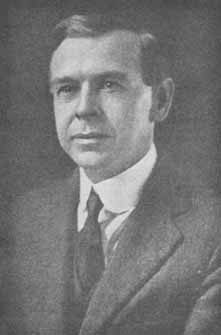
MR. FLOYD ROBISON
MR. Moss: Were there any charges filed against you?
DR. ROBISON: None.
MR. Moss: Have you the letter of dismissal with you?
DR. ROBISON: I have.
MR. Moss: Please read it to the committee.
(I will quote only last line of this letter.)
DR. ROBISON (reading): "He is removed from the department for the good of the service. James Wilson, Secretary of Agriculture."
Dr. Robison appealed to the Secretary of Agriculture for reasons which led to such drastic action. The Secretary, in his reply, under date of July 25, 1911, says:
"* * * At the meeting of the Association of State and National Food and Dairy Departments at Denver, in July, 1909, you attracted attention by taking a strong and public position against the policies of the department and of the administration. You appeared in the Federal court in Indianapolis in opposition to the policies of the administration with regard to the reports of the Referee Board on benzoate of soda and the report of the three secretaries with regard to it. * * * I have approved your dismissal for the good of the service. There are no charges against you; we make none. I recognize the fact that you have a perfect right to occupy any position you see fit. with regard to the policies of the administration or of the department, but I do not think you should draw salary while you are taking this stand."
Question by MR. MOSS: Were you a delegate to the Denver convention?
DR. ROBISON: I was.
MR. MOSS: Whom did you represent?
DR. ROBISON: The State of Michigan.
MR. MOSS: Who paid your expenses for attending that convention?
DR. ROBISON: The State of Michigan.
MR. MOSS: Were you drawing any salary from the Government at that time?
DR. ROBISON: I was not.
MR. MOSS: Did you draw any money, either directly or in. directly, from the National Government for your attendance at the convention or for your expenses?
DR. ROBISON: I did not.
MR. MOSS: What position did you hold at the Denver convention?
DR. ROBISON: I held the position of chairman of the committee of eleven State food chemists appointed by the president of the Association of State and National Food and Dairy Departments.
MR. MOSS: Did you make any report?
DR. ROBISON: As chairman of the committee, I did.
MR. MOSS: Will you read into the record that report?
DR. ROBISON: I will read the final recommendation:
"'Your committee therefore respectfully suggests to this association the wisdom of asking the President of the United States and the honorable Secretary of Agriculture to institute investigations along some such broader lines as indicated above."
MR. MOSS: Did you make any address to the Denver convention in which you referred to the Remsen Board one way or the other?
DR. ROBISON: I did not.
MR. MOSS: Did you receive any information from Secretary Wilson or any person representing him as to the policy of the Department of Agriculture?
DR. ROBISON: I received none.
MR. MOSS: Did you make any address to the convention advocating or opposing the use of benzoate of soda?
DR. ROBISON: I did not.
MR. MOSS: In your capacity as delegate did you cast a vote for president of that association?
DR. ROBISON: I did. I voted for Mr. Bird, the commissioner of the State of Michigan.
MR. MOSS: Did Mr. Bird receive the support of the Department of Agriculture?
DR. ROBISON: He did not.
MR. MOSS: So far as you know, then, did you appear in opposition to the Department of Agriculture in any other manner except casting your personal vote for the president of the association?
DR. ROBISON: I did not.
MR. MOSS: At whose request did you appear at Indianapolis to give testimony at that trial?
DR. ROBISON: At the request of the Board of Health of the State of Indiana.
MR. MOSS: Were you paid any fee?
DR. ROBISON: I received no fee.
MR. MOSS: In your testimony, did you give your original work as a chemist?
DR. ROBISON: I testified according to the truth as, I understood it to be and had found it from my own investigations, and according to my oath, and without any regard in any capacity to any other policy.
MR. MOSS: Were you warned in any way by the Department of Agriculture not to do this?
DR. ROBISON: I was not.
EXTRACTS FROM THE
DENVER PRESS, AUGUST 25-28, 1909
WILSON'S HOT REPLY
Replying to President Emery, Secretary Wilson said:
"I came out here to listen, and I glean from the address of your president that the Department of Agriculture, which I thought had been doing much, has been doing nothing. Now let me tell you some of the things that it has done within the last year.or so."
The Secretary then enumerated some of the achievements of the department.
"Now with regard to a few preservatives, there is, a difference of opinion among the chemists of the world. One of these questions is benzoate of soda.
"The manufacturers of the United States went to the President when the use of this was prohibited and asked for fair play. Finally he concluded to ask the presidents of the great universities to appoint some men to conduct an investigation who were competent to do the work. Under his authority I appointed five such gentlemen, who, I believe, are the best chemists in the United States, if not in the whole world.
"President Emery has attacked their report. Now I have but one request. You have arranged a place upon your program to have the Referee Board here on Thursday to be heard. All I ask is that the hearing be a full and fair one."
With representatives of interests aggregating more than $500,000,000 present to enter protest against a tentative "model" food law bill, which will probably be presented to the pure food convention for endorsement, the committee which drafted.the bill met last night at the Brown and gave the manufacturers' side a hearing.
(The Daily News, Denver, Colo., Aug. 25, 1909.)
The morning session was quite as pungent, although in another way. The convention was called to order at 10 o'clock and Gov. John F. Shafroth made an address of welcome. He complimented both Secretary Wilson and Dr. H. W. Wiley, Chief of the Bureau of Chemistry at Washington, upon the work they have done for the country. He termed Secretary Wilson "the greatest Secretary of Agriculture the country has ever known," and the remark was greeted with enthusiastic cheers. He favored a uniformity in the state and national food laws and finished with an eulogy of Colorado's growth and development.
PRESIDENT EMERY:
"We held that if the National Government should indorse benzoic acid it would thus license one of the preservatives which encourages the same conditions in fruit and vegetable manufacture as were abolished in the meat-packing establishments by the national meat inspection law.
In view of this position we appealed to President Roosevelt in the latter part of his term to appoint another committee to investigate the findings of the Remsen Board. This request was referred by President Roosevelt to Secretary of Agriculture Wilson, who reported back to the President against granting that request.
Secretary Wilson's remarks were greeted with cheers, yet before he had stepped from the platform President Emery angrily said: "This Referee Board was asked to come to this convention by the executive committee, and the insinuation that it is not to be given fair play comes with poor grace. The report went to the Secretary of Agriculture and he sent it back without comment. We took it that it did not meet his approval.
Secretary Wilson asked a moment to answer, and said dryly:
"You gentlemen up Mackinac way took it upon yourselves to condemn us down at Washington unheard, and so we figured you were not the material from which judges of the Supreme Court can be made."
R. W. Dunlap, of Ohio, is the only commissioner in the United States who is elected by the people instead of being, appointed. Commissioner Dunlap was elected by 12,000 majority, and is one of the most popular officials in Ohio.
(From Denver Republican, Aug. 25, 1909.)
After apparently having been whipped upon every question brought up during the pure food convention until there was no further fight left in them, the opposers of Secretary of Agriculture James Wilson's policies developed a remarkable strength in the battle for the electiort of the association's officers and put up one of the hottest contests ever seen during a convention meeting in this city. George L. Flanders, of New York, was elected president. New Orleans was chosen as the next place of meeting.
The thirteenth annual convention of the National Association of State Food and Dairy Departments developed at its termination yesterday afternoon into a political struggle for the officers for next year, in which the Wilson, or administration, crowd won the presidency by three votes and lost all but one of the other officers. Had not Secretary Wilson been in Denver on the spot the administration would have been badly defeated not only on the election of the president but on many other questions as well. It was his political power and prestige as a member of the President's Cabinet and his experience in political campaigns that won the support of the convention for the administration. He seconded the nomination of Flanders. Supporters of President J. Q. Emery and Dr. Charles Reed, of Cincinnati, the opponents of benzoate of soda and of the administration, were quite free to call Secretary Wilson's crowd apolitical "ring" and a "clique." Certainlyitwas largely by a political trick that. the election of George L. Flanders, of New York, was secured and the defeat of A. C. Bird, of Michigan, was encompassed. George P. McCabe, Solicitor of the Department of Agriculture, and director of the battle for Secretary Wilson, was very busy just before the vote was taken and the votes upon the other officers looked as if he had made some advantageous trades for Flanders. This did not prevent Mr. McCabe's defeat for the office of executive committeeman, A. N. Cook, of South Dakota, winning against him.
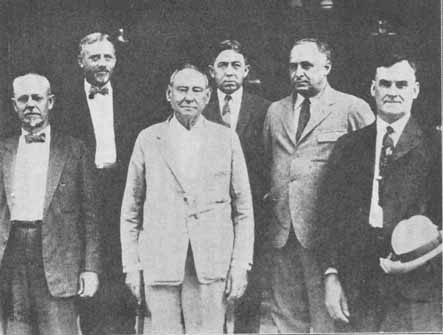
GROUP AT SECOND DENVER CONVENTION IN 1925
Left to right: Dr. W. D. Bigelow, my first assistant in the Bureau of Chemistry;
Dr. Harry E. Barnard, formerly Food Commissioner of Indiana; Dr. Harvey W.
Wiley, former Chief of the Bureau of Chemistry; Mr. I. L. Miller, present Food
Commissioner of Indiana; Dr. Robert M. Allen, former Food Commissioner of Ken.
tucky; Mr. W. C. Geagley, Sec.-Treas. Association of Dairy, Food and Drug
Officials of the United States
Field Marshal McCabe became busy in his travels about the convention room, and when the vote was finally taken it was 57 to 54 in favor of Flanders, or the Wilson administration had only one state the best of the argument. The fact that the Secretary took the floor to second Flanders' nomination personally operated greatly for the latter's benefit, it is said.
When the vote was taken on the other officers the Wilson slate was broken so badly that the pieces could not be found.
(Denver Republican, Aug. 28, 1909.)
After one of the stormiest sessions any convention of any kind ever had in Colorado, in which a great national organization at times took the aspect of a bitter political ward meeting, and in which politics was played every moment of the time, Dr. George L. Flanders, of New York, Secretary Wilson's candidate, yesterday was elected president of the Association of State and National Food and Dairy Departments, adding another point to the Secretary's sweeping victory in the benzoate of soda battle.
A.
C. BIRD
State Dairy and Food Commissioner of Michigan
The Secretary of Agriculture led the fray in person. Flanders defeated A. C. Bird, State Dairy and Food Commissioner of Michigan, Wiley's candidate, by a vote of 57 to 54. Thirty-six states voted, each state having three votes. The vote by states was: Flanders 18, Bird 18, but the Department of Agriculture had three votes, and these three votes went to Flanders.
The votes by states on the presidency was as follows: Flanders--Arizona, California, Colorado, District of Columbia, Georgia, Idaho, Illinois, Iowa, Louisiana, Massachusetts, Missouri, Nebraska, Nevada, New York, Oklahoma, Department of Agriculture, Utah, Washington and Wyoming, three votes each, total 19; total votes, 57.
Bird--Connecticut, Florida, Indiana, Kansas, Kentucky, Maine, Michigan, Minnesota, New Jersey, North Carolina, North Dakota, Ohio, South Dakota, Pennsylvania, Tennessee, Texas, Virginia, Wisconsin, total 18; total votes, 54.
(The Daily News, Denver, Colo., Aug. 28, 1909.)
J. S. ABBOTT
Food Commissioner of Texas, in attendance at Denver Convention
Thus ended that most turbulent exhibition of disreputable politics ever witnessed in a so-called scientific convention in any country. It was the vote of the Department of Agriculture that elected Mr. Flanders. The Bureau of Chemistry took no part in this discreditable affair. The Health Office of the District of Columbia through Dr. Woodward cast its three votes in favor of the candidate of the food adulterators. The eminent members of the Referee Board must have been amazed at the character of their enthusiastic admirers. It was an astounding apotheosis of the Unholy.
The Attorney-General of the State of Indiana, Mr. James Bingham, desired to have testimony in favor of the State Board of Health from.the Chief of the Bureau of Chemistry and from other employees of the Bureau who had taken an active part in the investigations of benzoic acid and benzoate of soda. A suit had been filed against the State of Indiana in the Federal Court before Judge Anderson on the ground that the ban placed on benzoated foods by the State Board of Health was unconstitutional. Mr. Bingham came to Washington for the purpose of securing permission from the Secretary of Agriculture for these officials to appear before the Federal Court in Indianapolis. The Secretary refused to grant the request of Mr. Bingham on the ground that the Department of Agriculture was on the other side of the question and that it would not be in harmony with official etiquette for the employees of the Bureau of Chemistry to appear against the Remsen Board and their assistants and experts who were attending the trial in the interest of the complainant by the executive order and request of the Secretary of Agriculture. In order to secure this testimony Mr. Bingham found it necessary to remove the Federal Court from Indianapolis to Washington. When this was done the Solicitor of the Department of Agriculture on the request of the Chief of the Bureau made a ruling that the Federal Court had no right to issue a subpoena for attendance of the employees of the Bureau of Chemistry in the sense that they were compelled to attend and give testimony. He informed the members of the Bureau of Chemistry that it would not be a contempt of court if they should refuse to appear and give testimony on the summons unless they wanted to. I volunteered to give my testimony before the Federal Court. It begins on page 3,212 of the printed record and continues to page 3,548, inclusive, 336 pages. When Dr. W. D. Bigelow was called to the stand, after qualifying, in response to the first question asked him, he declined to answer on the ground that his testimony would be of a character not approved by the Department and he availed himself of the privilege given by the Solicitor of refusing to answer (Page 3,693 of the Record of the Indiana Case). Mr. Bingham immediately carried the case to Justice Barnard of the District Supreme Court. Justice Barnard promptly ruled that the employees of the Department of Agriculture were compelled to give their testimony if subpoenaed by the Federal Court and that the statement made by the Solicitor that they were not thus compelled to testify was an error. Under this ruling Dr. Bigelow and other employees of the Bureau gave their testimony. It would not be proper to go into any extended explanations of the nature of this testimony given contrary to the opinion of the Solicitor. A sufficient explanation of it is found in the fact that Judge Anderson of the Federal District Court of Indiana, to whom all the testimony in the case of over 5,000 pages was placed, with the summary by the master, promptly decided the case in favor of the State of Indiana. He said, in point of fact, that the State's rights in regard to the regulation of the sale of foods inside the State could not be questioned before the Federal Courts by citizens of other states.
This recital shows plainly that although the privilege was denied the Bureau of Chemistry of bringing suit against anyone using benzoic acid, the employees were compelled to testify before the Federal Court. The users of these preservatives lost their ease due largely to the testimony of the experts of the Bureau of Chemistry. Thus it appears as if the "big chemists"--as the Secretary of Agriculture called them--of the Remsen Board, when opposed by the "little chemists" of the Bureau of Chemistry, were defeated. This incident shows the danger of unwise greed. The right to use these preservatives was guaranteed to those manufacturers who felt like doing so by all the power and authority of the United States Department of Agriculture. They should have been satisfied with that perversion of the law, but they were not. They determined to force benzoated goods upon the citizens of the State of Indiana. Fortunately they did not succeed. More fortunate still is the fact that one of the complainants against the State of Indiana was converted by the evidence adduced at the trial and abandoned the use of these preservatives. Still more fortunate is the fact that manufacturers in general, although this dispensation has now been in full force and authority for twenty-two years, have rarely indulged in the use of these preservatives. The goods manufactured under the aegis of the Department of Agriculture with these preservatives are distinctly inferior in quality and strength.
The activities of the Remsen Board were not devoid of doubts as to their wisdom. In a letter dated September 9, 1909, Dr. Remsen called attention to what might happen (Page 879, Moss Committee):
My Dear Mr. Secretary: The Referee Board is going to be subjected to very severe criticism for testifying in the Indiana suit, and in order to protect ourselves it is our desire that we should have from you a written request that we should give this testimony. I hope you will have no objection to sending this request to me. We are to testify at Seal Harbor, Me., on the 17th. We are all glad to have been at Denver, and we all recognize the soundness of your judgment in asking us to go.
Mr. Moss asked the Secretary to explain why the Remsen Board whose usefulness in so large a measure must depend on the respect and confidence which the public have for the high character of its membership should be subjected to severe criticism in order to assist in an effort by private corporations to overthrow the pure food laws of a sovereign state. To which Secretary Wilson replied that it was never in his mind to help overthrow the pure-food laws of a sovereign state, and that he would have been perfectly willing to have the Referee Board go where the people seemed to need information; but as to an attack upon the State of Indiana, that was not to be thought of. The Chairman continued by asking him if he did not know that the suit filed by Curtice Brothers and Williams Brothers was inaugurated before the Referee Board had made its report on benzoate of soda; to which he replied that he did not know anything about the nature of these proceedings. The Chairman of the committee continued by asking him if he had been requested by Attorney-General Bingham to permit Dr. Wiley to go to Indianapolis and testify in person in the Indiana case on behalf of the State of Indiana; to which the Secretary responded that he did not think Dr. Wiley had ever asked him whether he could go to Indianapolis or not. Whereupon the chairman submitted a letter dated May 31, 1910, which the Hon. James Bingham had written the Secretary in regard to this matter. This letter is so pertinent that it is given in full:
Hon. James Wilson,
Secretary of Agriculture,
Washington, D. C.Dear Mr. Secretary: I am in receipt of a letter from President Taft with copy of your letter attached in re testimony of Dr. Wiley in the so-called benzoate case. I am taking the liberty of writing you personally for the reason that I feel quite sure that you misapprehend the position of the State in this matter. You understand that Dr. Long, of Chicago, and Dr. Taylor, of California, both members of the Referee Board, attended in person here at Indianapolis and testified in this case.
The master, who is hearing the evidence, is manifesting considerable interest in the testimony of the different witnesses and personally interrogates them, and it is my desire to give him this opportunity in the case of Dr. Wiley if possible.
There is no attempt on my part to make it appear that the Government is not supporting the work of the Referee Board. On the other hand, whatever appears in the record to indicate that the Government has taken sufficient interest to sustain the decision of the board is there at my instance, since I personally asked the witnesses who have testifled that they were testifying at your request, at whose request they were testifying in the case, and I did this after a personal interview with them, and learning the facts with reference thereto before asking the questions.
My position is that this question is one not capable of scientific demonstration, and this fact, I think, I have pretty thoroughly established by the testimony of the members of the Referee Board themselves. I think, however, that such a test was perfectly proper for whatever value it might have in the investigation of the injurious effects of sodium benzoate, but I feel very certain that the results of such an investigation are not conclusive. Indeed, I would not hesitate to try this question before you or any other fair man regardless of any conclusion you may have reached based upon the results of the work of the Referee Board.
1 attach more importance to an investigation made by Dr. Wiley than I do to that of the Referee Board, in view of his practical experience in such matters and especially in view of the experience of the corps of workers he must have had to assist him. In the case of the Referee Board work was carried on by students in many instances, and in the investigation I have made I am satisfied that many of the results obtained, upon which the Referee Board bases its opinion, are unreliable. That the members of the Referee Board were conscientious and thoroughly capable scientists there can be no doubt, but their conclusion, vased upon a false premise due to inaccuracy in analytical work and want of regularity in habits of living by subjects, would, in my opinion, destroy the value of any such conclusion.
In justice to you I can not go into detail, but the evidence in this case shows in some instances variations in duplicate analyses where the same articles were being analyzed under the same conditions, running from 15 per cent. to 1,800 per cent., when every member of the Board testifies that there should not be a variation to exceed 2 per cent.
I am very desirous of having Dr. Wiley appear in person in order that the master may personally interrogate him as to his premises most thoroughly, and I think you will readily appreciate the merit of my position. I assume that you have no interest in this question except to have it decided right, and in this case we are not only availing ourselves of the results obtained by the Referee Board and Dr. Wiley, but of a vast number of other experiments, and especially of-the results of practical demonstrations, and it occurs to me that when the evidence is concluded in this case the court will be in a better position to reach an intelligent conclusion as to what the real effect of benzoate of soda is upon the human system when administered in food than the department was with nothing to depend upon but the result of a scientific investigation standing alone.
Thanking you for your courtesy in offering to permit the deposition of Dr. Wiley to be taken, but hoping that you will see your way clear to permit him to attend in person, I remain,
Very truly yours,
(Signed) JAMES BINGHAM,
Attorney-General
This letter of Mr. Bingham evidently removed every reason to justify, even in the smallest degree, the determined purpose of the Secretary of Agriculture, with the collaboration of the Remson Board, to break down the Board of Health of Indiana which had placed its ban on food products containing benzoate of soda. Driven to the last extreme the Secretary sought to justify his action against the State of Indiana because the law of Indiana forbade the manufacture of beet sugar within the State! In answer to the question of the chairman of the committee he said it was his purpose to help every state to the limit of his efforts, but when a state came out and said one could not use beet sugar it gave him pause. He continued as follows:
We are making 500,000 tons of beet sugar every year in the United States. Indiana, can make all the sugar she needs and supply half a dozen other states. But I have come up square against this law, and I do not want to break the laws of Indiana; I would not for the world do that.
It appears that William Brothers and Curtice Brothers alleged, in their suit to abolish the ruling of the State Board of Health as being unconstitutional, that there were other points in the Indiana law which were likewise unconstitutional, and among these was an expression in the law delining sugar as "cane suagar." Of course every one knows that cane sugar is frequently used to designate sucrose. Indiana in her statement for defense against the suit of Curtice Brothers used the following statement:
These defendants, farther answering, say that they deny that the use of beet sugar is prohibited by law in food products in the State of Indiana, or by any rule adopted by these answering defendants, as such State Board of Health of the State of Indiana.
Dr. Alonzo E. Taylor, whose absence in Europe had prevented him from taking any active part in the investigations of benzoate of soda, was nevertheless very eager to appear against the State of Indiana in the benzoate trial. Under date of March 1, 1910, he made the following report to the Secretary of Agriculture:
"I have just been giving testimony in the Indiana sodium benzoate case. I understand it was inferred that because I did not sign the report of the Referee Board that I was not in agreement. I therefore testified, not as a member of the Board, but as an expert, pure and simple. Since last summer, being engaged on the sulphite question, I have been making a lot of control observations with the purpose of determining the normal variations in the metabolism of nitrogen, sulphur and phosphorus. These data, I believe the best in literature, I wish to use in my evidence, as they support strongly the position of our Board and are in contradiction with the work of Dr. Wiley on the action of benzoate. In a word, these investigations indicate that many of the reported deviations of Dr. Wiley are entirely within the range of those to be seen in normal persons on a normal diet, and show that the figures obtained by my colleagues are normal figures for normal men. Have I your permission to offer these normal charts of normal metabolism to the United States Circuit Court in the Indiana Case?".
To which the Secretary replied under date of March 12, 1910, in a letter to Dr. Remsen in the following words:
"I enclose a very interesting letter from Prof. A. E. Taylor which please return to me. I shall leave this matter entirely with you."
Dr. Remsen in his reply to the secretary recommended that he be given permission to use the data in the manner suggested. The Secretary left no stone unturned in his determined effort by all means, fair and foul, to secure a declaration from the Federal Court that the Indiana law was unconstitutional. (Pages 367, 368, Moss Report.)
The testimony of Dr. A. E. Taylor in the Indiana case is found on pages 2137, to 2207 of the printed testimony. He repeated in his testimony that he thought the data he had obtained were the best in literature. Dr. Taylor in his experiments, which were not made, by the way, on the subject of benzoic acid, employed a plan greatly superior to that followed by the other members of the Referee Board. He employed as his subjects trained scientific men. He took over bodily the whole force of the California State Board of Health. He employed state chemists who made all the examinations for fertilizers in the state. When asked on cross-examination in regard to control of the diet of these trained men he stated that their diet was rigidly weighed and apportioned to them. When attention was called to the fact that the other members of the Referee Board did not control either the quantity or the kind of diet, therefore the results which they obtained could not be comparable to his own, he replied that he thought his own plan was better but that the uncontrolled diet might lead to similar results. He was particularly opposed to the use of benzoate of soda in milk. On direct examination he was asked this question:
Q. What are the reasons for not using it in milk?
A. For the simple reason that a large amount of experience has taught us that the bad milk ought to be allowed to spoil and that an absolutely harmless preservative, or even refrigeration, or pasteurization ought to be equally prohibited. (Page 2162).
Speaking further (page 2163) in regard to milk, he says:
A very minute trace of formaldehyde will keep milk for 48 hours but the tubercular and typhoidal bacilli will not be killed, and it is objectionable on that account. We object to anything that keeps milk without killing those germs, not being of a type to affect the common defects of sourness or souring. That is the reason I guarded myself absolutely in the use of this other substance. I would object to the use of benzoate of soda, of hydrogen peroxide, of the pasteurization of milk, this being the result.
Evidently Dr. Taylor was not aware of the fact that pasteurization of milk at 145° for thirty minutes would destroy both typhoid and tubercular germs. The spores of germs require a much higher temperature for their destruction. By reading his testimony, the historian of the future will gather valuable information respecting the attitude of Dr. Taylor in general toward preservatives in foods and pasteurization.
Dr. Taylor also was particularly opposed to the use of benzoate of soda in meat as well as in milk. He cites the attitude of Hammerstein, the Scandinavian chemist and physiologist. He asked him:
Q. Do you use benzoate of soda?
A. No, sir.
Q. Is there any law against it?
A. No.
Q. Do you use salicylic acid?
A. Yes.
Q. why?
A. It is cheaper.
Q. Is it injurious?
A. Possibly it is, but it is so easy we take the chance.
FURTHER EXCERPTS FROM THE REPORT OF THE MOSS COMMITTEE AND THE RECORD OF THE INDIANA CASE
Page 878.
THE CHAIRMAN, MR. MOSS, of Indiana: Please tell me in what sense you regarded the Indiana case as an important one?
SECRETARY WILSON: Simply because it was in the. Federal court, and it was taking up the question of whether the decision of the Referee Board was to be sustained.
THE CHAIRMAN: That brings me to a question I want to ask you. At that time, what did you understand the issues of this suit at Indianapolis to be?
SECRETARY WILSON: I understood it was a question of whether--I do not know that I am entirely clear. I think it was an injunction asked by somebody.
THE CHAIRMAN: It was by Curtice Bros. and Williams Bros.?
SECRETARY WILSON: Yes; to require the board that you have there in Indiana to do something they wanted done.
THE CHAIRMAN: We have a board of health; yes, sir.
SECRETARY WILSON: That is my recollection. It was something of that kind. But there was benzoate of soda on one side and opposition to it on the other.
THE CHAIRMAN: Would you mind telling us where you obtained that information?
SECRETARY WILSON: Oh, I could not do that; I do not remember.
THE CHAIRMAN: I have the original complaint here, and your information was so badly apart from what the real issues were that I wanted to find out your source of information.
Page 882.
THE CHAIRMAN: You did request, both orally and in writing, the members of the Referee Board to attend the Indianapolis hearing?
SECRETARY WILSON: They are on a little different basis.
THE CHAIRMAN: As the Indiana law expressly permits the sale of food products which are guaranteed under the provisions of the pure food law, how can the defense of this suit by the State or any of its agents be considered as an attack on the decision of the Referee Board?
SECRETARY WILSON: That is an academic question, I think, Mr. Chairman.
THE CHAIRMAN: You have stated that Dr. Robison in appearing to testify there was opposing your policy?
SECRETARY WILSON: He was a subordinate of the department.
THE CHAIRMAN: The question is that inasmuch as the Indiana law expressly permits the sale in Indiana of any food product guaranteed under the pure food law of your department, when you guarantee it, how can a defense against a suit to strike down that law be considered an attack upon the Referee Board?
(There is no apparent answer to this question, save the following.)
Page 883.
SECRETARY WILSON: I would not be known to do a discourtesy to the State of Indiana for the world, and besides, Mr. Chairman, I find in looking over my behavior toward Indiana that I have a great lot of scientists there, and it might be wise for me to get them back out of there. I have men from nearly all our scientific bureaus there, helping the State of Indiana along these scientific lines, and cooperating with them.
Pages 31-33-Indiana Record.
Q. Well, there was a meeting, wasn't there, of chemists, Doctor, recently, out at Denver, Colo., where a great number of scientific men congregated, wasn't there?
A. There was no doubt about it.
Q. And you had an election out there at which benzoate of soda was the candidate, didn't you?
A. I don't know. I had nothing to do with the election. I wasn't a member of the association. I was present as an interested spectator, but not a member of the association, had no vote.
Q. Now the fact is that of late there has been great interest manifested on both sides of this question by scientific men throughout the country, hasn't there, Doctor?
A. Apparently. I am out of that. I am not at all a part of the excitement.
Q. And were you present when the vote was finally taken at Denver on the question?
A. Which vote do you mean?
Q. On the harmfulness of benzoate of soda, the adoption of the resolution--not vote, but resolution.
A. I was present, yes, sir, the resolution approving the action of the board, the report of the board. They approved.
Q. By what vote?
A. That is too much for me--57 to 42, maybe, I don't remember exactly what it was; in the fifties for one and forties for the other; fifty-odd in favor and forty-odd against; I couldn't remember that, I am sure; I am near the truth.
Q. Now in the talks that you had with the Secretary of Agriculture, did you learn that the plaintiffs, Curtice and Williams, here, were interested in this question?
A. I do not remember that I ever heard them mentioned by the Secretary of Agriculture.
Q. When did you first learn that the plaintiffs were interested in this question, Doctor?
A. In this--you mean in this particular suit?
Q. No, in this question as to whether benzoate of soda was harmful.
A. Oh, I remember. I remember it was at a meeting, a hearing we gave, our Referee Board gave in New York before we began our investigation. We sent word to those who were interested in the general problem, not only those who use benzoate but those who do not use benzoate, informing them that we would like to get such information as possible to aid us in our work. And they were represented by a number of large manufacturing interests who appeared before us to state their problems; mind you, they were not those who use benzoate alone but those who do not use it. We felt that it was only fair to hear what they had to say, representatives of both sides--I regret that there are sides--there are sides, unquestionably, I recognize it. And my recollection is that this is the first that I ever heard of these firms, except so far as I had become familiar with them through labels that everybody has seen.
Q. Well, now, have you met them since that time?
A. Only as--except at Denver I saw these gentlemen, at Denver; saw them in passing. I had very little to say to them--I think they almost accused me of discourtesy.
Q. Did the manufacturers appear out at the Denver convention?
A. These gentlemen were there--I do not remember, I do not know them sufficiently well to say.
Q. Well, when you had this hearing of the Referee Board at which you heard both sides, did Dr. Wiley appear at the hearing?
A. No.
Q. Was he invited?
A. No. It was restricted to those who used benzoate of soda.
Q. I understood you to say that you did not, it was not only--
A. I don't say use--but who either use or do not use it, but who are interested in it from the manufacturing point of view, that is what I meant.
Q. You mean as confined to manufacturers?
A. Oh, yes, wholly.
Q. Now, you also stated that there had been a world of work on the physiological effect of benzoate of soda on the human system.
A. That is a question which has perhaps not been very fully investigated, and yet I recall in this connection an investigation which came to my notice when I was a very young man. I went to Gdttingen in 1868. I carried a letter to a distinguished physiologist who was there, Professor Meissner. He had just completed an elaborate series of experiments of the ffect of benzoic acid on the human organism. Mr. Charles U. Shepard, an American student, took large doses of benzoic acid, much larger than the quantities that have been used in our experiments. Those large quantities left no permanent effects.
Q. Now, so far as you know all these works of the original research upon the effect of benzoic acid or benzoate of soda upon the human system are referred to in that report, in the bibliography.
A. All the important ones.
Q. This experiment of Dr. Meissner, about which you have testified is that experiment which is reviewed in the bibliography?
A. It is.
Q. I read from exhibit 1, in which this experiment is referred to as follows:
There is no hippuric acid or benzoic acid in the blood of animals which excrete hippurie acid abundantly in the urine. According to the authors' experimenis on man, ingestion of 7.6 grams of benzoic acid as sodium salt in solution after breakfast was followed suddenly, 30 minutes later, by nausea and vomiting. When 5.7 grams were taken after breakfast there was vehement vomiting after about 35 minutes. When vigorous exercise was taken after the same dose (5.7 grams) there was some nausea, but no vomiting. The nausea can be made to disappear by violent exercise, with deep inspirations, etc. After taking 5.8 grams, when the subject was kept quiet in a warm room there was no nausea or vomiting. A stronger and heavier person repeatedly took 7.6 grams without these symptoms.
The authors conclude from their experiments on animals that the kidney is the only organ where benzoic acid is normally transformed into hippuric acid. When 2 grams of benzoic acid per day were fed to a rabbit during 3 days there was no decrease in urea output. In a dog of 12 to 13 kilograms, 8 grams of benzoic acid given in solution per os caused vomiting. Later 8 grams were given twice a day as dry powder packed in meat. There was apparently no decrease in urea. After several days a toxic effect was noted--difficulty in urinating, spasm, attack of rage, attempts to bite, foam at mouth. Benzoic acid was continued 2 days more and the attacks recurred. Appetite remained good. Convulsions occurred the day after the benzoic was stopped, and then they ceased. Similar attacks were observed in a small dog which received 10 grams benzoic acid for 3 days. The authors conclude that the continued administration of large amounts of benzoic acid is not without danger, although Keller took 2 grams per day for some time without feeling any ill effects. Hippuric acid is formed from benzoic acid in all animals. Authors conclude that in herbiverous animals the excretion of hippuric acid is dependent on the cuticular substance of plants ingested. The small amount in normal human urine probably derives its origin from metabolism products.
Q. Is that a correct review of that experiment as you understood it, Doctor?
A. Of course I cannot positively say that these details are correct, but I.believe them to be correct.
(Page 45 and page 46.)
In the cross examination of Dr. Remsen it was brought out that the reason young men were selected was because they would show the greatest resistance to any pathological effects that were probably produced. Dr. Remsen stated that he did not think the age of the subject would have much to do with the case and to the question that in selecting young men he would have all the power of resistance that could be found in the human system he said yes. Nevertheless he made an answer to the following question:
"And if there was a tendency of benzoate of soda or sodium benzoate in small quantities to affect the system, it would appear less in a test of young men than it would upon any other character of subjects that you could select, wouldn't it?"
A. "I am not sure of that." (Page 26.)
On Page 27 Dr. Remsen was asked what are the variations in temperature, what variations in pulse, what variations in the specific gravity of urine, what variations are there in the volume of urine in normal health. Dr. Remsen answered:
Those matters are not at all within my ken. I am not an expert in those lines, I have never claimed to be. My medical training is so far remote that I confess that that kind of information is not at my fingers' ends.
Page 30. Q. Well, who is at the head of the Chemical Department of the Government?
A. Dr. Wiley, I suppose.
Q. Were you in touch with him?
A. I had nothing to do with him, sir; I didn't see him about it at all.
Q. Well, he is quite an eminent chemist, is he not?
A. He is very well-known. I may say that he is an eminent chemist. Yes.
Q. Now he has been devoting a great deal of time to study of this question, the effect of benzoate of soda upon food products, has he not?
A. Some time, I don't know about a great deal.
Q. Don't you know that he made an investigation on this subject and got out a report on it?
A. He had the investigation made by others. He didn't do it himself.
Q. Well, was he as close in touch with his job as you was in yours?
A. I don't know the facts, but I know the work was carried out by his assistants in the laboratory of the United States Department of Agriculture.
Q. Well, now, Dr. Wiley reached the conclusion as a result of his investigation to which I have referred that benzoate of soda was harmful when used in foods in what you denominate "small quantities" didn't he?
A. Yes, sir.
Q. And all over the country there are scientific men who have been studying this question who agree with Dr. Wiley upon that question, do they not?
A. I don't know that scientific men all over the country have been studying that question in any scientific way. We have no records of experiments. I won't say there are none, but there are very few, if any, and so far as I understand the situation these gentlemen who agree with Dr. Wiley simply agree with him, accept his opinion.
Page 32.
Q. Well, when you had this hearing of the Referee Board at which you heard both sides, did Dr. Wiley appear at that hearing?
A. No.
Q. Was he invited?
A. No. It was restricted to those who used benzoate of soda or those who do not use it but who are interested in it from the manufacturing point of view; that is what I meant.
Page 35.
Q. Well, do you approve of the result that Dr. Wiley got in investigating this question?
A. I can't answer that question. I don't like to.
Q. Well, I would like to have you do it.
A. I do not. Or I should rather put it in this way, that our Board does not.
Q. That is to say you reached a different conclusion from Dr. Wiley? That is what you mean to say?
A. Yes, sir.
Q. You are not criticizing his work.
A. Not at all.
Q. But you say you approve the work of an expert because it is done by an expert?
A. Yes.
Q. Dr. Wiley is an expert, isn't he?
A. Not in physiological work.
Q. You think he has had no experience in physiological work?
A. I am unable to say, but my impression is that it has been very little. I am very sorry to testify in this way but you have pushed me to it.
Q. I understand that you yourself are not a physiologic chemist?
A. No, I am not.
Q. So that is the opinion of one non-physiological chemist upon another?
A. Hardly. My opinion is based upon my experience with a board of men who are thoroughly familiar with that kind of work.
Q. What peculiar knowledge now would a chemist have to have in order to conduct an investigation of this kind?
A. He would have to be an expert in physiological work, physiological chemist is really what you would want, a pharmacologist is a form of physiological chemist, a man who studies the effects of substances upon the system, but in order to judge the effects he must have physiological knowledge and must bring that into play at every step.
Q. Now you are not a pharmacologist, I believe you call it, is that correct?
A. That is the name; I am not a pharmacologist.
Q. And you are not a physiological chemist?
A. No.
Q. And it is necessary to have both these elements of education in order to be able to conduct properly this sort of investigation.
A. Undoubtedly.
Q. Well, if it is necessary that we shall have a pharmacologist and a physiological chemist and you are neither, isn't it a fact that your opinion is influenced by the conclusions reached by those who are pharmacologists and physiological chemists who are on the Board?
I desire at this point to introduce a statement in regard to my personal attention to the work carried on in the Bureau of Chemistry in studying the effect of small quantities of benzoic acid and benzoate of soda on the health of the young men who were undergoing these experiments. I may say that the Referee Board were not the authors of the plan of experiment which they followed. It was copied directly from the plan adopted by the Bureau of Chemistry in all of these investigations, with this exception. All foods used were carefully analyzed by the Bureau of Chemistry, very few foods were analyzed by the Referee Board. I gave my personal attention for five years to all the details of this work. During the winters I rose long before daylight, even before the street cars were running and walked two miles to my laboratory, which I reached by seven o'clock. I supervised the preparation of the breakfast, I weighed, with assistance of others, every article of food which was administered, I supervised the actual analyses of these foods in the laboratory, I studied the condition of the young men every day as a medical man. I saw that their excreta, solid and liquid, were collected and delivered to the laboratory. I dined with the young men except that I did not take the foods to which the preservatives were added. I felt that my continued good health would be at stake if I did, but I ate the same kinds of foods that they ate otherwise. When nine o'clock came I went to my office and performed the ordinary duties connected therewith until luncheon time. I then went into the kitchen and supervised the preparation of their lunch under the same conditions. After luncheon was over I again went to my duties as Chief of the Bureau of Chemistry. At five o'clock I again went back into the kitchen and supervised the preparation of dinner. I remained in the kitchen and dining room and dined with the young men at dinner. By seven o'clock the dinner was over. This was the routine which I followed for five years winter and summer except at such times as I was called away from Washington. When I was called out of town, Dr. W. D. Bigelow, my first assistant, took my place as supervisor of the experimental work; yet Dr. Remsen without making any effort to learn the truth about the matter said I took no part in this work, that I was not a physiological chemist.
In 1910 I was awarded the Elliot Cresson medal of the Franklin Institute for leading work in physiological and agricultural chemistry. This medal was given me for inaugurating the most extensive investigations ever undertaken in this country in improving the valuable properties of plants. I inaugurated and carried into effect, in connection with A. A. Denton of Kansas, experiments in improving the quantity and quality of sorghum for sugar-making purposes carried, over a period of many years in which the percentage of sucrose in sorghum was raised from nine to fourteen per cent. These experiments were published in numerous bulletins of the Department of Agriculture extending over a period of many years. In like manner I inaugurated and carried into effect a work extending over several years of ascertaining the factors which would produce the best quality of sugar beet in the United States. The results were published in the bulletins of the Bureau of Chemistry and enabled the manufacturers who were intending to go into the sugar-beet industry to locate their plants in those areas in which the best sugar beets were grown. In all some five hundred thousand analyses of sugar beets grown under similar conditions with the same seeds were made. Following this physiological chemical work I originated and carried into effect a series of experiments extending from Maine to Florida of the factors which produce the largest amount of sugar in sweet corn. These results were also published as bulletins of the bureau of Chemistry of the Department of Agriculture. It was for these far-reaching investigations of physiological chemical problems, and for similar work in studying the effects of preservatives and coloring matters on health, that the directors of the Franklin Institute awarded me the Elliot Cresson medal. The gold medal bears this inscription:
To HARVEY W. WILEY
For Distinguished Leading and Directive Work
in Agricultural and Physiological Chemistry, 1910
Yet Dr. Remsen under oath said I was not a physiological chemist.
Pages 112 to 116-Indiana Record.
Q. As a matter of fact, you know, don't you, Doctor, that the very opposite effect to which you testified has been found by other eminent scientists with reference to some of these subjects that you have testified about even in the administration of small doses of benzoate?
A. Well, I don't believe that I can agree to that.
Q. Have you not examined Dr. Wiley's report of his investigation?
A. I have.
Q. Well, do you not know that he so found?
A. I do.
Q. And what position does he hold, Doctor?
A. He holds that sodium benzoate--
Q. Well, I know--what official position does he hold?
A. He is chief of the bureau of chemistry of the Department of Agriculture.
Q. What Government?
A. The United States Government.
Q. That is rather a responsible position?
A. Very.
Q. And Doctor Wiley has occupied that position for many years, has he not?
A. I believe he has.
Q. And he conducted quite an extensive investigation on this subject, did he not?
A. I believe that he did.
Q. You know, too, don't you, Doctor, that a number of eminent scientists who have read and studied the report that was published of the work of the so-called Referee Board have reached different conclusions from the board as to the effect of benzoateof soda in foods, even based on the facts included in those published reports, don't you?
A. I have been told that there has been criticism of the report of the Referee Board, but I have felt that the criticism that has come to my notice has been for the most part, or wholly, from such sources as lead me not to give great confidence, to place great confidence in those results or in those opinions I should say--they are not results--opinions. In general I would say that that is my attitude.
Q. Well, you know that Dr. Wiley has criticized this report and draws a different conclusion from what the Board did from the facts that are published in the report, do you not?
A. I think so. Dr. Wiley told me so himself the other day when he talked with me.
Q. Now, you know Dr. Reed of Cincinnati, do you?
A. I had that pleasure at Denver.
Q. He is an ex-president of the American Medical Association, is he not?
A. I don't know that of my own knowledge. I will have to answer that on sQme kind of hearsay.
Q. Well, he is an eminent physician, is he not, and a scientist?
A. I don't think there is any reason to regard him as a scientist. I have been told that he was a good gynecologist.
Q. Well, do you know what his training is, Doctor?
A. No, I can't say that I do. That is a matter of hearsay.
Q. You know that he reaches a different conclusion from what the board did?
A. I do.
Q. I didn't get my question in--you know he reaches a different conclusion from what the board did as to the effect of administering benzoate of soda in the foods, based on the facts published in the report of the board, do you not?
A. I had a different idea of what he bases his views on.
Q. You know that he does not agree with the conclusions of the board, do you not?
A. I infer that.
Q. Now there was some sort of an association of chemists held at Denver recently, wasn't there, Doctor?
A. I think that the association contained some chemists. Whether they are all chemists or.not, I don't know.
Q. What is the name of that association?
A. That is the--I ought to remember on account of the squabble over the Mississippi, but I have forgotten--that is the National Pure Food and Dairy Association--no, that isn't right--The Association of State and National Food and Dairy Departments--I think that is what it is.
Q. Now that is made up of people who are connected with the study of foods, is it not?
A. Certain aspects.
Q. Study and manufacture of foods?
A. Certain aspects of the study of foods.
Q. You were present at that association?
A. I was present.
Q. Did you address the association?
A. Well, I spoke to the association.
Q. What was the subject of your address?
A. It had to do with the action of sodium benzoate on the human organism.
Q. Did you discuss the work of the Referee Board in that connection any?
A. I referred to it, but I particularly referred to the work done in my laboratory.
Q. Was there any of the other members of the Referee Board there?
A. They were all there.
Q. Did any of the other members address that meeting?
A. They all spoke except Dr. Taylor.
Q. What were the subjects of their addresses?
A. The same general topic, I should say.
Q. That you discussed?
A. Well, for their own reports--they did for their reports what I did for mine.
Q. And were there any other addresses delivered there on this subject of the use of benzoate of soda in foods?
A. Well, I suppose that the chairman's address might be so regarded and Dr. Reed's address; they contained reference to it.
Q. Who was the chairman?
A. Mr. or Dr. Emery--Mr. Emery.
Q. Now there was some sort of a report passed upon there by that association with reference to this effect of benzoate of soda upon the human system as administered in the food, and also as to the result of all investigations made on that subject up to the date of that association, was there not?
A. I think there was. I think that I have in mind probably the same report that you have in mind, but I am not sure.
Q. And that report that was made to the association was a report made by a committee of eleven men, was it not?
A. I believe that there was a committee which reported.
Q. I will ask you now if that committee was not composed of chemists entirely?
A. I don't know, sir; I don't think that I had heard the name of any one of the number.
Q. And you know that it was reported there by that committee that the investigation of that subject had not been carried to an extent sufficient to determine the question as to whether the use of benzoate of soda in food was or was not injurious to the human system--do you not?
A. I have only a very vague recollection of what was said in the report.
Q. You heard the report discussed, did you?
A. I think that I did. My impression is that a recommendation was made by that committee asking for further investigations. That is my recollection of it.
Q. You do know, don't you, Doctor, that there is now, and has been, a diversity of opinion among scientists upon this very question?
A. Which question, may I ask?
Q. The question as to whether or not the administration of benzoate of soda in foods to the human being is injurious to the human system.
A. I know that there has been a diversity of opinion about that.
Q. And you know, too, that this diversity of opinion has existed since the Referee Board report was published, do you not?
A. Well, you mean it has existed in spite of the publication, or do you mean that it was initiated then?
MR BINGHAM: Listen to the question, Doctor; I think it will explain itself.
A. Well, I wouldn't say since; it existed before.
Q. Well, you know that scientists have criticised it since it was published, do you not, and that they have even told you that they did not agree with you on the question?
A. I have never heard any adverse opinion of the report of the Referee Board from any person that I would class as a scientist.
Q. How do you class Dr. Wiley?
A. Well, I don't know Dr. Wiley very well, and I find it is a rather difficult task to class him. I don't know what you expect of me.
Pages 160-161.
Q. One more question as to Dr. Lucas. (Dr. Lucas was one of Herter's squad.) It is a fact, is it not, Doctor, that Dr. Lucas disagreed with you as to the result of the injurious effect of the use of benzoate of soda in food in small quantities?
A. I do not know very accurately what Dr. Lucas' views are, but I know he has done some work particularly on the action of benzoic acid and I judge from the paper that I heard read at Denver that his views are in some respects at least different from mine. I do, not know to what extent.
Page 165.
Q. Did you know that the Department of Agriculture of the United States Government stood ready to furnish this Referee Board with everything at its command that was necessary for making this experiment that is under consideration?
A. I heard that stated by the President of the United States and by the Secretary of Agriculture more than once.
Q. Did you know that the United States Government had a chemical laboratory in the City of New York?
A. I did not.
Q. Did you not learn from the Department that it had numerous analytical chemists in its employ at the time and before this experiment was begun, in the City of New York?
A. I was not aware of that fact.
Q. Well, you did know that it had a Department of Chemistry?
A. I did.
Q. And-you knew, too, that that department was engaged in the administration of pure food laws of the United States, didn't you?
A. So I had heard.
Q. And you knew that it had a corps of workers, of chemists, analytical and otherwise, constantly engaged in the work of analyzing foods and their analytical testing, did you not?
A. I assumed that to be the case.
Q. How did it come that you did not secure your analytical chemists and men for doing the routine work from the force of the Department of Agriculture?
A. Because it was intimated to me that it was the desire of the Department of Agriculture and by the President of the United States that in the investigation carried on by me I should be free to use my judgment as to all points connected with the matter of personnel in my laboratory.
Q. Why was it that you preferred to select such men as Dr. Lucas and Dr. Ringer and Mr. O'Brien and Dr. Harvey, some of whom at least are neither graduates or chemists and who, according to your own statement, would need instruction, rather than those experienced men in the Department of Agriculture who are regularly engaged in that class of work?
A. It never occurred to me that they would be available, partly because they had their own occupations for the entire year and partly for the reason that it nevef occurred to me that men such as I wanted would be willing to come from the Department of Agriculture. We canvassed the situation with regard to the universities particularly and if I had known there was a branch department of the Department of Agriculture in New York I certainly should have applied to them.
Pages 176-177.
Q. Well, you were impressed at that time, were you not, with the fact that this expenditure of time and money was not being made as a matter of idle curiosity, but for the purpose of opening the door, if possible, to the use of benzoate of soda for such purpose?
A. I did not hear the case stated so fully nor so eloquently as that, but I got the impression that the manufacturers felt that if they had to give up benzoate of soda--or at least that some of them felt that if they had to give up benzoate of soda--they would either have to be shown some other way of carrying on their preservation of food or they would be put to financial loss.
Page 178.
Q. Who was it that said that this benzoate of soda question was a pressing question?
A. I do not know that anybody said that it was a pressing question; I may have said it myself.
Q. How did you get the impression that that was a pressing question?
A. Well, I said that there were two or three questions, the sulphite question, the benzoate question, the saccharine question, that it was important to act on. The President wanted the saccharine question investigated.
Q. Who was it that gave you to understand that these two subjects were the most important?
A. I am unable to answer that question.
Q. Did you not get the idea that these questions were pressing because they involved large interests?
A. Yes, I did.
Q. Yes, I know; but getting this settled was desired owing to the fact that large interests were involved?
A. That was the general impression of the board.
Q. You knew that the interests involved were the ones that were clamoring for some sort of a chemical preservative, did you not?
A. I knew from the meeting of the manufacturers to which I have referred that many of them desired either to be permitted to continue to use benzoate of soda or requested a substitute for it, and I understood, principally from Dr. Taylor, that the question was a very live one in the west.
While writing these memoirs I was told that one of the principals in the Indiana case, namely Walter H. Williams of Detroit, was convinced by the evidence brought before the Federal Court that he was wrong in believing that benzoate of soda sliould be used in food products. Probably the adverse decisions of Judge Anderson and the Circuit Court of Appeals in confirming it strengthened Mr. Williams' opinion in regard to the matter. In order to be certain about this matter I addressed a letter to Walter H. Williams on May 7, 1927, from which I quote:
In some way I have received the impression that the Williams Brothers withdrew from further activity in the case when it was carried to the Supreme Court. They had become convinced that the use of benzoate of soda was either unnecessary or injurious and had taken the position that they could put up their catsup just as well or better without it than they could with it. Before I submit this statement in my autobiography to the printer I should be glad to hear from you in regard to this matter.
To this I received a reply under date of May 31, 1927. I quote the following, with Mr. Williams' permission:
Your remembrance of the Indiana benzoate case is substantially correct. The Williams Brothers of Detroit did join with Curtice Brothers of Rochester, New York, in seeking a Federal Court order in an endeavor to restrain the Health Department of Indiana from enforcing its ruling in regard to the use of benzoate of. soda as a preservative in food products.
The Williams Brothers Company later came to believe that benzoate, or any other preservative was entirely unnecessary in such food products as ketchup, sweet pickles, preserves, etc., and then withdrew as a party to the suit.
Not only did Williams Brothers find that a preservative such as benzoate was unnecessary, but were convinced that permission to use it allowed food manufacturers to be very careless in their methods of manufacture.
The writer well remembers the hearing before committees of both houses of Congress and the strong opposition food manufacturers presented against the passage of the national food and drugs act. At that time we all believed we were absolutely and honestly right in our contention, but most of us have since found that we were wrong, and that working under proper factory methods and conditions we can comply with all regulations called for by the national food and drugs act and turn out much better products than under the slip-shod methods generally used before the passage of the act.
In the early days of enforcement many of us thought, Dr. Wiley, that you were too radical in your ideas of pure food and felt that you were doing harm to our industry. When I look back over the changes that have come to the food industry during the past twenty-five years and see the great changes for the better that have come to our methods and our products, I wonder why we were all so blindly asleep as we were and why, much sooner than we did, we did not welcome and follow your teaching.
I am glad, indeed, Dr. Wiley, that this correspondence between us has started so that I am able to tell you what I have many times said to my friends and competitors in the industry, that Dr. Wiley was many years ahead of us in his thoughts and we had been terribly slow in awakening to the possibilities of pure food manufacture.
We should bear in mind that through the illegal creation of the Board of Food and Drug Inspection and of the Remsen Board of Consulting Scientific Experts, and by illegally transferring to the Solicitor the duties of the Bureau of Chemistry in enforcing the law, probably as much as $500,000 of public money appropriated for enforcing the food law was spent in protecting the business of adulterators and misbranders and in trying to force upon the people of Indiana these adulterated and misbranded products. The conversion of a man like Mr. Williams is a most pertinent fact. It is an additional evidence of the enormity of the crime commited. against the Food and Drugs Act.
This statement of Mr. Williams illustrates the wisdom of carrying into effect the food law in the way the food law itself provides. It is a much more excellent way of showing adulterators and misbranders the desirability of changing their ways than any amount of coaxing, persuading and other methods of procedure intended to wean the offenders of the law from their habits of infracting it. Moreover, it is the method of procedure which the law itself has laid down, and which the Supreme Court has affirmed with the added injunction that all unnecessary delay should be swept aside.
It is interesting to see that in the correspondence I lately had with Mr. Walter Williams he informed me that Mr. Grosvenor, who was his attorney, was also converted during the Indiana trial and subsequently moved to Indiana to establish a very extensive business in the production of non-benzoated catsup and other food products.
The record of the Indiana benzoate case will prove a mine of information to the subsequent historian who has opportunity and desire to review the whole case. Its 5,000 pages of printed matter disclose the magnitude of the conspiracy formed in the Department of Agriculture to destroy the provisions of the pure-food law and to seek to declare unconstitutional the Indiana pure-food law. This record will be found, I feel certain, in the State library of Indiana, in the Library of the Federal Court of Indiana, and in the Library of the Supreme Court of the United States. The copy which I have belongs to a private law firm in the city of Indianapolis. Owing to the courtesy of this firm I have been able to keep this copy of the record many years, and during that time as leisure was afforded me, I have studied its pages and prepared from time to time the abstracts thereof which are here presented. I wish I could give more space to this remarkable document.
I cannot leave these topics without summarizing briefly the testimony which the State of Indiana, defendant in this case, offered before the Moss Committee (pages 531 to 549, inclusive). The first witness called was Dr. Harry E. Barnard, Food and Drugs Commissioner of the State of Indiana, named as one of the defendants in this case. Dr. Barnard testified to the fact that Indiana had a pure-food law and he was the commissioner thereof. The particular section of the law which was under fire was Section 2 of Division 7, which reads as follows:
If it (a food) contains any added antiseptic or preservative substance except common table salt, saltpeter, cane sugar, vinegar, spices, or, in smoked food, the natural products of the smoking process, or other harmless preservatives whose use is authorized by the State Board of Health, it shall be deemed adulterated.
Dr. Barnard testified further that the complainants in filing their suit asked of Judge Anderson a restraining order preventing the State Board of Health from enforcing this law until the hearing for an injunction was completed. He explained why the suit was brought in the Federal Court, that there was no sentiment in the State favoring the repeal of the law, that it was supported enthusiastically by both political parties and that the press of the state was unanimously in favor of the enforcement of the law according to the interpretation put upon it by the State Board of Health. He showed that if the injunction were made permanent it would result in the repeal of the entire law and not simply one section of it.
He also testified that all the canners of the State putting up ketchup and other products were heartily in sympathy with the law as interpreted by the State Board of Health.
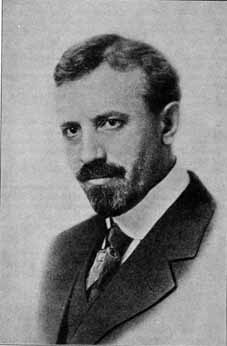
Mr. Barnard also explained that he was present at practically all the proceedings before the Federal Court and generally attended the Attorney-General. of the State, Mr. Bingham, in the taking of depositions without the state. He also testified that in taking these depositions they frequently were given by employees of the Department of Agriculture in areas extending from Maine to California. This part of the testimony of Dr. Barnard is quoted verbatim:
Mr. Moss: In the taking of these depositions, did Curtice Brothers and Williams Brothers take any testimony from any employees in the national Department of Agriculture?
A. They did.
Q. State to the best of your recollection how many employees of the Department of Agriculture gave testimony in this case for the firms of Curtice Brothers and Williams Brothers.
A. With the exception of two or three young men, subjects and clerks, any person who did any work in connection with the benzoate of soda investigation, employed by the Department of Agriculture, was examined. This included all members of the Referee Board, chemists, physicians, medical experts, clerks, stenographers, janitors--everyone who had any thing to do with the case.
Q. About how many in total.
A. I cannot say exactly, but more than 75.
Q. Did the State of Indiana secure testimony from any employees of the national Department of Agriculture?
A. We wished to secure the testimony of Dr. Wiley, Chief of the Bureau of. Chemistry, and those of his assistants who helped him in his benzoate of soda investigation.
Q. Did any of the employees appear voluntarily to give their testimony on the request of the State of Indiana?
A, No, we found it impossible to get their testimony.
Q. Have you any reason to believe that these employees were personally averse to giving such testimony.
A. No.
Q. Did any of these employees appear finally and testify, or give their depositions.
A. Yes; after we went to the Supreme Court of the District of Columbia to compel them to testify.
Q. In actual tests, then, did you find the Department of Agriculture cooperating with the State of Indiana in the enforcement of the pure-food law or operating in opposition to the enforcement of the pure-food law?
A. We found the Department of Agriculture opposing the State of Indiana in every move which we made to defend the pure-food law of our State.
This astounding attitude of the Department of Agriculture, with the exception of the Bureau of Chemistry of that Department, is the most remarkable illustration of how funds appropriated for the enforcement of the Federal pure-food law were squandered in helping adulterators of foods in their attempt to break down a popular state law with all the eagerness and enthusiasm, and moral and material support which a great department of the Government could command. Evidence has already been given that the members of the Referee Board, during their efforts to break down the Indiana law, were paid their salaries and expenses out of the money appropriated by Congress to carry out the provisions of the national pure-food law. While no evidence was asked for in regard to the persons employed by the Referee Board in their investigation, and who appeared as witnesses against the State 6f Indiana, as to the payment of their salaries and expenses while engaged in this activity, it is reasonable to suppose that they were treated in exactly the same manner as their principals. This was a great boon to the complainants as it saved them perhaps many thousand dollars which they would have had to pay for the testimony of over 75 witnesses whom they called for the support of their complaint.
Attorney-General Bingham was also a witness before the Moss Committee (pages 537 to 549, inclusive).
Mr. Bingham was asked by Mr. Moss to state concisely to the Committee just what was involved from a legal standpoint in the Indiana Case. Mr. Bingham replied that the constitutionality of the pure-food law of Indiana was in question. No federal law was involved. That if Judge Anderson sustained the prayer of the complainants the Indiana pure-food law would be practically destroyed. That in so far as he was acquainted with the public sentiment of the State it was entirely favorable to the proper enforcement of the law. Mr. Bingham reported also that in the case of the Referee Board he began taking depositions at Seal Harbor, Maine, and wound up in San Francisco, California. He testified that as representative of the State of Indiana he wished to take the testimony of employees of the Bureau of Chemistry, and he first applied to the Department of Agriculture. Mr. Bingham said he first approached Dr. Wiley who informed him that he would prefer that he first approach Secretary Wilson. He testified that his request that Dr. Wiley should appear in Indianapolis was not granted.
He testified that he next appealed to the President of the United States. As a result of this attempt of Mr. Bingham he felt certain that he could not get any of the employees of the Bureau of Chemistry to go to Indianapolis. He was compelled, therefore, to remove the court to Washington.
He tells how he first put Dr. W. D. Bigelow on the stand, who after giving his name and his profession declined to answer a question in regard to the benzoate matter unless he had permission to do so from the Secretary of Agriculture. He carried the request to compel the testimony of members of the Bureau of Chemistry to the Supreme Court of the District of Columbia before Justice Barnard. A lawyer from the Solicitor's office of the Bureau of Chemistry appeared before the Judge to argue against the order requiring the evidence to be given. The lawyer from the Department of Agriculture urged that as this was expert evidence it could not be given without the consent of the expert. To which Judge Barnard replied:
"It was about as much expert evidence as if they had seen a dog fight on the street and had been asked to testify about it."
He entered an order that the witnesses should go before the master and testify.
I am quoting just now verbatim from page 545:
MR. Moss: I will ask you if at any time during the taking of these depositions you received on behalf of the State of Indiana any encouragement or cooperation on the part of any official of the Department of Agriculture.
MR. BINGHAM: Voluntarily, no. But I may say this for Dr. Wiley. When I said to him that I wanted to take his deposition and question him about whether he would testify as an expert or not-I wanted his opinion of the results--he said that he would testify and that he would answer any questions that were put to him; that he would not hesitate to testify to anything that he was able to testify about.
Q. He explained to you that he was not in a position to act voluntarily, did he not?
A. He explained to me with reference to that particular thing that he did not propose to have any padlock put on his mouth.
I have given these copious extracts from the Indiana case because I consider it to be a most amazing attempt to pervert the national pure-food law and the purposes for which it was enacted to protect the interests of food adulterators and misbranders.
Judge Anderson of the Federal Court of Indiana decided this celebrated case in favor of Indiana. It was appealed to the Federal Circuit Court. The decision of the lower court was approved.
Appeal to the Seventh Circuit of United States Court of Appeals in the Case of Curtice Brothers, vs. Harry E Barnard, et al, Willis Baldwin, E. 0. Grosvenor, and John Barton Payne, attorneys for Curtice Brothers, Thomas M. Honan, Attorney-General of Indiana, attorney for Harry E. Barnard. Judge Kohlsatt delivered the opinion of the Court.
From the evidence and the master's report thereon, it is evident that the question of the harmfulness and harmlessness of benzoate of soda is as yet an open one in the scientific world. While the voluminous record of this case deals largely with that question, it is a question of fact. The finding of fact of the master may not in the absence of convincing evidence to the contrary be set aside. To show that the report is erroneous and not justified by the evidence the burden rests upon the appellant. That burden is not convincingly sustained by the record. We, therefore, start with the proposition that the question is yet an open one in the scientific world and, therefore, an open one for the purpose of this hearing. This being so, it was within the power of the Indiana Legislature to prohibit the use of benzoate of soda in the preparation of foods.
Manifestly, if the Legislature of Indiana in the reasonable exercise of its police power and for the welfare of its citizens condemns as an adulteration the use of benzoate of soda in the preparation of articles of food, then in the absence of a general acceptance of the proposition by the scientific world that such is not the case there can as to that matter arise no question of the violation of the Constitution of the United States, or, as here charged, of the State of Indiana. When deemed necessary by the Legislature for the public health property rights such as here involved must give way. It is therefore apparent that the position taken by the appellant with reference to the constitutionality of the act in question is without merit, as are also the other matters covered by the assignment of errors. The decree of the District Court is affirmed.
At the time of the decision of the Seventh Circuit Court of Appeals Williams Brothers of Detroit became convinced that benzoate of soda was an injurious substance and withdrew from the further prosecution of the case. It was carried by Curtice Brothers to the Supreme Court of the United States. In 1915 negotiations were begun between the State of Indiana and the Curtice Brothers looking to abrogation of hostilities. A stipulation was agreed upon in which Curtice Brothers obtained all.they had fought for in the district and circuit courts of the United States as follows:
The Curtice Brothers Co.)
              Appellant,)      No. 243
Harry E. Barnard, et al.)
Whereas, the statute of the State of Indiana known as Chapter 104 of the Acts of 1907 forbids the sale of adulterated or misbranded drugs and foods within the meaning of the act;
And whereas, subsequent to the passage of said act, and under date of November 10, 1908, the appellees herein notified the appellants, and the purchasers of their said products in the State of Indiana, that the use of benzoate of soda was illegal in said State, and that if they wished to find a market in said State they must not use the same;
And whereas, on the 22nd day of December, 1908, a bill in equity, being the bill in equity involved in this case, was filed in the District Court of the United States for the District of Indiana, in which an injunction was prayed to restrain the defendants, their successors in office, their agents and servants, from enforcing their determination to prosecute these selling appellant's goods as aforesaid;
And whereas, sundry proceedings were had resulting in the entry of a decree in the said District Court of the United States for the District of Indiana on June 21, 1912, dismissing said bill in equity;
And whereas from said decree an appeal was taken to the circuit Court of Appeals for the Seventh Circuit, which Court, on October 7, 1913, affirmed the decree of the said District Court of the United States for the District of Indiana;
And whereas, an appeal was taken on August 10, 1914, to the Supreme Court of the United States from said decree of the Circuit Court of Appeals for the Seventh Circuit, which appeal is now pending in said Supreme Court, entitled, "Curtice Brothers Co., Appellant, v. Harry E. Barnard, et al.," and numbered 243 on the docket thereof for the October Term, 1915;
And whereas, since the institution of said proceedings in the District Court of the United States for the District of Indiana, the government of the United States, acting by its proper officers, hereinafter named, and under authority of the Act of Congress, approved June 30, 1906, known as the "Food and Drug Act" promulgated a rule authorizing food products containing benzoate of soda to pass into commerce between the States, which rule is in the following language:
" It having been determined that Benzoate of Soda mixed with food is not deleterious or poisonous and is not injurious to health, no objection will be raised under the Food and Drugs Act to the use in food of benzoate of soda, provided that each container or package of such food is plainly labeled to show the presence and amount of benzoate of soda.
(Signed) George B. Cortelyou,
Secretary of the Treasury
James Wilson,
Secretary of Agriculture
Oscar S. Straus,
Secretary of Commerce & Labor
(F.I.D. 104, issued March 3, 1909.)
And whereas, the paramount and controlling authority of the Federal government over foods in original unbroken packages entering into interstate commerce is now recognized and admitted, in accordance with which recognition and admission the Board of Health of the State of Indiana, successors in office to the said appellees, under date of April 9, 1915, did promulgate the following regulations:
"Whereas, the decisions of the Supreme Court of the United States in cases concerning the sale of food transported in interstate commerce, and sold in original packages, reserve to officials charged with the enforcement of the Federal Food and Drug Act the authority to regulate the labelling and character of such food, the chemist to the State Board of Health, who is the state food and drug commissioner, is hereby instructed to follow, without exception, the regulations for the enforcement of the Food and Drug Act, promulgated by the Secretary of Agriculture, the Treasury, and Commerce and Labor, in the enforcement of the pure food and drug law, Chapter 104, 1907, in the cases of food sold in interstate commerce in the original unbroken packages;"
"And whereas, there now, therefore remains no question at issue before the Supreme Court of the United States for adjudication between the parties to said proceedings, entitled "The Curtiee Brothers Co., Appellant, v. Harry E. Barnard, et al;"
NOW THEREFORE, in consideration of the foregoing, IT IS HEREBY STIPULATED by counsel for the parties thereto, that the appeal herein shall be dismissed without prejudice, and without costs to either party as against the other.
(Signed) Lawrence Maxwell,
Counsel for Appellants.
Evan B. Stotsenburg,
Attorney General of the
State of Indiana.
This stipulation gave as a free gift to Curtice Brothers everything that they were asking for through both the District and Federal Circuit Court of Appeals which it had been denied by both Justice Anderson and Justice Kohlsatt. The whole stipulation appears to have been composed by Lawrence Maxwell, attorney for Curtice Brothers. It assumes that the contention of the Curtice Brothers that benzoate of soda is a perfectly harmless substance is true. It has never been pronounced so by a Federal Court. In so far as experts are concerned, there is always a difference of opinion, but the far greater number of experts have held that benzoate of soda is harmful. Those who used it have been led by one cause and another to entirely abandon its use. Even the persons who sought to restrict the Indiana State Board of Health from obeying the rules and regulations under the State law finally came to see the error of their ways and joined the ranks of the non-users of benzoate. The three Secretaries who signed Food Inspection Decision 104 had no warrant by law to make such a ruling. There was only one authority named by the law to bring an indictment under the law. This indictment was not valid unless it was sustained by the Federal court. The publication of this order on March 3, 1909 was a plain violation of law. The Indiana Board of Health on the 9th of April, 1915, issued an order forbidding interference with the sale of benzoated goods as long as they were in the original packages. The Attorney-General of the State of Indiana advised the commissioner of foods that there were certain conditions in which imported packages never ceased to be in the original containers. This of course is a reductio ad absurdum. The very moment an Indiana dealer sells goods it is an act of intrastate commerce and brings that article directly under the control of the Indiana law.
In my testimony in the Indiana case, Mr. Baldwin, the attorney for the complainants in cross-examination endeavored to fix the responsibility of the almost unanimous sentiment expressed in the newspapers and magazines on me. He asked me if I kept in touch with the progress of the case. I told him I did as I was greatly interested in it, that I knew it was under way and had been pending for a long while. He asked me this question:
Q. Now then, you have stated your opinion here to the reporters of the different papers as to the outcome of that case?
A. I think I have said that I hoped it would be decided in favor of the State of Indiana.
Q. You said that to the reporters of the papers.
A. I think so. I do not see any reason why I should not say so.
Q. You said that to them with the expectation that they would use those statements in the press.
A. I think reporters usually do.
Q. It is your experience that they do use those things.
A. I have no objection to my opinion being expressed in the public press on a question of that kind; none whatever;
I have a right to my opinion in this country and will exercise it.
Q. Didn't you know that it is improper for any person to express an opinion as to what the Court was going to do in a pending case.
A. In what sense? In what way?
Q. I say in a way so that that opinion would get in the newspapers.
A. As to the outcome of the case?
Q. Yes.
A. I did not know that it was improper to express the hope in a civil suit without a jury that the decision would be this way or that. If it were an illegal or an improper thing I am sorry I said it. I have done it dozens of times as to cases I have seen on trial.
Q. You made it in such shape that that opinion got.into the newspapers?
A. I suppose it did get into the newspapers. I had no objection to its getting in.
Q. In fact you wished it to get in?
A. I did not think of that.
Q. You must have volunteered it, because it was not forced from you.
A. I did not run around and hunt them up. They came to me.
Q. You voluntarily made those statements?
A. Oh, yes. Nobody tried to force me to make any.
Q. Do you keep a set of clippings from different papers at all?
A. I am not a subscriber to any agency. I usually cut out articles in which I am interested that come to my notice.
Q. And don't you know that those statements of your opinion were published generally throughout the country?
A. I don't know if they were or not.
Q. Don't you know they were published in other papers than those in Washington?
A. Oh, I suppose so; I don't know.
Q. Do you know whether they were published in any Indianapolis papers or not?
A. I do not.
Q. Don't you know they were published in the Detroit Free Press?
A. I do not.
At this point Mr. Baldwin offered an article published in the Washington Post, July 13, 1910. This article related the facts that at the 66th Convention of the American Institute of Homeopathy, held at Pasadena, California, a resolution was adopted denouncing food-laws that prohibit the use of preservatives in food and the use of sulphur in curing fruit. He stated that 12,000 homeopathic physicians had sent telegrams to President Taft and Secretary Wilson in favor of the farmer, the fruit-grower and the preserving factories and against the pernicious rulings of Dr. H. W. Wiley, Chief of the United States Bureau of Chemistry. The latter part of this clipping reads as follows:
"Although the American Institute of Homeopathy at its convention at Pasadena, Cal., Monday, adopted a resolution rescinding its action taken last year condemning the use of benzoate of soda as a food preservative, Dr. Wiley, chief chemist of the Department of Agriculture, has stronger opinions than ever on that subject. Dr. Wiley's views did not prevail in the department, as the board appointed by Secretary Wilson under the pure food law disagreed with the chief chemist and sanctioned the use of benzoate of soda as a food preservative.
" 'The developments during the last year,' said Dr. Wiley, 'have accentuated my opinion as to the harmful character of benzoate of soda as a food preservative. I expect to see that view sustained by the Federal courts, as the evidence that has been submitted recently in Indiana cases points that way.' "
(Page 3460, Indiana Case.)
I never lost faith, in the whole two or three years during which the Indiana case was considered, in the character of the outcome. I think Mr. Baldwin, the attorney for the complainants, was justified also in his optimism that the Referee Board would win. He realized that all the heavy artillery of the most powerful government in the world had been brought into play and directed against the crackling reports of the short shot-guns fired by the Bureau of Chemistry. Later he must have realized the truth of the poem;
Truth crushed to earth will rise again;
The eternal years of God are hers;
While error languishes in pain
And dies amid his worshippers.
Absurdum est ut alios regat, qui seipsum regire nescit.
"The world has a sure chemistry, by which it extracts what is excellent in its children, and lets fall the infirmIties and limitations of the grandest mind."
Emerson, Essay on Swedenborg.
In the early days of the enforcement of the food and drugs act great encouragement was given, due to the soundness of President Roosevelt's views as to what is whisky. On the other hand the temporary support of the harmfulness of benzoate of soda, which lasted for only a few minutes, was then entirely abandoned. There was another incident which led me to believe that the President thought the Bureau of Chemistry was entirely too radical in its efforts to carry out the provisions of the law under the mandates which the law gave it. Of course the Bureau simply tried to do, to the best of its ability, the duties imposed upon it by the law. All the Bureau of Chemistry could do was to serve as a grand jury. Any indictments it might bring could only be reported to the Department of Justice and could only be ratified by the decision of the Court. Soon after the law went into effect I was called to the White House by the President and directed to bring with me Mr. Harrison, the chemist in charge of the New Orleans laboratory. At the appointed time Mr Harrison had not arrived, due to a failure of the Southern Railway to reach Washington on time. I therefore went to the President's office alone. On my arrival I found the President in rather an ugly mood. The French Ambassador had complained to him that a shipment of vinegar from France to New Orleans had been refused admission because of a cluster of grape vines hanging full of grapes portrayed upon the label. The analysis had disclosed that the vinegar in question was not sour wine, as both name and label indicated, but was an artificial vinegar made by passing dilute alcohol, presumably distilled from beet sugar molasses, over beech shavings. The shipment was ordered returned to France, with the instructions that the grapes should be removed from the label. This was done but the grapevine was left. The shipment a second time reached New Orleans, whereupon I instructed Mr. Harrison to send it back as the grapevine was just as indicative that the vinegar was made of sour wine as were the grapes themselves. On reaching the President's office and explaining why young Harrison had not accompanied me, he said very sternly:
"The Food Law is an excellent measure, but it should be administered with some discretion. Full particulars in regard to the proper branding should have been furnished at once."
Explaining as best I could to the President I quoted the very words of the law itself, namely that an article was misbranded if the label bore any design or device or statement which was false or misleading in any particular, that as the executive officer I had no choice in the matter, but my only purpose was to execute the law as it was written. The scowl on the President's died away and a rather benignant smile took its place. He grasped my hand cordially and said:
" If the French Ambassador bothers you again in matters of this kind tell him to go to Hades."
Inasmuch as I valued my friendship for the French Ambassador and his for me very highly, I am certain that no one would have expected me to use any such language in any subsequent protest made from the French embassy in regard to the exclusion of French products from this country under the law. Nevertheless, this incident increased the feeling in my own mind that the President was not entirely in sympathy with a rigid enforcement of the food and drugs act.
He evidently felt that the Congress had made a great mistake in placing the execution of the law in the Bureau of Chemistry. Mr. Loeb, private secretary to President Roosevelt, was strongly impressed that the President considered the Chief of the Bureau entirely too radical in his views concerning the harmfulness of preservatives. He thought the Chief of the Bureau was lacking in diplomatic discretion. The President was undoubtedly still of the opinion that an underling who had the temerity to appear before a Congressional committee and denounce a presidential policy on reciprocity had few, if any, redeeming traits.
During the progress of the campaign for pure food legislation, and especially during the last one or two years when apparently public sentiment was sufficiently aroused and unanimous to warrant the expectation of a speedy successful issue, I felt that President Roosevelt was heartily in favor of this legislation. The appearance in 1906 of Upton Sinclair Is novel entitled "The Jungle," brought public opinion to the pitch of indignant excitement. President Roosevelt was eagerly in quest of a law supervising the packing of our animal food products. The time of the session was so nearly at an end, that it seemed hopeless to bring in a meat inspection bill as an expansion of the food and drugs bill. It was deemed best, therefore, to try to engraft the meat inspection bill as a rider on the agricultural appropriation measure. I am not aware whether at that period it was a violation of the rules to introduce legislation on an appropriation bill; at the present time it is. At any rate, a rider satisfactory to the President was offered to the appropriation bill in the House of Representatives. It was not adopted, however, except after serious mutilation of the measure. The chairman of the House Committee on Agriculture, Mr. Wadsworth, thought the offered measure was too drastic and uncalled for by those engaged in our meat industry. President Roosevelt was greatly disturbed at the changes made in the measure, but was powerless to prevent such modification as the House Committee on Agriculture thought desirable. It is not quite certain whether the Agricultural Appropriation Bill carrying these meat inspection provisions became a law prior to, or subsequent to the food and drugs act. Only a search of official documents could determine this fact. Nevertheless, it is a matter of some importance, for if the appropriation of the Department of Agriculture was approved subsequent to the approval of the food and drugs act, any disagreements between the two acts would be construed by the courts in favor of the later bill. In point of fact, no effort whatever was made by the Bureau of Chemistry to enforce any provisions of the meat inspection law. The reason for mentioning these matters here is because President Roosevelt's intense interest in the meat inspection bill seemed to obscure, at least for the time being, any interest he had in the food and drugs act.
I had the good fortune to know somewhat intimately two or three of the newspaper men who had the ear of the President and I learned from them that the President's interest in the food and drugs act was genuine and unreserved. Particularly I knew well Harry Needham, intimate associate of the President. Mr. Needham subsequently met an untimely death in an accident in an aeroplane in Paris. As was recited in the chapter on "What is Whisky," I learned from Mr. William Loeb, the President's private secretary, his great interest in that matter. This was subsequent to the passage of the food and drugs act.
I had close relations also to two other men who had more or less free access to President Roosevelt. These were Mr. Mark Sullivan and Mr. Robert M. Allen. I have secured interesting data from each of these gentlemen in regard to President Roosevelt's interest in the passage of the pure food bill. Mr. Allen has furnished me with the following data, which I have permission to quote. he says:
"I do not believe that President Roosevelt had shown any interest in the pure food law prior to 1905. 1 feel without any doubt that Roosevelt sincerely and earnestly supported the passage of the act after his message to Congress in December, 1905. When he took this stand it was characteristic of him to back it. Hapgood, Sullivan, Needham, and Gilson Gardner were close to the President, as was also Dr. Abbott, editor of The Outlook.
"The White House had a strong influence on their activities for the bill. Needham told the Dalzell story at the time it happened. If it is true, and I believe it was true, Roosevelt's statement to Cannon that he would call Congress into extra session if they did not pass the food bill, was one of the decisive factors in bringing the bill to a vote in the House. There are so many people, like the writers that I have mentioned, so earnest in their feeling that Roosevelt strongly supported the passage of the Act from the fall of 1905, that I do not want you to make any mistake in this matter in your memoirs. You have a big and important message to get over. The country needs it."
I have the following statement from Mr. Mark Sullivan, also :
"I cannot say that I have any positive recollection of ever having discussed the pure food bill specifically with President Roosevelt. I did discuss it very often with Harry Needham and with R. M. Allen. I also did discuss it occasionally with yourself, as you will remember. Based on my recollections of conversations I had with Needham and Allen, my strong belief is that Roosevelt not only believed in the Pure Food Bill but was energetic in getting it passed. It is true that the pure food bill.and the railroad rate bill were before Congress during the same session. I think it possible, or even likely, that Roosevelt's major interest was in the railroad rate bill, because at the time that was the great controversy; but I have recently been over the records sufficiently to show that Roosevelt gave powerful aid to the pure food bill."
Mr, Sullivan then discusses another overlapping and supplemental measure, the meat inspection bill.
To continue the quotation:
"That Roosevelt threw immense energy into the meat inspection rider there can be no doubt whatever. In effect the one went with the other. Roosevelt's pressure for the meat inspection bill is proved by scores of documents and publications in old newspaper files. The two bills, the pure food bill and the meat inspection rider, went through the lower house substantially on identical dates. Everybody thought of the two as one."
To this I wish to add my own recollection and impression at the time. I was fully convinced that although Mr. Roosevelt came into action late in the fray he was enthusiastic and earnest in his support of the pure food and drugs act. It was not until nearly five years later that I had any intimation whatever that I was wrong in this opinion. I did feel that I was under a serious handicap at the White House by reason of my opposition to Cuban reciprocity.
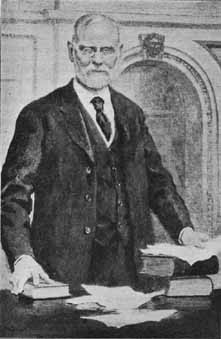
Two important statements were made to me in 1912, after my resignation from the Bureau of Chemistry. Mr. James R. Mann, leader of the final fight in the House for the food bill, thought the President not only was indifferent about the matter, but considered the measure the work of impractical cranks. Mr. Roosevelt made a similar statement in a letter published in a Kansas paper at that time. Senator Heyburn, who led the final fight in the Senat% showed me a letter written to him by Mr. Roosevelt while the bill was under discussion, begging him to cease his efforts for such an impractical measure, and aid him in passing a bill to restore to the Naval Academy three students who had been dismissed for drunkenness. Even if it be granted that the President favored the food bill, it is perfectly clear that he took the most active part in pre venting the Bureau of Chemistry from enforcing it.
The prejudice which the President had against the Chief of the Bureau of Chemistry was most pronounced. It arose early in his administration when he was urging Congress to pass the law remitting part of the duties on imported sugar coming into this country from Cuba. I have no desire to criticize the President for his attitude in this matter. At that time the planter and manufacturer of sugar in Cuba scarcely got a cent a pound on his product. All the nations of Europe producing beet sugar were paying large bounties on beet sugar when it was exported. The result was that practically all the sugar consumed by Great Britain, which was one of the great sugar consuming countries of the world was cheapened by bounties paid by France, Germany, Belgium, Russia and Austria on exported beet sugar. Sugar was so cheap in London that the makers of cane sugar in the West Indies had lost the greater part of their trade. At the time (1902) the United States was considering the subject of a rebate of import duties on sugar to Cuban planters a congress called by beet-sugar producing countries in Europe was sitting in Brussels considering the question of abolishing export duties on beet sugar. Sereno E. Payne of New York was chairman of the House Committee on Ways and Means before which the question of rebate on Cuban sugar was under consideration. I was very much embarrassed on receiving a summons to appear before that committee. I had no sympathy with the proposed legislation. I had devoted many years of study to the domestic sugar problem, in investigating the possibilities of extending our domestic production from sorghum, sugar beets and sugar cane. I was naturally a high protectionist on sugars imported from abroad. I went to the Secretary of Agriculture and explained to him that I was opposed to this legislation but that I did not want to appear in opposition to the President's plan. I asked him to communicate with Chairman Payne and have him withdraw the summons. The Secretary said:
I am just as much opposed to this legislation as you are but being a member of the President's cabinet I can not say anything; I think the committee ought to know the truth about this matter. (Quoted from memory.)
I replied that I also thought they ought to know the truth, but that I didn't see any difference between his telling them the truth and 1, who was only one of his assistants. The result was, however, that I had to appear before the committee. I was two days in giving them the data which to my mind clearly disclosed that the trouble in Cuba was not due to our import tax, but to the giving of bounties in Europe on exported beet sugar. I quote from the hearings of the Ways and Means Committee.
"It follows as a logical conclusion, therefore, that the people who come to this committee for relief from the low price of sugar should strike at the true cause, not the false one, of the evil of which they complain. * * * Their cause should be pleaded in the Parliaments of Europe, not in that of America; their plaints should go before the Reichstadt, Bundesrath, and the Corps Legslatif, and not before the American Congress. The place to plead their cause is before the Congress of Brussels, not before the Ways and Means Committee of the Congress of the United States. "
(Hearings Before Committee on Ways and Means, Fifty-Seventh Congress, First Session, Wed., January 29, 1902, Page 572)
MR. RICHARDSON: You have read the report of the Secretary of War?
DR. WILEY: Yes, Sir.
MR. RICHARDSON: And the recommendation of the President?
DR. WILEY: Yes, Sir.
MR. RICHARDSON: And General Wood?
DR. WILEY: I have not read that, but I have heard of it. I have read the other two, however.
MR. RICHARDSON: You do not agree with them in the recommendations in respect to the treatment of Cuba on this question?
DR. WILEY: I do not.
MR. RICHARDSON: I ask you this, doctor, for this reason: Do you contemplate remaining in the Agricultural Department? Is that your ideal (Laughter.)
You need not answer if you do not wish. I ask simply because I have heard that you did not.
THE CHAIRMAN: You need not answer that question, doctor.
MR. RICHARDSON: Not unless he wishes to.
MR. HOPKINS: I do not think that is proper.
MR. RICHARDSON: I do not want him to answer it unless he is willing to do so.
MR. ROBERTSON: That has not anything to do with the case.
MR. RICHARDSON: The object of my question is just this, Mr. Chairman, as I am frank to state, and he need not answer it if he does not wish to do so: I have understood that the doctor contemplated leaving the Agricultural Department and going into the sugar-beet industry. Whether that is true or not I do not know.
DR. WILEY: It is the very first I have heard of it. (Laughter.) Mr. Chairman, it is the first intimation of the kind I have ever had. I thought the gentleman implied that I would be removed because I did not agree with the Secretary or the President. (Laughter.)
As I left the committee room, a famous artist, Mr, Augustus C. Heaton, who had been in attendance, handed me the following rhyme:
"A chemist both learned and witty
Came before a sugar committee,
And O such statistics and learned linguistics
He poured upon Recipro-city."
As it turned out it was no laughing matter.
The result of my testimony was what I had anticipated. President Roosevelt was furiously angry. He sent at once for Secretary Wilson and ordered him to dismiss immediately that man Wiley. The Secretary pleaded for my life, explaining that I did not go up there willingly, but had earnestly tried to have my subpoena recalled. The President relented and said to let it go this time, but to tell Wiley never to do Such a thing again. The result was that I never was a favorite at the White House as long as Roosevelt was president. I was not surprised, therefore, to find that he took the lead in so limiting the activities of the Bureau of Chemistry as to deprive the Chief of that Bureau from performing the functions placed upon him under the law.
THE UNITED STATES PHARMACOPOEIA
The United States Pharmacopoeia is a book prepared by a national organization chosen by the medical and pharmaceutical colleges and societies of the country. This organization meets once in each ten years. The principal object of these decennial conventions is to appoint a committee for revising the United States Pharmacopoeia. At the Convention which assembled in Washington in 1910, much to my surprise, I was elected president of the Convention for the decennial period ending in 1920. Ex officio I became a member of the committee on revision. The food-law specifically recognizes the United States Pharmacopoeia, both as to the standard of quality of the remedies described therein and the methods of analysis by which the purity of remedies is established. Its activities, therefore, are specifically prescribed by the Congress of the United States as one of the methods of administering the Food and Drugs Act. Essential oils are frequently standardized and prescribed in the Pharmacopoeia. I was allowed to select the particular part of the revision work over which I was chosen to preside. I had for several years, on account of essential oils being agricultural products, collected and studied large numbers of these bodies. This work was assigned to the committee studying essential oils. I was very much surprised, therefore, to receive from the Secretary of Agriculture a written statement for the amount of time consumed in these investigations and the probable expense to date of the work done. Any one who is interested in the further details of this remarkable request will find them recorded on page 808 and following of the proceedings of the Moss Committee.
The methods of analysis and the standards of purity of drugs prescribed by the Pharmacopoeia are specifieally adopted by the Food and Drugs Act. The regulations enacted for the enforcement of the Food and Drugs Act are as follows:
Unless otherwise directed by the Secretary of Agrieulture, the methods of analysis employed shall be those employed by the Amociation of Official Agricultural Chemists and the United States Pharmacopoeia.
I made the following statement to the committee:
I may say, Mr. Chairman, that never in the history of the Pharmacopoeia has such pains been taken to make it as perfect as possible. In view of the fact that Congress has made it the official standard of drugs and medicines, the present committee is taking special pains to get all the information possible to make the new edition as useful as possible, for the purpose of securing purity of drugs in this country.
During my absence from the city I was informed by the Secretary of Agriculture on June 15 that Dr. Dunlap had told him he had information that work was going on in the Bureau of Chemistry in the revision of the Pharmacopoeia.
When Dr. Dunlap appeared as a witness before the committee he was asked: "What are your duties as associate chemist?"
He replied: "I have none."
Evidently he was mistaken. It was he who by his detective abilities discovered that the Chief of the Bureau of Chemistry had deceived the Secretary of Agriculture and induced him to appoint Dr. Rusby illegally. Continuing the exercise of these Sherlock Holmes activities he discovered the Bureau of Chemistry was doing illegal work in examining the agricultural products known as essential oils. These were noble and important functions that somebody had to perform. It was a great stroke of good luck that put Dr. Dunlap into the Department for this worthy purpose. President Roosevelt deserves the gratitude of the future for discovering and having appointed a scientist of such ethical activities and achievements. As a result of Dr. Dunlap's activities the Solicitor had told the Secretary that these activities of the Chief of the Bureau were clear violations of law and the Secretary instructed me to do no more work of any kind in connection with revision of the Pharmacopoeia. At this same time the members of the Referee Board were paid salaries exactly as Dr. Rusby was and had spent already several hundred thousand dollars in their attempts to prevent the food law from being enforced. I found that the total expense which had been incurred by the Bureau of Chemistry up to the time the order was issued to "cease and desist" from these activities as violations of law was exactly $55. Of all the tremendous inconsistencies in regard to illegal expenditures in the Bureau of Chemistry in connection with the Remsen Board, there was nothing so clearly and distinctly disclosed as the complete propriety of the activities of the Bureau of Chemistry in securing a proper revision of the Pharmacopoeia. This order forbidding work in the Bureau of Chemistry along that line was still in force in 1912 when I retired from the Bureau. I do not think it was removed during the remainder of my decennial term.
This pusillanimous persecution of itself amounts to nothing. It illustrates the petty meanness of the environment which the Chief of the Bureau was forced to endure for so many years. The report of the Moss Committee disclosed the whole fabric of the net in which the enemies of the food law had planned to enmesh those charged by law to enforce it. In regard to this matter the following quotation from the Moss Committee's record' is illuminating:
Page 887-888.
THE CHAIRMAN: Did I understand you correctly in your testimony, when I was asking questions, to say you can extend the functions of the Bureau of Chemistry, provided it is not prohibited by law?
SECRETARY WILSON: I can use administrative discretion that is not prohibited by law. * * * I can illustrate that by what happened at Denver. Dr. Long is a member of the Referee Board from Chicago. There had been going through the papers and being stated by the chemists, and so forth, that the best use to which we could put benzoate of soda, and the use to which it generally was put, was to preserve decaying vegetables and fruits. Dr. Long had made some extensive investigations and reported there that benzoate of soda would not preserve either vegetables or fruits.
THE CHAIRMAN: Did I understand you to say, in answer to Mr. Sloan, that there was no authority in law for this pharmacopoeia work--that it was absolutely forbidden by law to do this work?
SECRETARY WILSON: No authority.
THE CHAIRMAN: Coming back to your idea that you can extend the functions of the Bureau of Chemistry, providing it is not forbidden by law, would you not have authority, under your construction, to permit Dr. Wiley to do this work if you had cared to do so?
SECRETARY WILSON: No; administrative discretion can only be used in furtherance of the object of the law.
Page 894-895.
MR. HIGGINS: Have you pursued, Mr. Secretary, any different policy toward the Chief of the Bureau of Chemistry than with reference to any other chief in your department?
SECRETARY WILSON: Not a particle. You could not understand, if you happened to look over the transom of the door and see Dr. Wiley and me discussing one of his new farms
MR. HIGGINS (interposing): He is also an agriculturist?
SECRETARY WILSON: He has farms, but he and I discuss them. I give him advice. I am no chemist; but, then, he is no farmer (laughter), and so we swap information, you know. There is one delightful thing about the Doctor: he has humor, and unless I once in awhile get a laugh I would run back to Iowa and stay there. The Doctor has pleasant humor, and he is a pleasant companion. If you saw us in one of these interviews you would not believe there ever was any trouble about benzoate of soda.
MR. HIGGINS: You discuss pleasant subjects at those interviews?
SECRETARY WILSON: Always.
MR. SLOAN: You are both bonnie Scots, are you not?
SECRETARY WILSON: I am direct, but I imagine he is tainted with the blood.
The Bureau of Chemistry was not treated like other Bureaus. Secretary Wilson was well aware of that fact. In no other Bureau did he appoint an Associate Chief, as he did in the Bureau of Chemistry, without ever consulting the Chief of that Bureau. In no other bureau were funds specifically appropriated for definite purposes used without the consent of the chief for diametrically opposite purposes. In no other Bureau were changes made in administration without consulting the Chief of the Bureaus involved. No other Chief of Bureau was ever secretly tried before the personnel board, found guilty, and sentenced to be dismissed from the service, as was the Chief of the Bureau of Chemistry. In no other Bureau were important component parts thereof separated and put into an independent bureau as was the case in the Bureau of Chemistry with Soils and Investigations of Road Building Materials. While it is true that the Secretary and the Chief of the Bureau were on friendly terms personally, the Secretary never took the advice of the Chief of the Bureau of Chemistry on the important matters above mentioned. In no other bureau were funds appropriated for a specific purpose used for paying employees who were ordered to report to the Solicitor of the Department. These are only a few of the illustrations of the different treatment accorded to the Bureau of Chemistry.
Page 644.
THE CHAIRMAN: Will you please state your precise duties as existing in the department when you are not acting as chief chemist; what are your precise duties today in the Bureau of Chemistry?
DR. DUNLAP: I am associate chemist of the Bureau of Chemistry and member of the Board of Food and Drug Inspection.
THE CHAIRMAN: As associate chemist, what are your duties?
DR. DUNLAP: I have no duties.
THE CHAIRMAN: Then, having no duties as associate chemist, your sole duty is as a member of the Board of Food and Drug Inspection?
DR. DUNLAP: Exactly.
Dr. Dunlap seems to forget the important office be was to perform, namely, to see that the Chief of the Bureau did no unauthorized work to make the official standard of drugs as perfect as possible.
THE BUREAU OF STANDARDS
"Under free government trade must be free, and to be of permanent value it ought to be independent. Under our standard we do not expect the government to support trade; we expect trade to support the government. An emergency, or national defense may require some different treatment, but under normal conditions trade should rely upon its own resources, and should therefore belong to the province of private enterprise."--President Calvin Coolidge, address to the Pan American Commercial Congress; The Nation's Business, May 20, 1927.
In the great national game, theft is an important element of success. The man who reaches first must stick to his base as long as the first baseman is at the sack. When the first baseman goes off to quite a distance, the runner leaves his place of safety and goes as far as he dare toward second. He must keep a keen eye, however, as either the catcher or the pitcher may return the ball to the first baseman, who has crept up unawares, and the runner is "out." If the basestealer is put out he is booed; if he succeeds he is wildly cheered.
In general it is the first principle of safety to stick close to your base. An army that leaves its base too far may run into danger. Its supply of provisions and munitions may be cut off. The enemy may send an armed force to cut off retreat.in case of defeat. Upon the whole, sticking to one's base is not only considered a mark of good judgment, but often of honesty of purpose in fulfilling the duties imposed upon a player. Stealing bases in scientific matters is quite another story.
While the bureau is an important element in Government activities, it also affords an opportunity for ambitious directors (and all directors should be ambitious) to leave the base on which they are supposed to stay. I do not except even the bureau over which I presided for nearly thirty years from having at various times had attacks of this grasping disposition. The Honorable Frank A. Lowden says, in World's Work, December, 1926:
"The Government official is inclined to exaggerate the importance of his office. He is constantly endeavoring to expand its scope. He is properly jealous of his authority. * * * I think that this tendency is inevitable. * * * Where, however, the enterprise is a vast one, as in Government, or as in a great business organization, these tendencies, if left uncontrolled, are likely to inflict serious injury upon the service. * * * The original purpose of the creation of the Bureau is finally lost sight of and it is likely to seem to those who direct it an end and not a means."
It would be well to add to the warnings of President Coolidge and Governor Lowden in regard to mixing up business with Government, the opinion also of another expert along the same line. Mr. Merle Thorpe, editor of Nation's Business, published under the auspices of the National Chamber of Commerce, made this interesting statement before the National Association of Real Estate Boards held (Sept. 18, 1927) in Seattle, Washington. The title of his address was "From Bottom Up or Top Down."
"Because of our failure to do things for ourselves, we are calling upon the government to do everything under the sun. Statute books are groaning. Regulations are myriad. Bureaus and commissions spring up overnight. Taxes are mounting, and naturally, because every one of the laws we put upon the statute books requires administration and more people on the tax payroll. To-day it is estimated that each ten families in the United States feed and keep another family on the tax payroll. Two months' production of each man, woman, and child, out of the twelve, now go to keep up the tax payroll.
"'Let the Government do it!' is our favorite panacea. Of course, the politicians do not object. In fact, there have been occasions where they have been known to encourage legislation and join in the national anthem, 'There ought to be a law--'
"The waste and inefficiency and mounting costs, however, are not the greatest penalties we pay for doing the nation's work from the top down. Most of the legislation is directed at business and business is no longer the simple act of trade and barter it once was. It has become most complex. Business is so interrelated, so interdependent, that a law regulating this industry reaches out and out and affects scores of us thousands of miles away.
"It is a wise man indeed, who can see through and through to its conclusion a simple piece of economic legislation. We shall never know how much the orgy of lawmaking has slowed down the legitimate task of furnishing food and shelter and clothing, to say nothing of the luxuries of life, to those who need and want them, but it is safe to say it has done a great deal.
"The breaking point will come. Already there have been four parliamentary governments overthrown and dictators rule to-day. As Mussolini says, 'Democracy, with its endless talk and politics, has miserably failed.' We may never come to that situation of dictatorship in the United States, but we may reach a stage where democracy and its accredited representatives are discredited. That would be disastrous, for democracy is based upon confidence.
"Disastrous, too, for it would destroy the one thing which has made this country great, 'individual reward for individual initiative.' Every time we ask government to do something which we as individuals, or groups, or communities, can do better for ourselves, we are striking at that individualism which has given us our strength."
Bureaus are either created by Act of Congress or by executive order. In the latter case Congress must approve the executive act by appropriations for specific purpose. By specific legislations Congress also assigns to certain bureaus special duties which presumably can not be abrogated by executive orders. It follows that all expansive work must lie in the scope of the bureau and in harmony with problems already allocated.
In Science, July 19, 1927, page 103, is found a proposed code of ethics for scientific men. No. 2 of this code reads as follows:
"Exemplify in your conduct and work a courageous regard for the whole people, and not alone some powerful and influential faction thereof with which you come in close personal contact."
This is most excellent advice in connection with the above observations.
The American Chemical Society has no printed code of ethics. There is, however, an unwritten code which every member of the society is under obligation to respect.
There are two cardinal principles involved in the unwritten code of ethics of the American Chemical Society. The first is that no member of the society shall seek by improper means to deprive any other chemist of his employment. The second is that a field of investigation which is already occupied shall not be entered by an outsider without full cooperation and agreement with the party already occupying the field of investigation. These two fundamental principles guide and control the relations of the members of the Society toward each other.
A much younger association of chemists, namely, the American Institute of Chemical Engineers, has already adopted a code of ethics. Inasmuch as some of the activities of the Bureau of Standards are essentially those of chemical engineers, it is probable that most of the chemists in the Bureau of Standards are members of the American Institute of Chemical Engineers. This code of ethics is not very long but it is very pertinent. The principal elements of this code are the following:
1st. That in all their relations, they shall be guided by the highest principles of honor.
2nd. The upholding before the public at all times of the dignity of the chemical profession generally and the reputation of the Institute, protecting its members from misrepresentation.
3d. Personal helpfulness and fraternity between its members and toward the profession generally.
4th. The avoidance and discouragement of sensationalism, exaggeration and unwarranted statements. In making the first publication concerning inventions or other chemical advances, they should be made ithrough chemical societies and technical publications.
5th. The refusal to undertake for compensation work which they believe will be unprofitable to clients without first advising said clients as to the improbability of successful results.
6th. The upholding of the principle that unreasonably low charges for professional work tend toward inferior and unreliable work, especially if such charges are set at a low figure for advertising purposes.
7th. The refusal to lend their names to any questionable enterprise.
8th. Conservatism in all estimates, reports, testimony, etc., especially in connection with the promotion of business enterprises.
9th. That they shallnot engage in any occupation which is obviously contrary to law or public welfare.
10th. When a chemical engineer undertakes for others work in connection with which he may make improvements, inventions, plans, designs, or other records, he shall preferably enter into a written agreement regarding their ownership.
The 4th, 7th, 8th and 9th sections of the above code of ethics are not italicized in the original.
The object of establishing the Bureau of Standards is luminously set forth in the hearings before the comittee on weights and measures and in the debates in Congress on this measure.
I desire to call attention to a bureau in which it appears that the desire to get control of all forms of activities has developed into a megalomania, and to point out some of the crimes it has committed or attempted to commit against the battered and bleeding food law.
Professor Edward Murray East, eminent biologist of Harvard University, says:
In our most cherished beliefs, from the earliest ages to the present, there is a great deal to justify the opinion of the cynic that man is to be distinguished from the apes not by his lack of a tail, but by his megalomania. Since becoming the dominant animal on the surface of this cosmic atom, he has never, until recently, had the slightest doubt concerning his supreme importance in the general scheme of things.
I am not looking into the activities of the Bureau of Standards in any way which would reflect upon any member of the Bureau, either as to his capacity and ability, or as to his honesty. I assume, and I believe the disease of megalomania is to some extent epidemic; it attacks people against their desire and will. We do not lose our esteem for those who are ill of influenza or high blood pressure. We might attach some personal blame to those who suffer from typhoid fever. We should regard megalomania as a sad misfortune.
It is not in any way my purpose to review all the expansive activities of the Bureau of Standards. I will confine my remarks to those activities which affect scientific ethics, public health, and adulteration of foods.
The Bureau of Standards was intended to be a natural enlargement of the old office of Weights and Measures. This office for some mysterious reason was connected with the Department of the Treasury. The enlargement of the office and its change of name to the Bureau of Standards was first publicly suggested by the Secretary of the Treasury, the Hon. Lyman J. Gage (50th Congress, first Session, House of Representatives, Document No. 625.) The general purpose of the new Bureau is outlined by the Secretary of the Treasury in the following language:
The functions of the bureau shall consist in the custody of the standards; the comparison of the standards used in scientific investigations, engineering, manufacturing commerce, and educational institutions with the standards adopted or recognized by subdivisions; the testing and calibration of standard measuring apparatus; the solution of problems which arise in connection with standards; the determination of physical constants, and the properties of materials when such data are of great importance to scientific or manufacturing interests and are not to be obtained of sufficient accuracy elsewhere.
Under the head of conditions which necessitated the establishment of a National Standards Bureau the Secretary makes, among others, the following remarks:
Throughout our country institutions of learning, laboratories, observatories, and scientific societies are being established and are growing at a rate never equaled in the history of any nation. The work of original investigation and instruction done by these institutions requires accurate reliable standards, which in nearly every case must be procured from abroad, or can not be procured at all. * * *
The recent acquisition of territory by the United States more than proportionately increases the scope and importance of the proposed institution, since the establishment of a government in these possessions involves the system of weights and measures to be employed. During the near future large public improvements will be undertaken in these countries; schools, factories, and other institutions will be established, all of which require the use of standards and standard measuring apparatus.
The National Academy of Sciences endorsed the movement in the following resolution:
Whereas the facilities at the disposal of the Government and of the scientific men of the country for the standardization of apparatus used in scientific research and in the arts are now either absent or entirely inadequate, so that it becomes necessary in most instances to send such apparatus abroad for comparison: Therefore, be it
Resolved, That the National Academy of Sciences approves the movement now on foot for the establishment of a national bureau for the standardization of scientific apparatus.
The American Chemical Society approved the measure:
Resolved, That the Congress of the United States be urged to establish a national standard bureau in connection with the United States Office of Standard Weights and Measures, which shall provide adequate facilities for making such verification of chemical measuring apparatus and for stamping the same as are provided by foreign governments for similar work."
Prof. Simon Newcomb, U. S. N., said:
I do not think that anything I could do or say is necessary to emphasize the practical and scientific importance of introducing the highest standard of efficiency and precision in the work of such a bureau.
Prof. Albert A. Michelson (head of department of physics, University of Chicago) made the following statements:
It gives me great pleasure to indorse the measures proposed regarding the importance of the establishment of a central bureau of weights and measures, the functions of which shall be:
(1) The calibration of all standards and measuring instruments used in scientific or commercial work.
(2) The investigation of problems which arise in connection with standards or standard measuring apparatus.
(3) The determination of physical constants and the properties of materials.
A large number of eminent scientists joined in the same general way in urging the enactment of the measure. Wherever reference was made to foreign institutions they were institutions for standardizing weights and measures of various kinds in all the different countries.
When the measure went before the Senate (50th Congress, Second Session, Document No. 70), the Secretary of the Treasury appeared also before the Senate Committee. Among other reasons which he advanced are the following:
In this particular of standardizing weights and measures and testing apparatus of every kind the older countries are far ahead of us; in fact, it may be said that there is no comparison between us. We are dependent utterly upon Germany, perhaps France to some extent, and England for our measurements and those standards which we are obliged to resort to in testing and comparing when we enter into competitive work against them. * * *
Now the establishment of a bureau like this, where the Government is the custodian and the originator of these standards of weights and measures as applied to all the higher scientific aspects of life which we are so rapidly developing in, has, to my mind, a value far and above the mere physical considerations which affect it, although those physical considerations are fundamental and most important. Nothing can dignify this Government more than to be the patron of and the establisher of absolutely correct scientific standards and such legislation as will hold our people to faithfully regard and absolutely obey the requirements of law in adhesion to those true and correct standards.
Before the Senate, as was recorded in the document above mentioned, many scientific men appeared and all in the same strain stressing the importance of standards of accuracy for all kinds of weights, measures and instruments of precision. Among those was Mr. 0. H. Tittmann, Superintendent of the United States Coast and Geodetic Survey, and Professor H. A. Rowland of Johns Hopkins University.
The Association of Official Agricultural Chemists adopted the following resolution:
Resolved, That the Association of Official Agricultural Chemists most heartily indorses the movement in progress for the establishment in this country of a national standardizing bureau, and hereby declares that the absence of facilities such as would be provided by the proposed bureau has seriously hampered the work of this Association, owing to the difficulty of obtaining in this country, with official certificates of accuracy, the flasks, burettes, pipettes, weights, thermometers, polariscopes, and other apparatus needed in the work of official chemists. The use of apparatus which bears the official stamp of the Government would eliminate one element of dispute in commercial analyses, thus preventing the expense of litigation, and would, in general, increase the value of the work of this Association by facilitating the attainment of uniform results.
Not only were scientific men all over the country interested in the establishment of standards invited to give testimony, but the heads of departments in which scientific work was carried on were also asked their opinions respecting the proposed legislation. The Secretary of Agriculture asked the head of the bureau most interested to prepare his paper. Mr. Southard, in introducing the discussion in the House said:
Mr. Speaker, the functions of the present office of weights and measures are confined to the ordinary measurements of mass, length, and capacity. That was sufficient, perhaps, when that office was established. In the early days the standards in question were the pound, the yard, the bushel, and the gallon. Now, however, the progress of science and the complexity of industrial processes resulting from it require derived standards of a thousand and one kinds--all kinds of measuring apparatus--volumetric apparatus used in the chemical laboratories of the Government and similar laboratories all over the country--standards of measurement for high and low degree of temperature, etc.
I must stop here to indicate some of the different kinds of measuring apparatus. They are barometers, thermometers, pressure gauges, polariscopes, instruments of navigation, steam-engine indicators, and instruments of a thousand different varieties. That the graduations and indications of these instruments should agree with the fundamental standards is a question of most vital importance, and without the facilities for such tests and comparisons the public is deprived of the greatest benefits to be derived from the standards recognized by the Government. We have in this country to-day no means of testing these different instruments of precision. The result is, we have to send them to Germany or France or England or somewhere else to have them tested and calibrated.
The bill has been enthusiastically indorsed by all the heads of Department of the General Government having scientific bureaus, as well as by all the chiefs of such bureaus. As furnishing an illustration of the necessity and value of this proposed bureau to the General Government, I will quote from the statement of the Secretary of Agriculture:
"I have the honor to acknowledge the receipt of your letter of April 24, and beg to assure you that the establishment of a national standardizing bureau, having the function outlined by you, will be of the highest value and importance, not only to the scientific bureaus, offices, and divisions of this Department, but to the country at large. Its influence will be felt wherever the quality and value of substances are fixed by chemical and physical tests, whether this be in connection with scientific investigations, in connection with manufacturing and other industrial processes, or in connection with commercial transactions.
"Speaking for this Department alone, I wish to say that it has been our policy to patronize the American manufacturers of scientific apparatus whenever practicable without hampering our investigators by compelling them to use apparatus of an inferior grade. The art of the construction of scientific apparatus has been brought to such a high degree of perfection under the fostering care of European govemments--notably Germany--that we have been compelled to send abroad a large proportion of our orders, either directly or indirectly, through importers. The greatest disadvantage resulting from this state of affairs is not the delay, inconvenience, and expense connected with making purchases abroad; nor is it to be found in the danger of injury to delicate and expensive apparxtus during transportation across the sea.
"It is the necessity of importing the certificate of a foreign government whenever an official certiflcate of accuracy is desired with apparatus. In Germany an order can be issued for apparatus with the specification that the goods delivered must be of the quality and accuracy recognized by the regulations established by the standardizing bureaus of the Imperial Government. Apparatus made in accordance with these regulations are regular commodities, and are described in the catalogues of all the apparatus makers and dealers. When the goods are received the purchaser is able to send a proper proportion of the shipment to the government standardizing bureaus and base his acceptance or refusal of the goods upon the results of the official tests. For the accommodation of customers who need certified apparatus for immediate use most of the dealers keep in stock apparatus bearing the official stamp.
"The disadvantage under which American scientific workers--notably chemists--labor is evidenced by a recent experience of the Division of Chemistry of this Department. The confusion of standards and carelessness which has characterized the manufacture of graduated chemical glassware in the past is notorious. Some months ago the Division of Chemistry issued to an American dealer and importer an order for graduated glassware, to be made in accordance with the regulations of the German Imperial Testing Commission.
"While all this apparatus was to fulfill the requirements in point of construction and limits of error in graduation of the regulations named, certain pieces were to bear the official stamp of the Imperial commission. At the special request of the American dealer to whom the order was sent permission was granted to import only the pieces of apparatus requiring the official stamp and to supply for the remainder of the order apparatus of American manufacture, but made in accordance with the regulations named. After considerable delay the goods were delivered. The certified pieces were eminently satisfactory; the uncertified ones were quite the opposite. They were unsatisfactory both in the form of construction and in regard to accuracy.
"As an example of the degree of inaccuracy, it may be stated that a flask marked to contain 100 cubic centimeters was found to contain 100.3 cubic centimeters. I do not believe that this experience was due to unworthy motives on the part of either the manufacturer or dealer. This experience is simply the result of the absence in this country of any well-established and authoritative standards governing the forms of construction, the system of graduation, and the allowable limits of error for apparatus of this kind. The mere adoption of regulations relative to the character of apparatus admissible for stamping by a national standardizing bureau will cause a revolution in the apparatus manufactured and give to it that highly important quality, uniformity.
"As a further illustration of the great desirability of such an establishment, I may call your attention to the contention which has arisen in the courts in the United States in the last few years concerning the regulations prescribed by the Treasury Department governing the polarization of imported sugars. These regulations were prepared by a joint commission consisting of the Chemist of the Department of Agriculture as chairman, a representative of the Coast and Geodetic Survey, Office of Weights and Measures, and the Chemist of the Bureau of Internal Revenue.
"The regulations were based upon the most careful scientific determinations and the apparatus and utensils employed by the customs-house officers standardized by the Office of Weights and Measures of the Coast and Geodetic Survey. Nevertheless, the accuracy of these officials has been called into question by the importers, and the question is now the subject of expensive and tedious litigation. The existence of such an office of your Department as you propose to establish would have avoided all sueh trouble by the weight of its authority. This is only one of the many instances where the utility of such a bureau would prove of practical advantage to official operations."
It is not because of any desire to claim credit for supporting the campaign to establish the Bureau of Standards, but for other reasons which are important that the Chief of the Bureau of Chemistry at the time mentioned desires to state that he was the author of the letter signed by the Secretary of Agriculture.
It is a matter of some interest to know that the importers of sugar paid import duties under protest according to the regulations above cited. The case finally reached the Supreme Court. The Chief of the Bureau was asked by the Solicitor of the Treasury to write the scientific part of the brief before the Court. It was unanimously decided in favor of the Government. Nearly a million dollars were saved by this decision. It would be illuminating to cite many other cases but the records of the discussion of this bill are all on file and those who are interested in the matter can find them in the references given. The Congressional Record of Feb. 1, 1901, pages 1793 to 1795, and March 2, pages 3473 to 3478 in the House; and 3487 and 3515 in the Senate may be consulted.
The wonderful unanimity of scientific men in support of this measure is best illustrated by the words of Mr. Southard's address on page 1794 of the Record above referred to:
Shortly after the reference of the measure to the Committee on Coinage, Weights and Measures that committee received a deluge of indorsements, most commendatory in character. They came from almost every Department of the Government and from the different bureaus in the various Departments. They came from the governors of States and from the departmental officers in the States. They came from scientific bodies, from scientific men, and from associations of scientific men. They came from men engaged in educational pursuits everywhere. They came in the form of resolutions adopted by the faculties of universities and colleges throughout the country. They came from the great railroad corporations, many of which maintain, as gentlemen know, chemical laboratories in connection with the operation of their roads. They came from the great iron and steel industries of the country and from the manufacturers of electrical machinery and appliances, and they came from agricultural associations and from other sources. In other words, they came from almost everywhere. and I may say that these were no mere perfunctory indorsements, but were characterized by a remarkable zeal and earnestness, indicating clearly and strongly the desire, in this connection, of the people making them.
The attitude of all these supporters of this measure, who practically represent all the scientific men of this country interested in physics and chemistry, shows that they all understood the bill exactly the same way; it was to be a real bureau of standards, of all weights and measures. There was no hint of extending the functions of this bureau to standards of purity of foods, drugs, soaps, or anything else; nor was there the least hint of the Bureau of Standards engaging in manufacturing, or promoting manufacturing in any way except by furnishing accurate standards of measurements for all the processes that go on under the guidance of accurate measurements in official industrial and commercial activities. To invade the domain of agriculture and to furnish plans for building dextrose manufactories were never even suggested.
Rarely has any topic been presented to Congress in which members of the committees considering the measures, and witnesses brought before them, and speakers on the floor of each house, have shown greater unanimity than was exhibited in connection with the establishment of the Bureau of Standards. The character of the work was fully understood by all participants in these discussions. The standards which were to be established were those in every case of precision and accuracy for the use and enlightenment of all parties needing standards of measurement of all kinds. Only one witness, Professor Rowland, saw in the wording of the proposed act any possibility of departing in the activities of the bureau from the basic purpose for which it was organized. Professor Rowland, with that keen sense of accuracy and definiteness for which he was so renowned, pictured some future Director, who, by misinterpreting the spirit, and also the words of the act, might proceed to explore fields of investigation entirely foreign to its purpose. In his testimony before the Committee of Coinage, Weights and Measures, Professor Rowland made the following suggestion:
There is one point that is left out in this bill, and I do not see how it can be covered, and that is with regard to the kind of standards that are to be adopted. Shall the director of this standardizing bureau have the right to introduce any standards he pleases, or shall they be more carefully defined?
Many of the activities of the Bureau of Standards illustrate the prophetic wisdom of Professor Rowland's foresight. As an illustration of how far the Bureau of Standards has departed from its base, a few quotations from the budget submitted for the fiscal year 1928 will show.
(Page 369) For structural materials, such as stone, clays, cement, etc., and for collecting and disseminating approved methods in building, planning and construction, economy in the manufacture and utilization of building materials and supplies, and such other matters as may tend to encourage, improve and cheapen construction and housing.
For the authority to do this the original Act of March 3, 1901, is quoted.
(Page 371) For investigation of fire-resisting properties of building materials and conditions under which they may be most efficiently used, and for the standardization of types of appliances for fire prevention.
The original act is also quoted as authority for this investigation:
(Page 375) "To study the methods of measurement and technical processes used in the manufacture of pottery, brick, tile, terra cotta, and other clay products, and the study of the properties of the materials used in that industry." The original Act is again cited.
(Page 376) "To develop methods of testing and standardizing machines, motors, tools, measuring instruments,. and other apparatus and devices used in mechanical, hydraulic, and aeronautic engineering. " The original Act is cited.
(Page 377) "To investigate textiles, paper, leather and rubber, in order to develop standards of quality and methods of measurement." Original Act cited.
(Page 380) "For investigating the conditions and methods of use of scales and mine cars used for weighing and measuring coal dug by miners for the purpose of determining wages due and of conditions affecting the accuracy of the weighing or measuring coal at the mines." Original Act quoted.
Again on the same page: "For metallurgical research, including alloy steels, foundry practice and standards for metals and sand; casting, rolling, forging, and the properties of aluminum alloys; prevention of erosion of metals and alloys; development of metal substitutes; as for platinum; behaviour of bearing metals; preparation of metal specifications; investigation of new metallurgical processes and studies of methods of conservation in metallurgical manufacture and products; investigation of materials used in the construction of rails; wheels, axles, and other railway equipment; and the cause of their failure." Again the original Act is cited.
(Page 381) "For laboratory and field investigations of suitable methods of high temperature measurements and control in various industrial processes, and to assist in making available directly to the industries the results of the Bureau's investigations in this field." Same Act is cited.
(Page 382) "For the investigations of the principles of sound and their application to military and industrial purposes." Same Act cited.
(Again on the same page) "For technical investigations in cooperation with the industries upon fundamental problems involved in industrial development following the war with a view to assisting in the permanent establishment of the new American industries." Same Act cited.
(Page 384) "To enable the Bureau of Standards to cooperate with Government departments, engineers and manufacturers in the establishment of standards, methods of testing and inspection of instruments, equipment, tools, and electrical and mechanical devices used by the industries and by the Government, including the practical specifications of quality and performance of such devices and the formulation of methods of inspection, laboratory and service tests." Same Act cited.
(Page 388) " During the fiscal year, 1928, the head of any Departmed or independent establishment of the Government having funds available for scientific investigation and requiring cooperative work by the Bureau of Standards on scientific investigations within the scope of the functions of that Bureau, and which the Bureau of Standards is unable to perform within the limits of its appropriations, may, with the approval of the Secretary of Commerce, transfer to the Bureau of Standards such sums as may be necessary to carry on such investigations."
These transferred funds in 1926 amounted to $173,250. They were used to investigate oil pollution, radio direction for the coast guard, helium recorders, chromium plating, corrosion, fatigue and embrittlement of duralumin, electrically charged dust, optical glass, substitutes for parachute silk, goldbeaters skin, storage batteries, internal combustion engines, fuels, lubricants, photographic emulsions, stresses in riveted joints, machine guns, bomb ballistics, rope and cordage, chemical and metallurgical tests, wind tunnel tests of models, aircraft engines, velocity of flame in explosives, etc.
According to Industrial and Engineering Chemistry, one of the largest publications of the American Chemical Society, the Bureau of Standards has just completed an investigation of the suitability of caroa fiber for paper making, also the development of suitable lubricants for glass stopcocks.
Since the publication of budget estimates, a supplemental grant of funds to the Bureau of Standards has been submitted by the budget authorities, to the amount of $50,000, to enable the Bureau of Standards to investigate farm wastes. These illustrations show how in nearly all cases the Bureau has introduced the word "standardization" or "measurement" in some way to connect these miscellaneous investigations into everything under the skies with the original Act. This Act is cited as authority for these universal studies which can in no way be connected with the basic idea of the standards implied in the hearings.
In the annual report of the Bureau of Standards for the fiscal year ended June 30, 1920, page 129, is found the first report on a commercial process for manufacturing pure dextrose. In this report it was announced that for the first time dextrose had been separated from a water solution. It is stated:
"Previous methods for the preparation of the pure substance have demanded the use of alcoholic solvents."
It is stated further down on the same page:
"In carrying this investigation to a successful conclusion the Bureau has -virtually created a new industry of great magnitude. * * * The magnitude of the commercial possibilities of the new sugar is shown by the fact that one of the largest corporations in the country requested the Bureau to design a large scale experimental plant costing approximately one-half million dollars. This has been done and the plant is now practically completed."
A careful re-reading of the original bill which was enacted into a law, fails to find any warrant for, the architectural excursions which the Bureau of Standards confesses to have made. Let us examine for a moment some authorities relating to this discovery. In Industrial and Engineering Chemistry, issue of July 10, 1924, News Edition, on page 2, Ifind the following copied from an address made by T. B. Wagner, for many years chief chemist for the Corn Products Company, the corporation for which the Bureau of Standards designed a half-million dollar factory. It was on the occasion of the presentation to the Chemists Club of New York City of a portrait of Dr. Arno Behr, for many years chief chemist of the Corn Products Company, and one of the most eminent carbohydrate chemists this country has produced. Dr. Wagner said, in speaking of the earlier investigations of Dr. Behr, some Menty or twenty-five years prior to the new discovery of the Bureau of Standards:
"It was while engaged in the refining of cane sugar that Dr. Behr turned to a study of the chemistry of corn and while following these pursuits he discovered a simple method of producing without the aid of alcohol, crystallized, anhydrous dextrose of great purity and beauty. * * * That was over forty years ago, and it is curious therefore to note the Director of one of,the important Government Bureaus in Washington coming forth at so recent a date as July 1, 1920 with the announcement * * * that * * * the Bureau has shown that a pure, white dextrose may be obtained by crystallization from a water solution and may be easily separated from the mother liquor by using a centrifugal machine. Previous methods for the preparation of the pure substance have demanded the use of alcoholic solvents.
Dr. Wagner adds:
"These are almost exactly the words employed by Dr. Behr in his patent specifications of 1883. Being on the subject I will be pardoned, perhaps, for commenting upon another discovery pertaining to the discovery of pure dextrose and described in the same report in the following language:
'Two processes were investigated. In the one which met with almost immediate success the converted starch liquor was boiled in a vacuum until concentrated to 42° Baumé, and was then dropped into a crystallizer. It was then inoculated with pure crystals of dextrose and agitated until the crystallization was complete.'"
Dr. Wagner then continues as follows:
"That is the substance of U. S. Patent 835, 145, issued on Nov. 6, 1906, of which I happen to be the author. "
The Bureau of Standards sent a representative to a large glucose manufacturing company to apply the process on a large commercial scale of operation. It is interesting to inquire whether the Bureau's process, which was discovered about one hundred and thirteen years before the Bureau discovered it and had been practiced in commercial production frequently, succeeded in making the new discovery practical in the special factory costing a half million dollars, which was built upon architectural plans supplied by the Bureau of Standards. As we are dealing here with United States patents there is no harm in calling names. Mr. Newkirk, who was the man sent to introduce this new process, which was to establish a new industry on a magnificent scale, succeeded in doing so with the knowledge he obtained in working out these plans in the Bureau of Standards. It was not long before he resigned from the Bureau of Standards to accept the position of chief dextrose-maker for the Corn Products Company. After he left the Bureau of Standards Mr. Newkirk began to take out patents on the new process of manufacture. He filed an application for a patent on Nov. 16, 1922, and the patent was issued to him, No. 1,471,347, on October 23, 1923, and assigned by him to the Corn Products Refining Company, a corporation of New York. The title of the patent is "Method of Making Grape Sugar." He says in this application:
"I have found that by making a radical departure from the methods usually employed in the manufacture of grape sugar, a sugar of very close to absolute purity can be produced by a process which is relatively simple and is economically practical."
This shows, if it shows anything, that the method devised by the Bureau of Standards wouldn't work economically. He clinched this conclusion by continuing:
" Dextrose or grape sugar of high purity has been made heretofore, but never, so far as I am aware, on a commercial scale by methods which can be regarded as feasible from its economic point of view."
The Bureau of Standards' own expert in this language denies that the great discovery which founded a new industry was economically workable.
Mr. Newkirk continues his assertions of the failure of all previous processes, as follows:
"Failure of previous experimentors to realize the importance of these considerations accounts for the practical unworkability of many of the processes described in the literature for manufacturing high purity grape sugar. By accident when conditions were just right a satisfactory product might be produced. But there was no certainty that another batch, treated in apparently the same way, would not prove a failure. Obviously manufacture on a commercial scale under these conditions was impossible. Other processes, theoretically possible, have proved too expensive for commercial utility. Hence a literature disclosing apparently repeated successful solution of a problem, which as a matter of fact, has not prior to the present invention received any satisfactory solution."
It seems, therefore, that the Bureau of Standards was somewhat mistaken in having claimed to make the only discovery which put this great industry on its feet. Either a mistake was made by the Bureau, or Mr. Newkirk has done the Bureau of Standards a grievous wrong.
The Bureau of Standards not only claims the discovery of a process which has created, or will create a new industry, but it specifies particularly the things which it has discovered. Before their experiments, which evidently were carried on immediately prior to 1920, they stated that all previous preparations of dextrose were from alcoholic solutions. In a patent, No. 256,623, dated April 18, 1882, issued to Arno Behr, he makes the following statement:
In carrying out my process I form a watery solution of grape-sugar containing, say, thirteen per cent. of water and deposit the same in a suitable tank or vessel, and maintain it at a temperature of about 90° Fahrenheit for a period of one to two weeks, or until thorough crystallization has taken place. * * * In order to somewhat hasten crystallization, I introduce into the concentrated solution a minute quantity of finely-divided crystallized anhydrous grape-sugar previously prepared."
Thus it is seen that two of the discoveries of the Bureau of Standards, one, that dextrose could be crystallized from an aqueous solution, and the other that it could be hastened by the addition of previously crystallized dextrose, were known and patented forty years prior to this great discovery. The fact that the temperature should be kept up to or, above blood heat for the purpose, of making anhydrous dextrose is clearly pointed out in the patent issued to T. B. Wagner (No. 259,794, dated June 20, 1882). He says:
"Prior to my invention it was known that crystallized anhydride of grape-sugar could be produced by dissolving grape sugar in strong alcohol and crystallizing it from the alcoholic solution; but in this process it is difficult to entirely free the resulting product from all traces of alcohol and from an unpleasant flavor resulting from impurities contained in commercial alcohol. My improved product,, which consists of pure crystallized anhydrous grape-sugar, entirely free from all traces of alcohol, may be made in various ways from water solutions of grape sugar."
The claim he makes is as follows:
"I claim as my invention a new article of manufacture, crystallized anhydrous grape-sugar, free from any trace or flavor of alcohol or its impurities, produced from a watery solution of grape-sugar.
In a patent issued to T. B. Wagner, No. 835,145, dated Nov. 6, 1906, the following purpose of the invention is described:
"The object of my invention is to produce anhydrous grape-sugar from corn or other analogous farinaceous material by a method in which the yield of sugar is larger, its quality is purer, the time required for its production is shortened, and the amount of labor required is materially lessened. I have found that all of these results may be obtained by abandoning that part of the present process which has heretofore been considered neeessary--that is keeping the crystals during the process of generation in as quiet and still a condition as possible, and on the contrary employing the principle of crystallization in motion."
From the above citations it seems plain that the claims made by the Bureau of Standards as the original discoverers of this great industry are, to say the least, contrary to historical evidence.
While the foregoing is interesting as a sample of bureaucratic ethics it serves solely as a background to an assault on the food law.
The most objectionable effort of the Bureau of Standards was in trying, by the great weight of its authority as the original discoverers, to force this product upon the American people under the guise of real sugar.
A bill was introduced into the House of Representatives by Mr. Cole, on December 7, 1925 (H. R. No. 39), providing that the Food and Drugs Act be amended so that the presence of dextrose in food products would not be regarded as a misbranding and would not require any notification of its presence. The same bill (S. 481), was introduced into the Senate of the United States by Mr. Cummins on Dec. 8, 1925.
The Senate bill was considered by the Committee on Manufactures, beginning Thursday, January 7, 1926. There was no very great publicity given to this hearing and the only persons who appeared, besides the members of the Committee, were Senator Cummins, Representative Holaday, and Representative Cole. Senator Cummins said to the Committee:
"Introduction of that paragraph into the law would avoid the charge that any article of food in which corn sugar is used is either misbranded or adulterated."
Mr. Holaday said:
"Mr. Chairman, I should like to voice my approval of the measure before you, and the feeling is somewhat general throughout the agricultural regions of the country that this bill may be of benefit to corn producers. The fact that the producer of goods sweetened with cane sugar is not compelled to place anything to that effect on his label, while the manufacturer who sweetens with corn sugar is required to mention that fact on his label, creates an unjust impression in the minds of the people."
Representative Cole stated:
" The difference between dextrose and sucrose, a chemist has told me, is as small as a molecule of water.
"Now what does that mean? It means that it will be used very largely, especially in the case of sweetened fruits. You buy canned peaches, sweetened apples, in many cases too sweet, in fact they have to put in so much cane sugar in preserving these fruits that they become almost like a sirup. In using corn sugar that degree of sweetness would not be obtained, but still the preserving power would be there.
The Committee, after hearing these witnesses and no one appearing in opposition, made a favorable report and as a result of this report the Senate unammously passed the bill.
When these bills came before the House, the Bureau of Standards appeared as the chief protagonist of this effort to mutilate the Food Law. At the time the hearings were begun on March 2, 1926, a formidable array of opponents to the measure was on hand. Among these were Mr. George S. DeMuth, representing the bee-keepers, the Hon. Franklin Menges, representative in Congress from Pennsylvania, Mr. W. G. Campbell, chief of the Regulatory Service of the Department of Agriculture, Dr. George M. Kober, .eminent physician and Dean of the Georgetown University Medical School, and Mr. Harvey W. Wiley, farmer. Among the protagonists of this measure was Mr. Frederick Bates of the Bureau of Standards. Following is a brief outline of his testimony.
He said he did not feel it would ever be necessary to defend the creation of industries of such momentousi importance, and when the Bureau of Standards created crystallized dextrose, a carbohydrate of great food value, great stability, great purity, and great cheapness, it was deemed a waste of time to attempt to take out a basic patent on a subject in which the process of manufacture requires so many individual steps. .He called attention to the fact that the Bureau of Standards for the first time in one hundred years had successfully crystallized manite and dextrose from.a water solution, and that is the crux of the whole matter.
He referred to the fact that there had been, he presumed, several hundred patents on the subject of dextrose. As an example he cited Mr. W. B. Newkirk, a practical sugar-maker.
"He was the man I sent to the Corn Products Refining Company to perform the first experiment, and he threw down four thousand pounds of chemically pure crystallized dextrose after forty years of failure."
Mr. Bates grew more enthusiastic as he was questioned in regard to whether Mr. Newkirk in his patents had mentioned any of the things discovered by the Bureau of Standards. Like the men in Buckram, these patents "grew apace." Finally (page 122) Mr. Bates said:
" I suppose 500 would be a conservative estimate of the number of patents on dextrose processes now in existence. Possibly there are 1000."
These patents must have been granted in foreign countries. Very few are found in our patent office, even including the six taken out by Mr. Newkirk after he left the Bureau of Standards.
A careful search was made in the archives of the patent office, aided by the experts employed therein, to determine the number of patents issued in the conversion of starch into other products, and particularly to dextrine, gums, glucose and grape-sugar or dextrose. Possibly a few patents may have been overlooked, and perhaps two or three may have been included which do not belong to this category. A total of 64 patents treat of making dextrose or grape-sugar from starch. It is curious to note that the greatest activity in taking out patents was in the years 1880 to 1886 inclusive, during which time 27 patents were issued for this purpose. This was at the time the glucose industry was attracting public and financial attention, and naturaJly marked the era of greatest activities and inventions.
As has already been shown, all the principal methods used, with the exception of those covered by the patents of Mr. Newkirk, included substantially the processes employed in all dextrose factories at that time and subsequently. There seems to be nothing fundamentally new in any of the patents taken out by Mr. Newkirk since his resignation from the Bureau of Standards and his employment by the Corn Products Company. The patents taken out by Mr. Newkirk were at first assigned to the Corn Products Company, but later ones were assigned to the International Patents Developing Corporation, of Wilmington, Delaware.
The Bureau of Standards claims a relative sweetness for dextrose of about 75 per cent. of the sweetening power of sucrose.
Dr. C. A. Browne presented a paper to the Thirtieth Annual Conference of the Association of Dairy, Food and Drug Officials of the United States in Washington, October, 1926. On Page 6 of the printed proceedings I find the following:
"Gottloeb Kirchof about the year 1806 discovered that the starch of cereal grains from heating with acid could be converted into a crystallizable sugar. * * * The process as originally described by Kirchof consisted in beating 100 pounds of starch with 400 pounds of water and 1-1/2 pounds of strong sulphuric acid, boiling for a period of 25 hours with constant renewal of the evaporated water. After clarification the neutralized mass was evaporated to a thick syrup, set aside for several days until crystallization was complete. The inventor, Kirchof, made the following observation :
'Although starch sugar does not have the sweetness of ordinary sugar, the ratio of its sweetness to that of the latter being only 1 to 2-1/4, it can nevertheless replace cane sugar for many purposes.'
Dr. Browne continues (page 11)
"Certain advocates of 'corn sugar' have employed, as their measurement of its sweetness, the recently determined value of Biester, Wood and Wahlin for pure anhydrous dextrose which is 74.3 per cent of the sweetening power of sucrose. . This value is much higher than any reported by previous investigators. The values in the literature for the sweetness of anhydrous dextrose range from 40 to 74.3 per cent, the variations being due to the differences in the methods of determination and to differenes in individual taste perception. In such cases the only legitimate procedure is to take the average of the results of all observers and this average, including the very high figure of Biestor, Wood and Wahlin, for the nine determinations which I have found in the literature is 54.4 per cent. This value when corrected for the 8.43 per cent of water in 'corn sugar' gives a true value of 49.81 per cent for the sweetness of the product as compared with sucrose. In other words 'corn sugar' is only about one-half as sweet as cane and. beet sugar and twice as much of it must be used in food products as of cane or beet sugar, if the same degree of sweetness is to be obtained.
This discussion of the subject by Dr. Browne is in strict conformity with scientific ethics and leads to a conclusion entirely different from that assumed by the Bureau of Standards. If dextrose is used for sweetening purposes, twice as much of it is required as.for ordinary sugar. If it is used as a, filler, that is an adulterant, the more you put in the better the purpose of its use is secured. This is the kind of sugar which the committee decided, chiefly under the influence of the Bureau of Standards, was the proper thing to offer the American consumer without notice of its presence. What a remarkable change from the attitude of the members of the Interstate and Foreign Commerce Committee at the present time to that which characterized their deliberations in 1906!
The following question was propounded to Mr. Bates, Page 127. Hearing, before the Interstate Commerce Committee:
Is it possible for any one else to produce corn sugar that you know of now, profitably, that is this crystallized dextrose sugar without using the process that was perfected .in your laboratory and subsequently patented by the men that represent you?" To which Mr. Bates answered, "Yes."
Another embarrassing question is found on page 130;
"Right here let me ask, was your study of dextrose instigated by the Corn Products Refining Company?" to which Mr. Bates replied, "Oh, no, they had nothing whatever to do with it."
Evidently, however, the first mass experiment made by the Bureau of Standards' process was not made in the Bureau at all. On the same page Mr. Bates said:
"Our contribution was to demonstrate to the world that a man could take ordinary sugar-making machinery and throw down pure crystallized dextrose on a factory scale. We made 4000 pounds on the first experiment."
On the same page the question was asked:
"The Corn Products Refining Company had been unable to do that?"
To which Mr. Bates replied:
"They.had spent about $6,000,000 in effort to make dextrose. They had built one factory in Chicago costing $1,500,000 and had abandoned it many years before, after attempting to operate it. for a year or two."
Mr. Bates finally acknowledged that dextrose is not a new sugar, and in answer to a question he said:
"There is nothing new in the product. It is a new sugar in the sense that after forty years of failure by the anufacturers who are interested in utilizing corn we have sueceeded in throwing down the material from water solutions."
The fact is that Kirchof in 1806 described the process and Dr. Arno Behr, in 1882, took out a patent for producing dextrose from water solution, and Dr; Wagner in 1906 described in detail the technique of crystallizing and how to secure anhydrous crystals.
According to the records of the Bureau of Standards, their experiment in creating this new industry was made in 1919. In 1923 Mr. Newkirk had already been in the service of the Corn Products Company for about two yeaxs. In. 1922 he filed his first application for patents which were assigned to the Corn Products Company. Mr. Bates informed the Committee that according to the best figures he had available, so-called corn sugar, that is dextrose, can be produced under present methods at about 2 cents per pound, when corn is a dollar a bushel. He told the Committtee that there is no pure corn sugar produced in the world today on a commercial scale except that produced by Americans, and that this fact is entirely due to the initiative of the Congress of the United States, which provided the funds to make this work possible. When asked to give some idea of the future of the industry, Mr. Bates replied:
"Experience has taught me that it is better to remami silent. But I leave it to your experience and knowledge as to what happens when any basic material of great stability, purity and cheapness can be produced."
In point of fact, the members of the Committee on Interstate and Foreign Commerce had very little confidence in those who appeared in opposition to the pending bill. In the report of the sub-committee, which was adopted by the whole committee, it is stated on the first page:
"In arriving at this conclusion we have had the benefit of conferences and frequent consultations and advice with the Bureau of Standards, the Department of Agriculture, and with the legislative Counsel, to all of whom we acknowledge our obligation. We are, however, under special obligation to Dr. George K. Burgess, Director, and to Dr. Frederick Bates, of the Bureau of Standards, and attach hereto as a part of our report their concise and clear statement regarding these new sugars which were first developed by their department, and call your especial attention to a definite statement made therein by eight of the leading medical authorities of the United States as to the complete wholesomeness of these sugars, which opinion is supplemented by a letter dated March 18, 1926, from Dr. H. S. Cumming, Surgeon General of the United States Public Health Service, which we also attach with this report. We call attention also to the numerous citations of authorities furnished us by the Bureau of Standards in support of their position."
Not a syllable is said concerning the luminous opposing data presented by the Honorable Franklin Menges, Member of the House, Mr. George DeMuth, representing the bee-keepers, Mr. W. G. Campbell of the Regulatory Service of the Department of Agriculture, and H. W. Wiley, in defense of the Food Law. The only quotation from the Department of Agriculture is the Secretary's approval of the amended bill.
In securing this information the Bureau of Standards entered on a new activity, namely as promoters of the public health. Director Burgess in his letter of March 28, 1926, said:
"In addition we would state for your information that the Bureau of Standards does not deal with the subject of foods in relation either to health or to physiologic action in their primary aspect. Investigations of the character involved in these subjects belong to the realm of medical science."
The above is a most important statement. There is one field of activity in which the Bureau of Standards has not yet entered. Nevertheless they have made a fine beginning and the nose of the camel is now under the edge of the, tent. It is to be expected that within a short time the Bureau of Standards will assume all of these medical investigations in which they have made already a very considerable start.
When the Bureau of Standards was asked to do this public health work by the committtee, it looked around to see where it could best direct its efforts. Dr. Burgess says:
"In deciding upon the sources from which to obtain the information you requested, the staffs of various Government institutions, such as the United States Public Health Service, the Hygienic Laboratory, the Army Medical School, and the Bureau of Home Economics have been consulted, and their able suggestions followed. And it may pertinently be noted at this point that in our search we have failed to find a statement by a single authority that is detrimental to the use of dextrose and levulose as human foods, or that their use as foods would cause diabetes mellitus. On the contrary we have found that all authorities are positive as to the desirability of these sugars as human foods. Their commendation of the Bureau's work on the sugars, whenever they have. had occasion to comment, has been unstinted.
This investigation into the realms of public health made by the Bureau of Standards, at the request of the Committee on Interstate and Foreign Commerce was due to a statement I made before the Committee in regard to the undesirability of increasing the amount of prechewed and predigested foods in the American dietary.
On page 113 of the hearings I said:
Now let me give you just a few more words about another feature of injury. You understand that we eat starch and fruit sugars. We digest those. If the sucrose has not been digested we digest it. If the starch has not been digested we digest it, with the functions which we have achieved in this life, and then the sugar enters the blood stream. Now what becomes of the levulose? We never find levulose in the blood stream. We find only dextrose. The sugar that is in the blood and goes to the tissnes and there is burned is always dextrose, it is never levulose. I wish I knew what became of levulose. I do not; but it is possible that there may be an enzyme, a digestive enzyme, that converts levulose into dextrose. Suppose you have too much starch and too much sugar. You cannot burn it all at once. It is converted into an inert substance called glycogen and is stored up in this condition in the liver and in the tissues. The burning of the sugar in the blood is activated by the pancreas. Now if we flood our stomachs with dextrose, then we will need half a dozen artificial pancreases to take care of it, and there is the real danger, the threatening danger, as every wise physiologist will tell you, from that source. So that both by reason of paralysis of our digestive apparatus through lack of functioning that is a threat in itself, and by reason of the increase of the amount of dextrose which we ingest far above what we need we endanger our health in the most serious way. So that I voice now, and with all the emphasis I can put on it, my disagreement with every other person, except Dr. Menges, who has testified here, and it has been unanimous almost, who has said that this predigested and prechewed dextrose is harmless. I deny it and I think I have most scientific grounds to convince you, gentlemen, that it is not a harmless substance. In closing, Mr. Chairman, I want to say that I labored for 22 years before I saw the fruits of my labors in the Food and Drugs Act. I did not give myself the name ' but I am universally acclaimed as the father of the Food and Drugs Act, as I am universally acclaimed as the father of the Beet Sugar Industry. I see both of my children threatened, and I have a parental love. Now I have lived long enough to see my two alleged children grow up almost to their majority. Twenty years old they are. I do not want to live long enough to see them crucified."
The activities of the Bureau of Standards in securing expressions from various eminent medical authorities to the effect that levulose and dextrose as found in honey and in invert sugar are not prejudicial to health was a work of supererogation. I can not find in any of the hearings before the committee, or otherwise, that any such question was under consideration. Evidently the purpose of this investigation by the Bureau of Standards into the region of health was to counteract the statements I made before the committee that predigested starch (glucose), in such quantities as was suggested by the Bureau of Standards, was a real threat to health.
I desire to refer to page 135 of the hearings on Interstate and Foreign Commerce on H. R. No. 39.
MR. HOCH: "Are you familiar with the quotations that Mr. Cole makes from medical authorities?"
DR. WILEY: "Certainly, I am. I do not deny the virtue of dextrose as a medicine for any man who cannot digest his own food. It is a valuable remedy; for use in a hospital. I should hate to see dextrose moved out of the hospital, because people in the hospital usually have poor digestive faculties and need blood sugar."
MR. HOCH: "If corn sugar should be used generally throughout the country instead of cane sugar or beet sugar what would be the effect upon the health of the country?."
DR. WILEY: "I have no quarrel for use of dextrose in hospitals, and if you should use dextrose in place of sugar that would be all right as to food but all wrong as to conservation of natural digestion."
I quote here two statements, one from a physiologic chemist and one from a celebrated physician. Dr. Albert P. Mathews, Professor of Physiological Chemistry, University of Cincinnati, under date of Jan. 11, 1927 says:
"As regards the effect of lack of use of our digestive apparatus by eating predigested food, I dare say the point you make is correct. It seems to be the general experience throughout the animal kingdom that the use of an organ increases its efficiency and keeps its health. What you say as to the quantity of this new sugar which would probably be consumed staggers me, but it is true that it can't be told by its appearance from a good grade of granulated sugar, and if it is cheaper I have no doubt it would drive the other out of the market, which would be a great calamity."
The other authority, the eminent physician, is Dr. E. L. Fiske, Director of the Life Extension Institute of New York. Writing under date of Jan. 21, 1927, he says:
"I concur in your views that it is unwise to make any change in the present law requiring that dextrose should be so labeled. While it is quite true that dextrose is just as available a fuel as sucrose, indeed more available because of the fact that the action of digestive enzymes is not required, I feel that the present consumption of sugar is far beyond the physiological needs of the population and tends to narrow the diet. I believe that food sugars should be drawn from natural sugars, such as fruit sugars and sucrose. Statistics would indicate that diabetes is increasing in this country and I can see some point in your caution that the use of a predigested sugar may in itself not be in the interest of public health. In regard to no other food is predigestion looked upon as a physiological advantage, but rather the contrary, except in the emergencies of illness."
These opinions of these two eminent experts would be supported by every competent physiologist and dietitian in the country not under the influence of the Bureau of Standards and the Corn Products, Company. Predigestion of our foods to the extent indicated would tend to undermine and destroy public health.
In regard to the quantity of sugar I quoted to Dr. Mathews the statements before the committee that if this bill (39 H. R.) should pass, permitting dextrose to be used in food. products without notice, as much as two billion pounds would enter into the stomachs of the American public annually. In a book entitled "What Price Progress?" by Hugh Farrel, page 183, reference is made to the work of the Bureau of Standards and of the Corn Products Refining Company, stressing somewhat gingerly the importance of "If."
"Did you ever think about the word "if" as a shock absorber? Probably not. "If" is usually used as a license for loose talk. If I couldn't use "if" in telling you about the probable effects of recent scientific research on the sugar industry, I would keep quiet, I wouldn't say anything. I'm not timid, not to speak of, but I wouldn't like to. assume the responsibility for a bald statement that researches of chemists in the employ of the Bureau of Standards and of the Corn Products Refining Company meant the beginning of the end of the cane and beet sugar industries, I wouldn't like to make that a flat-footed statement even though it might be and probably would be true."
This enthusiastic follower of the Bureau of Standards makes the Bureau's modest estimate of 2,000,000,000 pounds look like the prognosis of a piker, by predicting a possible 40,000,000,000 crop.
It is of interest to know that while the Corn Products Company was perfectly satisfied to leave its case with the Bureau of Standards, it was in deep sympathy with this measure. In the American Food Journal of January 1927, Page 24, is an article entitled "Some Facts About Corn Sugar," by W. R. Cathcart of the Corn Products Refining Company, New York City. In this article Mr. Cathcart says:
Of course the production of dextrose in commercial quantities did not remain hidden under the bushel. Corn sugar soon figured conspicuously in the public press, particularly in papers circulating in the corn growing, states, and dextrose entered the political arena. It was clear that an increased market for corn sugar meant an increased market for corn. The movement for the relief of the corn grower was strong in the corn growing states and several measures were introduced into Congress to meet the situation. Identical bills were introduced by Senator Cummins and Congressman Cole to amend the Pure Food Act so that a product could not be deemed misbranded or adulterated if it contained corn sugar. Hearings before the House Committee developed opposition on the part of the Department of Agriculture and Dr. Harvey W. Wiley, former Chief of the Bureau of Chemistry. It was denied by Dr. Wiley that dextrose is a wholesome product. * * * The Corn Products Company is a strong supporter of the Pure Food Law and has no desire to change from this position. Speaking as the representative of that industry, we intend to work in harmony with the constituted authorities and obey the prescribed regulations. We believe in hard common sense. We will continue to present arguments which we know to be economically and scientifically sound. We are confident that eventually reason and well established facts will overcome fanaticism and misstatement."
The persons who manufacture commercial glucose and commercial dextrose may not engage in adulterating foods therewith, but they do furnish the raw materials which adulterators use. The predecessor of the Corn Products Company manufactured "Flourine" which was used to adulterate wheat flour. To correct this abuse it was necessary for Congress to pass the mixed flour act. This effectually stopped the use of "flourine" in wheat flour. It was the Corn Products Company that secured the change of label for one of its products, namely glucose, to "corn sugar," a clear violation of the food law. The natural sugar of corn, both in the stalk and in the ear, is sucrose and the law forbids calling any other object or product by the same name as one already established. The Bureau of Standards also referred to dextrose as the ideal filler. To a food adulterator the ideal filler is a cheaper substance which he can substitute for a dearer substance. Mr. Cathcart's statement that the Corn Products Company does not desire to misbrand or adulterate any product is hardly borne out by well known facts. Glucose and its near relations have been, are and will continue to be the champion adulterants.
The committee on Interstate and Foreign Commerce rejected the Senate bill which would open all foods indiscriminately for the use of dextrose without limit and without notice to the purchaser. The committee reported the bill in which the permission to use dextrose in this way was limited to frozen products, such as ice cream, and to bakers' products and meat products. This bill was approved by the House of Representatives but only with a very small majority. The opposition to it had grown to enormous proportions.
. The bill, as it passed the House, was entered on the Senate calendar and it was understood that when it was called up the Senate would not insist upon its own measure, but would be content to adopt the measure as it passed the House. It was called up on the 2nd of July, 1926, just two or three days before both houses of Congress had voted to adjourn. Unless it could be acted upon on this occasion there would be no additional time in which it could be considered by the Senate.
Senator Neely of West Virginia had become convinced that this was a vicious measure. He felt also that if it came to a vote the Senate, having already passed a more drastic bill, would probably concur in the bill as modified by the House. He therefore determined to defeat the measure by a lone filibuster. He secured the floor of the Senate and openly announced his determination to hold it until the hour at which the bill could be considered had passed. He held in his hand A copy of Good Housekeeping, and read from time to time paragraphs therefrom, showing the enormity of the crime intended. By that time, however, a large number of Senators had seen the error of their way and expressed their sympathy with Senator Neely who was trying to prevent a national crime.
I addressed to Senator Neely after his successful filibuster the following letter:
"The country owes you a vote of thanks for your heroic and successful endeavor yesterday to block the approval of the so-called 'Corn-Sugar' Bill. * * *
"As determined by Dr. C. A. Browne, the sweetening power of corn sugar is only 50% of that of sucrose. It is much more insoluble. It leaves a very disagreeable, bitter after-taste. To foist this sugar upon the American public without knowledge is a crime of the deepest dye. I sincerely hope you will be on your guard if any subsequent attempt is made to rush this legislation through the Senate.
To this letter Senator Neely, on the 3rd of July, replied as follows:
"I regret to confess there are no words in my vocabulary sufficiently vigoious to convey to your mind my sincere appreciation of your more than gracious letter of the second day of July. Frankly, whatever service I have rendered the country's consumers of sweetened food products, I have been able to perform solely by virtue of the information contained in your illuminating article which recently appeared in Good Housekeeping.
"Sincerely hoping that the public may be thoroughly informed as to the menace of the pending legislation on the subject of corn sugar before Congress reconvenes in December, I am, with the best of wishes and the kindest of regards, always,
Faithfully yours,
(Signed) M. M. Neely."
On December 16th, 1926, I wrote Senator Neely as follows:
"I am writing to ask if there is any immediate prospect of the so-called Corn Sugar Bill being taken from the calendar and considered by the Senate? I am preparing a document which I wish to submit to each member of the Senate when it is likely that such consideration will take place. Your work last summer in blocking this legislation was most notable and successful. I hope you have not lost any of your enthusiasm in this case and will be on guard, with the other Senators who stood by you on that occasion, to prevent any mutilation of our food law."
To this letter Senator Neely on the same day replied as follows:
'Replying to your very acceptable letter of the sixteenth day of December, I regret to inform you that it is quite probable that the so-called 'Corn-Sugar Bill' will-be 'called up' at almost any hour of any day.
"Yesterday, a Senator from a western state inquired of me particularly as to the possibility of my discontinuing my opposition to this measure. I told him, and I now assure you, that I purpose to oppose the passage of the Corn Sugar Bill to the limit of my capacity as long as I continue a member of the Senate.
"In view of the article on the subject which appeared in the last number of 'Good Housekeeping,' I feel impelled to tell you that I have absolutely no selfish interest of any kind or character in seeking to defeat this legislation. I am prompted to the course I have adopted by a single motive, and that motive is to preserve, protect, and defend the Pure Food Law and thereby protect the health of the people of the country."
On December 17th, 1926, 1 wrote Senator Neely as follows:
"I hope, even if Congress should pass this measure, that the President will refuse to sign it. I feel certain President Coolidge could not complacently approve of the perpetration of such a huge.fraud upon the American public. It means fraud in every household in this broad land. I sincerely hope you may be able again to block this vicious legislation, either by force of reason, or, if necessary, by filibuster.
Under date of December 18, 1926, Senator Neely wrote me as follows:
"Yesterday Senator Ashurst and I conferred at considerable length about the subject matter of your communication, and rededicated ourselves to the task of preventing the enactment of a measure (despite the good faith of its proponents) which he and I believe thoroughly vicious."
There was organized, therefore, a number of Senators into a committee who promised to guard carefully the rights of the people by objecting to any unanimous consideration of taking the bill from its regular place on the Calendar. This was particularly true in the last days of, the session when night sessions were called to consider bills to which no objection was made. I wrote Senator Neely and asked him to organize a watch-meeting to see that at least one Senator was always present who would object to taking the so-called. Corn Sugar Bill from its place on the. calendar, by unanimous consent. In this way all legislation of this kind was blocked until the 69th Congress expired at noon on the 4th day of March,1927.
All pending bills are now dead. If the 70th Congress undertakes to enact a measure of this kind, a powerfully organized minority at least, will be ready to interpose all required parliamentary obstacles to such legislation. It is quite certain, therefore, that any other bill of a similar character would have a very rugged future before it, and it is almost morally certain that no such legislation can now be enacted.
ESTABLISHMENT OF THE DEPARTMENT OF AGRICULTURE
"There shall be at the seat of Government a Department of Agriculture, the general design and duties of which shall be to acquire and to diffuse among the people of the United States useful information on subjects connected with agriculture, in the most general and comprehensive sense of that word, and to procure, propagate, and distribute among the people new and valuable seeds and plants"--Act May 15,1862.
From the very beginning of the investigations of sugar they were given by Congress to the Bureau of Chemistry, Department of Agriculture. Dr. MacMurtrie in the early 70's, first as an assistant and then as Chief of the Bureau, worked upon these problems and particularly carried on investigations looking to the establishment of the beet sugar industry. His successor, Dr. Collier, my immediate predecessor, made extensive investigations as to the possibility of using sorghum as the principal source of sugar.
When I was put in charge of the chemical work in 1883 it was with the distinct understanding that the sorghum investigations would be completed. To that end, in collaboration with A. A. Denton, the first study of the possibility of increasing the content of sugar and the percentage of purity in the sorghum plant was undertaken and continued for eight years. Varieties of sorghum were developed showing an average content of 4% increase in sugar. All of these investigations have been published in numerous bulletins of the Bureau of Chemistry. My successor, Dr. Alsberg, continued these investigations. His successor, Dr. C. A. Browne, has kept the work up. Thus from 1870 to 1927, a period of 57 years, Congress has continuously provided the funds for carrying on these investigations in the Bureau of Chemistry.
The appropriation for the fiscal year ended June 30, 1926, provided funds:
"To investigate the chemical composition of sugar and starch-producing plants in the United States and their possessions.
For the fiscal year ended June 30, 1928, the appropriation bill for the Department of Agriculture contains the following authorization:
"For the investigation and development of methods for the manufacture of table syrup and sugar by utilization of new agricultural sources."
If this means anything, it means that levulose is one of the new sources of sugar production, which Congress in its regular session committed to the new Bureau of Chemistry and Soils. Does not then this problem by right of possession and by a continued recognition by Congress for 57 years entitle the Bureau of Chemistry to carry on all investigations of this kind? By right of possession, as well as by ethical considerations. that rule ought not to be transgressed.
A careful survey of the original act establishing the Bureau of Standards fails even to give a hint that any investigations of this kind should be assigned to any other department than that of agriculture. The investigations which led to the establishment of the beet sugar industry were given exclusively to the Department of Agriculture, as the original act provided. There is one point, however, in which perhaps it is wise to permit the investigations of levulose through another department. The Bureau of Standards has proclaimed that when levulose under its initiative is made as cheaply, as dextrose, then there is no longer any reason for the existence of either the beet sugar or the cane sugar industries. Of course Congress never intended that the Department of Agriculture should be used for the destruction of established agricultural industries. So, naturally, investigations which would destroy these industries would not be germane to the fundamental idea around which the Department of Agriculture has been built. It does seem a little bit strange that Congress which is now bending all its energies to do something for the relief of the farmer should give to the Bureau of Standards a large sum of money for the purpose of endeavoring to destroy some of our most profitable agricultural industries.
Speaking before the committee in favor of a defieiency appropriation for the development of the levulose industries, the Director of the Bureau of Standards gave glowing accounts of what could be done with the Jerusalem artichoke. In answer to a question of the chairman as to the difficulty of gathering the wild artichoke economically, it was stated that it would be cultivated, and he illustrated the improvement in the content of sugar, that is levulose, in the artichoke from what had been done in breeding beets. He called attention to the fact that the percentage of sugar in the wild beet had been, by careful breeding, more than doubled.
The chairman asked Dr. Burgess (page 279 of the hearings),
"Is any of this sugar which you have shown it is possible to produce used anywhere?"
DR. BURGESS: "Not yet. It has only been actually produced in sugar form in our laboratory. The trick was to get it out of water solution."
The director enlarged on the problems they were about to undertake (page 288 of the hearings.)
"The production of sugar is one of the world's largest industries. A new industry which threatens to modify this production is a thing of first importance to mankind. The Bureau of Standards is considering not merely the question of modification, but the possibility to a great extent of replacement of ordinary sugar (sucrose) by levalose.
It is no wonder, therefore, that the $50,000 asked for were given to the Bureau of Standards, which is a branch of the Department of Commerce, and not to the Department of Agriculture, which is immensely interested in the maintenance of both the cane and the sugar beet industries. The purpose of the Bureau of Standards is to abolish both of these industries.
There are many serious difficulties in the way of developing an economical levulose industry. It is stated by the Bureau of Standards that the present price of levulose is approximately $100 a pound. They proposed to make it as cheaply as they have been able to manufacture dextrose. The director promised the committee that the experimental work would be finished in.1927. This time has come and gone but no publication of levulose at 5 or 2 cents. a pound has yet been issued. The wisdom of the proverb, as it is read in Boston to the effect that it is undesirable to enumerate the number of progeny arising from the incubation of the ova of gallinaceous birds until the process is entirely completed, is a matter which the Bureau of Standards should take under careful consideration. It is quite evident that if this policy of the Standards Bureau be carried out any further the original intent of Congress will be entirely lost, sight of. Evidently there is nothing going on in this world which, following out the plan already adopted, may not come within the limits of investigation of this all embracing Bureau. Meanwhile, the work which it was intended to do must of necessity be neglected in order to gather in all these miscellaneous activities which plainly are foreign to the purpose of the original act. An unbiased study of these activities magnifies to colossal proportions the dangers which Professor Rowland pointed out.
From the first the Bureau of Standards immediately began a system of accretion from all sources, which it has practiced ever since. The following year, 1903, it was transferred to the Depaxtment of Commerce. It took over at once the supervision of polarizing imported sugars, which for many years had been a function of the Bureau of Chemistry. This was its first offense of scientific ethics, the cardinal canon of which is, "Don't butt into any problem already in charge of some one else. This was followed by the invasion of fields fully occupied by the Bureau of Chemistry in studies of leather, paper, farm. wastes, and other strictly agricultural problems. This was followed by occupying the field of specifications for civil and military supplies, establishing new definitions for Castile soaps, and finally an assault on the Food and Drugs Act.
The encroachments of trade practices on the enforcement of the Food Law will be shown in the last chapter.
I refer solely to the illegal and unethical practices. They are also likely to be dominant in the activities of the Bureau of Standards in the case of scientific associates. It is even possible that activities of the Food and Drugs Act, or the investigations of the Federal Trade Commission may be invoked to restrict the scientific investigations of the Bureau of Standards. One of the dangers which attend the exploitation of trade practices is illustrated by the attitude of the Bureau of Standards in regard to Castile soap. The methods employed by the manufacturers of so-called Castile soaps are thoroughly outlined in Circular No. 62 of the Bureau of Standards devoted to this subject. The trade practices are set out in detail. Brands of Castile soap are made which are entirely foreign to the original idea universally accepted of this article. In the data below it will be noticed that the principal chemist who has been consulted in this matter, and whose suggestions have appaxently been adopted, is the chemist of a firm making so-called Castile soaps of different kinds without any olive oil whatever entering into their composition.
The Food and Drugs Act was passed for the purpose of correcting trade practices. Now the efforts of the Bureau of Standards seem to be directed toward establishing them as ethical processes. This, of course, means great danger to the consuming public. A great government organization ought not to aid fraudulent trade practices and try to foist them upon the public, even by mentioning them approvingly.
" Castile Soap was originally made from low-grade olive oils. The name now represents a type of soap, the term 'castile' being applied to a soap intended for toilet or household use, sold usually in large, unwrapped, unperfumed bars, which are cut up when sold or when used. It is often drawn directly from the kettle without 'crutching,' but is sometimes crutched a little or even enough to make it float and is sometimes milled. It is also sold. in small bars both wrapped and unwrapped. The type is not one easily defined, so now when made from olive oil it is invariably sold as olive-oil castile. There are soaps made entirely from cocoanut, oil which are sold as cocoanut castiles or hardwater castiles. Many other castiles are made from a mixture of cocoanut oil and tallow." (Dept. of Commerce--Circular of the Bureau of Standards, No. 62--SOAP--p. 9, Jan. 24, 1923.
NOTE: Previous Edition of Standard Circular No. 62 (Second Edition June 17, 1919, p. 7) reads as follows:
'Castile soap, otherwise known as Marseilles or Venetian soap, is prepared from low-grade olive oil.
A letter from Director of the Bureau of Standards, dated September 22, 1924, explains the change in language note above:
"As stated in our letter of Sept ember 9, the statements made in paragraph (c) page 9, of the third edition of our circular No. 62 were intended to give information as to conditions as they are at the present time rather than as to what they should be.
"The Bureau has not issued a specification or set up a standard for Castile Soap, nor has the bureau intentionally, in a passive way or otherwise, injured any existing standard or trade practice regarding this commodity. Our sole aim in circular 62 was to state the facts as we found them." * * * (Signed F. C. Brown, Acting Director; George K. Burgess, Director.)
A further explanation by Dr. Burgess, Director, in letter to T. R. Lockwood, March 27, 1926, is as follows:
" The statements were approved by the Soap Committee of the Soap Section of the American Specialty Manufacturers Association, as indicated by the following quotation from Circular No. 62 (page 4):
'The Bureau has received much valuable assistance in the preparation of this circular from the Soap Committee .of the Soap Section of the American Specialty Manufacturers Association, and especially Messrs. A. Campbell and C. P. Long, chairman and secretary of the soap and soap products committee of the American Chemical Society, for which it wishes to express its grateful appreciation.
Further explained by Dr. Percy H. Walker, U. S. !Bureau of Standards, in his testimony at Trade Practice Submittal at the office of Federal Trade Commission, March 30, 1926 (Transcript, Page 31).
"The gentleman sitting near me has asked me to read from a circular of the Bureau of Standards. I may preface this by saying that THIS IS A PIECE OF INFORMATION FOR WHICH WE ARE INDEBTED TO THE SOAP TRADE. I SUBMIT IT AS A PIECE OF INFORMATION. IT IS AS FOLLOWS:" (Then follows the quotation from Circular No. 62, 1923, Ed. p. 9, quoted above.)
C. P. Long, referred to as a source of information for Bureau of Standards Circular No. 62, is, or was, Chemical director of the Globe Soap Company, Cincinnati, which manufactured or manufactures four brands of "Castile" referred to as "Castile in combination," namely, GLOBE CASTILE, GLOBE LION CASTILE, GLOBE WHITE CASTILE, and LION CASTILE.
The statement above that true Castile is "invariably sold as olive-oil Castile" is a gross error. This statement is undoubtedly due to the regrettable mistake of the revisers of the tenth decennial pharmacopoeia, for the first time in its history of defining Castile soap as olive oil Castile. This gives no warrant for calling other soaps, not made wholly from olive oil, Castile.
The work of the Bureau of Chemistry on tanning materials, hides, tanning, and leather which is conducted under the appropriations for agricultural investigations, has been and is being duplicated in part by the Bureau of Standards of the Department of Commerce. Work along those lines has been done in the Department of Agriculture almost since its organization in 1862, and was specifically provided for in 1904, 23 years ago. Investigations on leather, according to the annual reports of the Bureau of Standards, were inaugurated as a new line of work in that Bureau in 1917, but 12 years ago. The attention of the Bureau of Standards has been called to this duplication which several times has been the subject of conference between the two Bureaus. Nevertheless the more recent annual reports of the Bureau of Standards continue to outline a program on leather which involves a striking and extensive duplication of lines of work plainly within the scope of the following long established and published projects of the Bureau of Chemistry:
Investigation of the Wearing Quality of Sole leather.
Investigation of the Composition of Leather and Tanning and Finishing Materials.
Deterioration of Upper, Bookbinding and Other Light Leathers.
Tanning Sole and Harness Leather on a Small Scale.
These projects were known to the Bureau of Standards not alone through annual reports, program of work, and other publications, but also through the fact that before the Bureau of Standards had organized and equipped its laboratories the courtesy of the laboratory of the Bureau of Chemistry was extended to them and its force was temporarily housed in the laboratories devoted to the leather, tanning and related work of the Bureau of Chemistry. Nevertheless, the Bureau of Standards later entered these fields despite this knowledge and ignored the usual customs of scientific bureaus to referring inquiries and work within the province of other bureaus to those bureaus. In other words, the Bureau of Standards has, without discussing the subject with the Bureau of Chemistry, duplicated and started to build up on this work, knowing that it was already organized and had been in operation for some time in the Department of Agriculture.
Moreover, with the view to eliminate the duplications which had become intolerable and indefensible, the Bureau of Chemistry, in July, 1914, transferred to the Bureau of Standards and itself discontinued the work it had been doing for many years, and before the existence of the Bureau of Standards, on paints, varnishes, inks, oil, and miscellaneous supplies for the Government departments with the distinct verbal understanding between Dr. Alsberg, then Chief of the Bureau of Chemistry, and Dr. Stratton that work in certain fields, among them leather and tanning, should remain in the Bureau of Chemistry.
Authority for the Work. Authority for the work on tanning materials, hides, tanning and leather, which the Department of Agriculture has been doing, is contained:
(a) In the organic act creating the Department of Agriculture, which act defines its duties as "to acquire and to diffuse among the people of the United States useful information on subjects connected with agriculture in the most general and comprehensive sense of that word,
(b) In subsequent annual appropriations made for work on these and related subjects after statements by the several bureau chiefs before Congressional committees, describing the work being done;
(c) In a special order, by the Secretary of Agriculture, on July 1, 1904, as follows:
"There is hereby established in the Bureau of Chemistry a laboratory to be known as the Leather and Paper Laboratory to which are to be committed the analyses and investigations relating to the following subjects:
"Investigations of tannins and tanning materials and their effects upon the strength and properties of leather with a view to promoting the agricultural industries relating to the production of tannins and tanning materials and leather of a high quality.
"All technical problems of a chemical nature relating to the production of tannins and tanning products and of leathers.
"All technical problems of a chemical nature relating to the production of leather, * * *."
(Signed) James Wilson, Secretary.
The substance of this order has been made public in Bureau of Chemistry Circular No. 14, 1904, on " The Organization of the Bureau of Chemistry."
History of the Work. Work on tanning materials, hides, tanning and leather, began in the Deparment of Agriculture in the early days of its existence, and has been described in the various annual reports as far back as 1872. The nature and results of this work were laid before Congress not only in these annual reports but in the hearings before the appropriation committees. This work had progressed so that by 1900, that is before the establishment of the Bureau of Standards, it was definitely organized and a cooperative basis between the then Divisions of Forestry and of Chemistry. The work on all these lines has continued uninterruptedly. Since the specific organization of this work the Bureau of Chemistry has developed an experienced and informed personnel which has done much valuable work in the conservation and development of raw materials; in the development and improvement of methods of examination to determine quality: on the care and serviceability of leather; and in an advisory capacity to the Government, the public and the industry, the results being published from time to time either as Government bulletins or in scientific journals until the publications now number in all more than eighty-five.
It has been the claim of the Bureau of Standards that all standardization work and even all scientific work of the Federal Government should be done there. Obviously this Teutonic, imperialistic viewpoint can not be admitted by any of the Federal Departments, first because it is not fair, economical or efficient, and second, because such has never been the intent nor practice in government work. It would seem clear that from any reasonable point of view each Department should, so far as feasible, standardize those materials which fall within its functions, and this has been the practice until the Bureau of Standards has constantly encroached upon the fields of other bureaus of the several departments.
This ruthless and expensive duplication of fields of work has actually, as is to be expected, resulted in needless duplication on specific problems, as strikingly shown by the duplication of the work done by the Bureau of Chemistry on the wearing quality of shoe leather, published as Department Bulletin 1168 in 1923, which work was duplicated even to the conclusions and published by the Bureau of Standards in 1925 as Technological Paper 286, "Comparative Durability of Vegetable and Chrome Sole Leathers."
The last and most astonishing encroachment of the Bureau of Standards on the functions of the Department of Agriculture is found in the appropriation to investigate agricultural wastes. These studies heretofore have been almost continuously conducted by the Bureau of Chemistry. It will result in useless repetition of many studies in the past thirty years looking to utilization of cornstalks, salvaged fruits and watermelons, waste of canning factories, unmerchantable marketable products, and various other agricultural wastes. These may not rise to the dignity of crimes but they afford striking instances of bad ethics.
The most objectional feature of the activities of the Bureau of Standards, aside from the attempt to mutilate the Food Law, is seen in employment of research assistants. This activity seems to fly directly in the face of the statements of President Coolidge, at the beginning of this chapter.
In Circular No. 296, Bureau of Standards, Page 3, is the following statement:
"Devices developed during the research are for the free use of the industry, the government, and the public and will not be patented unless the patents are dedicated free to such use."
Immediately following this statement is another to this effect:
"The work of a research associate is one of peculiar trust, often confidential, on problems of concern to an entire industry."
It is thus seen that much of the research work done may be of this confidential character and if so would not be published in any manner to, prejudice the interest of the industry concerned. While associate scientists conform to government regulations in regard to conduct, hours of work and leave of absence, they are paid by the industries interested in their work. I can find no statement in Bulletin 296 as to the total amount of compensation of these workers. Correspondence with the industries is sent free of postage, and all facilities of every description for the work are provided by government appropriation. No estimates of the total value of these contributions by the government are given. The total number of research associates in 1926 is given at 62. On page 8 the amounts saved by the researches of the Bureau in many instances are stated. From study of brakelining methods fifteen million dollars, from tire studies forty million dollars, and from motor-fuel investigations one hundred million dollars are saved annually. With such savings as these the pitifully meager $2,000,000 appropriation granted to the Bureau of Standards proves Uncle Sam a. piratical piker.
The limit of activities seems. to have been reached in the following case copied from the Washington Star, April 4, 1927. It is an illustration of one of the experiments of the Bureau of Standards with a machine intended to measure the shock absorbed by the driver of an automobile. The description is as follows:
"To find out how much shock the driver of an automobile absorbs through the bumping and rolling of his car on the road is the purpose of this delicate measuring device designed by the Bureau of Standards. The information will be given to manufacturers for its bearing on driving efficiency.
The following pertinent suggestions find an appropriate place here:
From "YOUR MONEY'S WORTH," by Stuart Chase and F. J. Schlink, published by The Macmillan Company, comments on the Bureau of Standards.
The Bureau of Standards was set up by legislative enactment in 1901. It was placed under the control of the Secretary of Commerce and Labor (now Commerce), but has always functioned with a considerable degree of independence. Its director is appointed by the President, upon nomination by the Secretary of Commerce; its staff is under civil service regulations and protected to an almost unique degree from political pressure.
Its original duties were simple--the erection of suitable scientific standards for weights and measures. Page 198.
Gradually the Bureau began to take on other duties. Its scientific staff provided a nucleus for further investigations on the Government's behalf, (and later on behalf of industry at large.) On account of its excellent equipment and expert staff, other departments got into the habit of referring dubious materials and devices to it for analysis and test. Page 198.
Which brings us to ask a blunt and necessary question. Why does a service run by taxpayers' money refuse information covering competitive products--to that same taxpayer? The answer is obvious but not altogether convincing. It is argued that the general release of test results covering competitive products by the name of maker will promote commercial injustice. Page 203.
In the long run would not the great savings which the Government achieves through the Bureau's work be multiplied a hundred fold if all could take advantage of its findings-both ultimate consumer, manufacturer and dealer? Page 204.
Furthermore there is no reason why the citizens who pay for the Bureau and the other Government laboratories should not have the right to initiate a series of tests when the field is important and the known information either inadequate or non-existent. Manufacturers and promoters can now secure all the results of competitive tests (maker's names deleted); and they have initiated thousands of new tests which the Bureau has conducted often without cost to themselves. Has not the ultimate consumer an equal right? Page 204.
The Bureau of Standards meanwhile has ruled that proper coöperation of the federal authorities with state and other governmental bodies, justifies the release to the latter of technical information. It is willing to approve or condemn commercial products by name in a table giving comparative quality or performance. Local governments can thus secure what the taxpayer can not. If any state or city government wishes to know what is the best typewriter ribbon or lubricating oil to buy, its officers need only write the Bureau to learn the detailed results of tests that have been made upon the product before its acceptance or rejection for Government purchase under specification. If the article has not already been tested by the Bureau, it is likely that the needed analysis can be arranged for without charge. Page 216.
It is clear from the foregoing that a real start in the testing technique has been made in American Government--federal, state and municipal. There is the beginning of solid ground Under our feet. It is equally clear that an .enormous amount remains to be done, both in the direction of coördinating and making available the results of present activities, and in the development of new activities. Uniform state laws and city ordinances would seem to be essential next steps. Another is the release to taxpayers of the invaluable information of the Bureau of Standards, and of the other federal, state and municipal bureaus. Page 217.
During 1926 sixty-two associates representing various industries were stationed at the Bureau of Standards. The Portland Cement Association maintains a corps of eight chemists and physicists at the Bureau. The Natural Terra Cotta Society has two, the National Dyers and Cleaners has three, the Society of Automotive Engineers four. Circular, No. 296, describes in part the gigantic association of the Bureau with big business. Such intimate union as this justly merits the condemnation which President Coolidge has pronounced against collaboration of government with business.
In a circular of the Bureau of Standards, No. 296, which describes the activities of the research associates of that Bureau, on page 1 is given the authority for such collaboration.
On April 12, 1892, Congress passed a joint resolution for the promotion of learning in the City of Washington, for the express pupose of opening Government scientific exhibits and collections to students of higher education. The joint resolution provided as follows:
"Whereas, large collections illustrative of the various arts and sciences and facilitating literary and scientific research have been accumulated by the action of Congress through a series of years at the National Capital; and
"Whereas it was the original purpose of the Government thereby to promote research and the diffusion of knowledge, and is now the settled policy and present practice of those charged with the care of these collections specially to encourage students who devote their time to the investigation and study of any branch of knowledge by allowing to them all proper use thereof; and
"Whereas it is represented that the enumeration of these facilities and the formal statement of this policy win encourage the establishment and endowment of institutions of learning at the seat of Government, and promote the work of education by attracting students to avail themselves of the advantages aforesaid under the direction of competent instructors; Therefore,
"Resolved, That the facilities for research and illustration in the following and any other governmen al collections now existing or hereafter to be established in the city of Washington for the promotion of knowledge shall be accessible, under such rules and restrictions as the officers in charge of each collection may prescribe, subject to such authority as is now or may hereafter be permitted by law, to the scientific investigators and to students of any institation of higher education now incorporated or hereafter to be incorporated under the laws of Congress or of the District of Columbia, to wit: 1. Of the Library of Congress. 2. Of the National Museum. 3. Of the Patent Office. 4. Of the Bureau of Education. 5. Of the Bureau of Ethnology. 6. Of the Army Medical Museum. 7. Of the Department of Agriculture. 8. Of the Fish Commission. 9. Of the Botanic Gardens. 10. Of the Coast and Geodetic Survey. 11. Of the Geological Survey. 12. Of the Naval Observatory. (Approved, April 12, 1892.) "
It will be observed that this joint resolution was passed about ten years before the Bureau of Standards was established. In 1901 another authority is quoted. It is entitled:
This is found in a Deficiency Appropriation Bill which became a law on March 3, 1901. The provisions of this bill are as follows:
"That facilities for study and research in the Government departments, the Library of Congress, the National Museum, the Zoological Park, the Bureau of Ethnology, the Fish Commission, the Botanic Gardens, and similar institutions hereafter established shall be afforded to scientific investigators and to duly qualified individuals, students, and graduates of institutions of learning in the several States and Territories, as well as in the District of Columbia, under such rules and restrictions as the heads of the departments and bureaus mentioned may prescribe."
This legislation also was enacted before the Bureau of Standards was established. It provided facilities for study and research along the line of the joint resolution above mentioned. There is no indication of any collaboration with big business of any kind but only with students who were seeking opportunity for education and research.
On Page, 20 of Circular No. 296 it is stated, under the caption, 'Actions by Congress":
"The full text of the two actions by which Congress opened the way for the admission of qualified individuals to the use of the research facilities of the National Bureau of Standards is given below."
It seems rather strange that this statement should be made by reason of the fact that there was no National Bureau of Standards in existence at the time of either of these Congressional authorizations. It is plain that only students of universities and higher institutions of learning were included in this authorization.
That it should be the basis of linking up Government activities with corporations who desire research for their own individual benefits or that such activities as scientific associates could by any means be included in either one of these enactments is not even to be inferred. It is a well known principle of nearly every kind of business that research is absolutely necessary to keep pace with the progress of science. A business that does not conduct research is likely to go upon the rocks. Those corporations which have the most extensive research laboratories are those that are making the most progress and securing the best results from their activities. In most instances these great corporations conduct their own researches. In some instances they appeal to such institutions as the Mellon Institute of the University of Pittsburgh, or to such scientific institutions as the A. D. Little Corporation of Cambridge, Mass. In all cases where new processes are devised and new products perfected, the corporations protect themselves by letters patent. In the Mellon Institute, according to, the official report (1925) it is stated that about 300 patents on industrial procsses have been the result of their investigations. When we turn to the activities in the Bureau of Chemistry in which new discoveries are patented for common benefit, we find that 81 patents have been taken out.
The number of investigators and importance of the investigations at the Bureau of Standards almost equals those of the Mellon Institute of the University of Pittsburgh.
"At the close of the Institute's fiscal year on February 28, 1927, as shown in the accompanying chart, fifty-eight industrial fellowships were operating, employing one hundred and two research chemists and engineers. The sum of $598,493 was paid during the year in support of research in the Institute by the fellowship donors--an increase of $70,942 over the payments of the preceding year. The total amount of money appropriated by companies and associations to the Institute, for the sixteen years ended February 28, 1927, was $4,318,397, all of which was disbursed in sustaining fellowship research.
"The extent and variety of the Institute's scientific investigations on behalf of industry are shown in the appended list of the industrial fellowships in operation during the entire fiscal year, February 28, 1926, to February 28, 1927. There were sixty-seven fellowships--twenty-two multiple fellowships and forty-five individual fellowships--on which 124. scientists and engineers were occupied in research.
The Mellon Institute and the A. D. Little Corporation of Cambridge, Mass., are doing the same kind of work. as that conducted by the Bureau of standards and are in direct competition therewith. This is unfair competition.
Apparently all of the expenses of the Scientific Associates in the Bureau of Standards and in addition their postage are paid by the tax-payers of the United States.
No statement is made of the amounts paid by the industries to the sixty-two associates employed in the Bureau of Standards in 1926, nor of the number of experts belonging to the Bureau or cooperating with them. If the industries paid the representatives $2,500 a year, their contribution amounted to $155,050 per annum.
While I have called attention to only a very few of the activities of the Bureau of Standards, and chiefly those that belong by all right and custom to the Department of Agriculture, at least I have shown the ground work of the indictment against this Bureau. It has attempted to repeal some of the most important features of the Food and Drugs Act. It has claimed as its own the inventions of others. It has broken deeply into the activities already started by the Bureau of Chemistry and some of the other Bureaus of the Department of Agriculture, violating the fundamental principle of ethical standards. The Bureau of Standards should violate no standards. It has undertaken collaboration with great industries in such a way that the extent of its activities have not been disclosed, nor do we know, from any reports that have come to my notice, just how great a contribution is made by these industries in the way of paying the salaries of the scientific associates. In this respect it is in competition with the Mellon Institute and other organizations of a similar character specifically intended to conduct this research work in an open and proper manner. The Mellon Institute has given information of the amount contributed by those industries. I have not been able to discover any such information in the reports of the Bureau of Standards.
No kind of investigation seems to be foreign to the Bureau of Standards. It has departed so widely from its fundamental conception as to be no longer recognized chiefly for the purpose for which it was specifically designed, namely, the determination and preservation of all standards of measures of all deseriptions for all legal and technical purposes. Either the original act establishing the department of Agriculture should be repealed, or any further incursions of the Bureau of Standards into the domain of Agriculture "in the most general and comprehensive sense of that word," should cease.
THE PASSING OF THE BUREAU OF CHEMISTRY
In the organic act establishing the Department of Agriculture in 1862, no scientific department was mentioned. The Commissioner evidently regarded chemistry as the dominant science in the promotion of agriculture. The first scientist appointed in the Department of Agriculture was the chemist, Prof. Charles Wetherell, of Philadelphia. The activities of the chemist were first designated as the Division of Chemistry. At a latter date a more resounding title was adopted, namely, "Bureau." The term "Bureau" has since then been extended as a name to many activities, not only in the Department of Agriculture but in all the other departments and subdivisions of scientific research. The whole activities of the Government from the organizing point of view are now designated as "Bureaucracy." In the present agricultural appropriation bill, as passed by both houses of Congress and signed by the President, this original activity of the Department, viz., the Bureau of Chemistry, has been eliminated. This was done without any action of Congress, except as found in the appropriation bill. The rule of. procedure forbids the inauguration of new legislation in an appropriation bill. Unfortunately, when the bill was before the House of Representatives no one interposed a point of order on the abolition of the Bureau of Chemistry. The Food and Drugs Act specifically charges the Bureau of Chemistry with its enforcement. The present appropriation bill, 1927-28, not only destroys the Bureau of Chemistry, but violates the law in transferring the activities of food administration to a new unit under the immediate supervision of the Secretary of Agriculture.
Naturally one of the great problems of chemistry in its application to agriculture is the study of the soil. The Bureau of Chemistry did not neglect this primary activity. There was established in the Bureau the most extensive soil investigation that had ever been attempted. The purpose of this investigation was to determine the natural productivity of soils, gathered from all quarters, and kept under standard environment of light, moisture and temperature. Typical soils were secured from the various states of the Union. There was added to this collection samples of the. celebrated field at Rothamsted, England, which had been cultivated in wheat for nearly one hundred years without receiving any artifical fertilizer whatever. In the midst of these investigations a new Bureau of Soils was created in the Department of Agriculture, entirely distinct from the Bureau of Chemistry. At the demand of this new Bureau of Soils all activities of the Bureau of Chemistry in the progress of its investigations were ordered discontinued and the expensive equipmeni was abandoned and destroyed. At the instigation of this new Bureau of Soils, publication of the data already obtained was denied.
The small remnant of the Bureau of Chemistry after its separation from the enforcement of the Food and Drugs Act, under this illegal action, has been combined with the Bureau of Soils and has practically lost its identity.
Chemists in particular in this country should be inquisitive in regard to the enactment of such illegal provisions, demolishing a great Bureau fundamentally related to the greatest problems in Agricultural research and public welfare. The handicap which the small remnant of the old Bureau will encounter when it is combined with the dominant Bureau of Soils, creates a doubt of the most serious character as to its future prosperity. The theories on which the Bureau of Soils has heretofore been conducted have never received the approbation of competent soil chemists in this or in any other country. Among those may be mentioned three of great renown, namely Professor Hilgard, of the University of California, Professor Hopkins of the University of Illinois, both now passed to their reward, and Sir Daniel Hall of England, former Director of the famous Agricultural Experiment Station at Rothamsted, and now attached to the. ministry of health. When changes of this stupendous character can be made in a way which is thoroughly illegal and undesirable, it is a threat to the progress and welfare of chemistry in the whole country. In former days the Bureau of Chemistry was a power in the land. Beginning its activities in 1863, in 1883 it led the long fight for the enactment of the Food and Drugs Bill, which was finally accomplished on the 30th of June, 1906. When this law went into effect on the first of January, 1907, the Bureau of Chemistry had already made ample preparations for its enforcement. It had conducted a long series of experiments upon healthy young men for the purpose of determining the effects of preservatives and coloring matters in foods on health and digestion. It had secured from the Congress authority to formulate food standards which came into play on the day the Act was to be enforced.
The Bureau of Chemistry started to enforce this Act in the light of this preparation. Under the law the Bureau was the sole judge, in its capacity as grand juror, as to whether any sample of food or drugs was adulterated or misbranded. Its decision was not final, except as to the bringing of an indictment. The final decision of all these points was placed by Congress, very properly in the Federal Courts, where it naturally belonged. Those who adulterated our foods and drugs foresaw that if they could cripple the activities of the Bureau of Chemistry, they could save themselves from indictments. They proceeded along successful lines to effect this paralysis. The decisions of the Bureau in regard to adulterants and coloring matters and in regard to proper names and labels were speedily overturned contrary to the provisions of the law. The Solicitor of the Department and the Secretary thereof joined in this destruction of the functions of the Bureau. These restrictions and illegal limitations on the Bureau have never been removed and finally the Bureau itself was sacrificed, crucified and abolished.
There are many mysteries which, though seemingly unsolvable, still occupy the mind of man. Perhaps Conan Doyle in the person of Sherlock Holmes might have turned the light on these dark places. Alas! he didn't. Now he is old and shaky; his hand trembles and his words stick in his throat, or, as the Latin poet has said it, "Vox in faucibus haesit." We shall never learn from him who killed Cock Robin, who struck Billy Patterson, nor what became of Charlie Ross.
While the death of the Bureau of Chemistry did not take place until midnight of June 30, 1927, it had already been irrevocably decreed. The criminals are still at large. It is wise to try to unravel this mystery while we may. Was it manslaughter or murder in the first degree? Was it assassination or suicide? Was it done legally, or was it a clear case of lynching?
First let us produce the corpus delicti. The old friends of the Bureau of twenty-five years ago, who know of its struggles and passion under the assaults of the successive favorites of the Secretary of Agriculturel if still living on that most unhappy day, should come to take a long and lingering look at the form of the crucified Bureau, which they will see no more forever. And those true and tried friends of the Bureau in its twenty-five years of endeavor to secure a national food and drugs act, which it finally did on June 30th, 1906, come also, and while remembering the great victory with joy, shed a tear for the old Bureau that died on the 21st anniversary of the birth of that law. Yes, there is a corpus delicti with no shadow of doubt. Orphaned and homeless that poor law will be. No one yet knows what sort of step-father it will have. Let us hope he will be kind to the poor waif.
In the following statements relating to the activities of the officials of the Department of Agriculture in securing these fundamental changes in the functions of administering the food law, there is a desire to emphasize the point that they are not of a personal character. The highest regard is felt for all these officials. Some of them are personal friends. This makes their mistakes more regretful.
The same remark applies to the Bureau of Soils. On the other hand, the Bureau of Soils, in respect to academic freedom in research and publication, and in its bizarre and thoroughly unscientific theories and its principal activities, has been from the start of a nature which has failed to commend it, both as to quality and character, to the great majority of scientific investigators. This disparagement does not affect the personnel of the Bureau, nor the late problems submitted to it.
In life insurance adjudication you have to prove the death of the insured. Can the death of the Bureau of Chemistry be established? The following quotations from the hearings before the appropriation committee consfdering the agricultural bill for the fiscal year, 1928, are illuminating, and leave little doubt of death.
The Chairman of the committee, in speaking of the Enabling Act, said:
Q. " I wish to take up now this new language, the 'enabling' paragraph. This is new language, is it not?"
A. " Yes, sir. The food and drugs act provides that examination of products subject to its jurisdiction shall be in the Bureau of Chemistry. Under the new arrangement the Bureau of Chemistry goes out of existence and is supplanted by this new organization, the food, drug, and insecticide administration."
The chairman also calls attention to the demise of the Bureau of Chemistry in other parts of the report. He speaks of the "new Bureau of Chemistry and Soils." In another place he mentions the appropriations for the proposed Bureau of Chemistry and Soils. In the next paragraph is found the following statement:
" Under this appropriation we enforce the so-called pure food law which controls purity and freedom from misbranding of foods and medicines."
This is a,most appropriate designation. Under the administration of the law as now conducted it is only a "so-called" pure food law. Its activities are confined chiefly to misbranding of foods and medicines. The real pure food law was designed principally to protect our foods from additions of poisonous and deleterious substances, a feature which has been almost entirely obliterated by the present administration of the law. No one could have found a more appropriate qualifying phrase than that which is used above.
In another part of the hearings the Chairman of the subcommittee asks:
"In other words, this is an appropriation for the enforcement of what is known as the pure food law?"
to which this reply was made:
"To insure freedom from misbranding of foods and drugs."
This answer confirms the present attitude of the food administration.
It seems rather strange that after attention has been called to the fact that the law confides the examination of samples of foods and drugs to the Bureau of Chemistry, the Congress of the United States should immediately proceed to destroy that organization. This accentuates the discussion of how the Bureau of Chemistry was destroyed. Even granting that the Bureau wanted to be hanged does not legalize the crime. That may be an extenuating fact when the criminals are sentenced.
If it was a desirable thing to change so radically the instrumentalities of enforcing a law, it should have been brought before the Congress in a legitimate way. There was no reason why a bill should not have been drawn making these changes and repealing the existing law. I am far from saying that there might not be a better method of enforcing the law than the present one. In fact, I do not think there could be a worse.
The promoters of the destruction of the Bureau of Chemistry took a desperate chance in their illegal attempt. They hoped that no one in the House of Representatives would kill their efforts by making a point of order on this legislation on an appropriation bill. The bluff was not called. Not a member of the House objected. That the legislation could have been prevented by one member is shown by the following statement of Mr. Lehr Fess, the House Parliamentarian:
"In reply to your letter of January 10th (1928) 1 am writing to advise you that the item referred to was subject to a point of order at the time it was under consideration in the House. However, no question of order was raised. The question of order not having been raised at the time the matter was under consideration it can not be subsequently presented."
The Secretary of Agriculture in his report for 1927 states on page 61 that:
"The Federal food and drugs act, designed to prevent the sale of adulterated or falsely labeled foods, drags, and feeding stuffs, is a benefit to consumers and producers alike. Through its enforcement the consumer may feel confident that the products he buys are what they are represented to be on the labels and the producer need fear no competition with low-grade goods masquerading as high-quality goods. Cooperation with the various industries in an effort to keep their products in conformity with the law and action against producers found guilty of deliberately adulterating or misbranding their goods were continued during the fiscal year just ended."
The Secretary seems to forget that strenuous efforts were made pending the time the bills were before Congress to insert the. word "knowingly" into the Act. All of these efforts were defeated. For this reason the dealer who unwittingly violates the law is just as guilty under the law as the one who knowingly and deliberately violates the law. The most destructive vice that has for many years been gnawing at the vitals of proper enforcement of the food law is the effort now making to protect the producer. There is no warrant for this erroneous conception anywhere in the law. Every reference to the producer in the law is punitive.
Thus it is clearly seen that the chief activities of the present administration are proper branding. The purpose of the law as a health protector is of no importance whatever.
Mr. W. G. Campbell, Director of the Regulatory Service, justifies the abolition of the Bureau of Chemistry and the transfer of the Regulatory Service therefrom, in an article published in the American Food Journal, January, 1928, page 24:
"But no effective concerted action against adulterated and misbranded food was possible in the United States until the Federal Food and Drugs Act became a law in 1907, after some forty years of investigation and twenty years of agitation. The Bureau of Chemistry had framed it and actively endorsed. its passage for many years. Naturally enough, then, Congress entrusted its enforcement to this unit. * * *
"Whenever it became apparent that for lack of funds or shortage in personnel one of the two must be temporarily neglected it was usually the research work that gave way."
It was the regulatory work that was provided for instead of. research. It was this condition of affairs which resulted in the destruction of the Bureau of Chemistry and the creation of a new enforcement unit. This was exceedingly drastic action to change what Congress had established after twenty years of discussion in the open forum of the Senate and the House of Representatives. The cruelty of this punishment and its wickedness is indicated by the fact that it was legislation grafted on an appropriation bill, the consideration of which was limited to a few hours debate, with no hearings having been called on the proposed measure, and no opportunity given to any one opposing it to be heard.
To continue from Mr. Campbell's article:
"The work of administering the Food and Drugs Act has in no way been upset by the recent change in machinery."
If the work has not been upset nor changed in any way, why was it necessary to destroy a great bureau and transfer the enforcement of the act to an entirely new unit?
This is a sad story which will be discussed in another place. In point of fact, at the very beginning successive attempts were made to nullify this provision of the law, placing its enforcement in the Bureau of Chemistry. During the debates in Congress on food legislation, on numerous occasions attempts were made to divorce the Bureau of Chemistry entirely from any part in the enforcement of the law. In every case the proposals made for this purpose were overwhelmingly defeated in both Houses of Congress. It was the plain intent of the law-makers, after full and free discussion, that its enforcement should be in the Bureau of Chemistry. The purpose now is to show that the present administration of the Food Law is entirely different from that intended by Congress. The death of the Bureau of Chemistry is a clear case of mob violence. It was lynched.
The Secretary also refers to the fact that this is the proper time to lynch the Bureau of Chemistry in the following statement:
"This is the logical time to make some changes which could not have been made before without hurting somebody or doing an injustice to somebody, which we did not want to do. But now we must get some new heads and if we effect this reorganization before these changes are made, they will work in with the new changes and we shall not have to work an injustice on anybody."
This means, of course, bringing in more heads of bureaus. There will have to be a head and subheads for the new Bureau of Chemistry and Soils, and there will have to be a new head for the Food and Drugs Administration.
Secretary Jardine gave as an excuse for putting a small fragment of the Bureau of Chemistry with the whole Bureau of Soils the following pertinent reason:
"The Bureau of Soils itself needs to be revitalized. Everybody in this country that is working with soils realizes that."
Most truly said. But why does he want to put the Bureau of Soils into the Bureau of Chemistry to be revitalized, while he takes out of the Bureau of Chemistry a food administration which is needing revitalizing more than the Burean of Soils ever did?
The Secretary also has made another discovery which is most interesting. He states:
"Then in the Bureau of Chemistry we also have questions that are closely related to soils. Thirty years ago it was not so."
This statement would be interesting to Liebig and the founders of the Rothamsted Station in England, Lawes and Gilbert, a hundred years ago; to the late Professor Hilgard, who made soils his specialty during his whole lifetime, and to Johnson, Hopkins, Snyder, and Goessmann in this country, Hall in England, Boussingault in France, and to those other chemists, too numerous to mention, who have for one hundred and fifty years regarded soils a peculiarly appropriate subject for chemical investigation. One of the great faults of bureaucracy is to, claim long-known truths as its own discoveries. Before the Bureau of Soils was ever thought of, the Bureau of Chemistry had developed a scientific investigation of soils on a strictly practical plan. It had brought samples of soils from all the different states and from the Rothamsted Station in England. These soils had been carefully analyzed by the most approved methods, had been placed in pots carried on railways. It had built a house to put them under cover when it rained or when it froze. It had carried on elaborate cultivations of the kinds of crops these soils produced under a standard environment of moisture, temperature and sunlight. When the Bureau of Soils was organized the first thing it did was to demand the entire cessation of scientific soil investigation by the Bureau of Chemistry. The Secretary, at the instigation of the Bureau of Soils, ordered the soils thus accumulated to be thrown out, the railway demolished and the building in which the soils were kept, razed. Data accumulated under several years of investigations were denied publication by the Bureau of Soils. They still lie in the celebrated morgue of the Department of Agriculture, mute witnesses of violence, with many others of their like, waiting for Gabriel's trump. Surely the Bureau of Soils needs a "revitalization." It needs more a second birth!
When the Appropriation Bill for 1928 reached the Senate, a luminous statement was made by Senator King of Utah in regard to it. Speaking of the bill he says (Congressional Record of January 4, 1927, Vol. 68, No. 17, Page 1051):
"The pending bill reveals a parental care that will put to shame the Bolshevik or Soviet parentalism. of Russia. We are soon to have a Federal official in a Bureau or agency now created--and if not we will create one--for every activity of every individual. He will tell us when to wash our faces, how to clean our teeth, how to comb our hair, what kind of clothes we should wear, and how we shall determine the temperature. For every conceivable and inconceivable mutation of life we shall have the beneficial and blessed care of some functionary of the government. But let the merry dance go on! We are on the highway to Bureaucracy. Let Bureaucracy be crowned King and make the appropriations as much as may be desired, and they regret that they have not demanded more. So some of these little appropriations, for instance, like the Bureau of Mines, or the Biological Bureau, or the Bureau of Soils, soon become so powerful that they will want millions of dollars annually.
Now let us see what happened in the committee hearings to the Bureau of Soils. The following question was asked:
"I want to know wherein the practical benefit is received by the ordinary farmer or by the agricultural interests of the nation from the chemical and physical investigations of this Bureau we are now discussing."
The business of the soil survey is to decide what is a soil. Nobody ever did that before. Unfortunately it seems even God Almighty did not do it."
The modesty of this answer is something overwhelming. It seems that the young man making the survey, who probably was not even brought up on the farm, ~cam ride out in a Ford car and look over the fence at a field and tell more about it than God Almighty, who. created it, knows. This faculty of original discovery of facts long known is not confined to the Bureau of Soils. It is also characteristic of other Bureaus in other Departments.
Here is what the man in the Ford car finds out:
"We determine the nature of a soil. We determine the distribution of that soil wherever that soil is found. We determine the characteristics of that soil. We know then when the soil survey is carried out that here in a given place is a certain kind of soil and there is so much of it. We know the soil in terms of its characteristics, of its texture, for example, of its chemical composition. To be sure when I talk about chemical composition I cannot say that it has 2.39 per cent. of potash in it, rather than 2.37 per cent. of potash. It would take thousands of years to determine that; but I can say whether it has 2.39 per cent. of potash, or 1.5 per cent. of potash, or .65 per cent. of potash.
For example:
"Let us take Genesee County, New York. We send out two men into that area, usually with a Ford car, and they locate themselves in some spot in the center of the area to be surveyed. They go over every road in that county and examine the soil all along the road. I do not know that I could say accurately that they examine every foot of the soil in the county; but they go along the roads and also between the roads, so they can undertake to see all the land in the county and determine its characteristics. Two men will survey an average county containing 600 square miles in about six months."
It is thus seen that these two surveyors by driving along the roads in a Ford car (I suppose any other make of car would do just as well) determine all the characteristics of the soil down to the depth of ten feet, give it a name, which is usually the local name of the vicinity, and furnish all the data to make a map of that county with apparently never having the benefit of a single chemical or physical analysis of the soil. As in a field of fifty acres, outside of the glacial region, there may be a dozen different types of soil, this is some feat. Of course all these men must be trained agriculturists or else they could not tell the character of the subsoil to a depth of ten feet without having a sample of it. If they had a sample they couldn't tell anything about its nature until they had a chemical and physical analysis thereof. They must have intellects of most unusual character and training that few, even practical farmers, have had, to make these nice distinctions. Their eyes, too, must have amazing powers of telopsis to see ten feet below the surface. The striking thing about this is the vast amount of information the man in the Ford car gathers in about an hour and a half. So much more information than the Almighty possesses! If it would take thousands of years to tell whether a soil has 2.39 per cent of potash, rather than 2.37 per cent, the question arises, how many thousands of years would it take to get these other data?
Let me quote from another author about this omniscient scientist in the Ford car; (of course Goldsmith didn't know anything about soil-mapping):
"And still they gaz'd, and still the wonder grew
That one small head could carry all he knew."
But the wonder is not to be restricted. The witness goes on further:
"Now here we have that soil distributed so far. The same results can be effected on that soil wherever that soil is found."
This is most interesting information. Suppose we take any one of about a thousand varieties of soil that have been mapped. We find one particular soil in the northern part of Minnesota. The same soil is found in Missouri. That same soil is found in Florida. You can grow oranges and sugar cane on that soil found in Florida. According to the Bureau of Soils you can grow oranges and sugar cane on that soil in Missouri and in Northern Minnesota. Knowledge of soil is rapidly growing! This is emphasized by the rhyme:
"When the Sea rolled its fathomless billows
Across the broad plains of Nebraska,
When around the North Pole grew bananas and willows,
And mastadons fought with the fierce armadillos
For the pineapples grown in Alaska."
Speaking of the soil survey man it is stated:
"When his experiments have been carried out, when he obtains his result in the end--it may be a good long while, experiments are necessarily slow always, it takes a good long while to find them out,-but when he has found out that on a given soil certain results are obtained, then if the soil survey has done what it ought to do those same resulta can be effected on that same soil wherever that soil is found."
To this I may say that if the soil survey has done what it ought to do it would take several thousand years of experiment before there would be justification for publishing a single soil map.
The questioner did not seem to be quite convinced. He asked some other troublesome questions in regard to how all these data were obtained, and especially what the chemists were doing. He was informed:
"Well he (the chemist) assists. I am talking now of what he does in relation to the soil survey. He helps us to determine what the characteristics of soils are. You see in the soil survey we do not maintain laboratories because there are other laboratories and there is no use in duplicating.
Considering the intimate knowledge which is obtained by the soil survey in a Ford, it is interesting to know how much ground is gone over. In answer to the question, How is your work progressing? thefollowing information was elicited:
"Very well; we are covering now, I cannot give you the exact figures in square miles, something like 25,000 to 30,000 square miles per year; possibly a little more than that. Two men will survey an average county containing 600 square miles in about six months.
Another embarrassing question was asked:
"I am talking about the maps. I want to know what practical use the people who get these soil surveys put them to."
He was told:
"Sometime ago I picked up a copy of Hoard's Dairyman, and in that Journal there were two photographs; one., a photograph of the roots of alfalfa grown on one soil type, and the other was a photograph of the roots of alfalfa grown on another soil type. I believe one lot was grown on bottom land and the other was grown on upland soil. Now let me stick a pin in it for a moment and go to another thing.
(The questioner.) "We will put a twenty-penny nail through it."
To this came the response, going one better:
"Or a railroad spike. The soil survey map shows the characteristics of the soil, not only on the surface, but down to a depth of, say, from six to ten feet. In other words, it shows the soil all the way down."
All this intimate information from 30,000 square miles a year! C'est magnifique!
Many questions were asked as to what benefit to the farmer came from the soil survey. It was the opinion of the Committee that the chief benefits that the farmer got from the soil maps was in the fact that they gave all the roads. The particular thing it wanted to know was what practical use ihe people who get these soil maps put them to. The answer was that the county agent is really the man to interpret the maps. That may be true now, but when the maps were first printed there were no county agents.
~ It finally developed that about 35 per cent of the agricultural portion of the United States has been mapped. At this rate the soil survey will last until about 1980. The number of different kinds of soils will be nearly 3,000 and oranges will be growing in Alaska. The different types of soils which have already been given distinctive names are well up toward athousand.
While this so-called soil survey has been going on now for nearly thirty years, costing, exclusive of the printing, approximately five million dollars, another real survey and mapping has been made by the geological survey.
Numerous contour maps, showing the altitude and physical characteristics of the soil, have been published. Now the geological survey has introduced aerial photography as a salient feature of the work. They do not simply look at the fields from a Ford car. They show them as they are.
"The War Department cooperates with the geological survey in this useful work. Each photographic unit has an enlisted pilot and photographer and airplane. As to the area covered, the phenomenal extent of the Soil Bureau sinks into insignificance. One detachment in 1926 photographed 9,000 square miles. Another this year has assigned to it 8,000 square miles. Another unit has been assigned 4,000 square miles in Illinois and will then begin photographic work in Michigan and Wisconsin." (Science, August 19, 1927, page 165.)
There is a growing feeling that the whole system of soil survey is a gigantic caricature of applied science; .in other words, it is simply "bunk." This feeling was a general one at the very beginning of the activities of the Bureau of Soils. It was not confined solely to the Soil Survey, but to the theories put out by the Bureau of Soils. Their famous Bulletin No. 22 was vigorously assailed by the leading agricultural chemists of this country. Among these there was none of greater eminence than Professor Hilgard of the University of California. Dr. Hilgard says (Science, New Series, Vol. 18, No. 467, Dec. 11th, 1903, page 755):
"Now the criterion usually applied to the relevancy of soil analyses is whether they will stand the test of agricultural practice. Judged by this test, both the ultimate analysis and that by distilled water are, equally, failures, according to Whitney's own testimony. But his conclusion is that since his method fails as a criterion of rich and poor soils, therefore the chemical composition of soils has no bearing upon the crop production; and that, therefore, the chief factor determining the yield is 'the physical condition of the soil under suitable conditions.'
" To this assertion 'non sequitur!' is the obvious flrst answer. * * *
"The recent enunciation of the Chief of the Bureau of Soils, while still maintaining the preferential claim for the physical properties of the soil, at least admits the importance of the functions of plant food; but claims that fertilization is unnecessary because the supply would be 'indefinitely maintained.' He in fact takes us back to the times of Jethro Tull and the Louis Weedon system of culture, which also presupposed the indefinite duration of productiveness; but signally failed to realize it when the test of even as much as twelve years came to be applied.
"In the foregoing discussion, only the salient points of the bulletin in question have been taken up, and their most obvious weaknesses briefly considered. To do more would involve the writing of a paper as long as the bulletin itself; and it is to be hoped that the matter will be taken up by others, also. Thus, for instance, Rothamsted Station might have something to say regarding the singular interpretation here put upon the splendid work of Lawes and Gilbert.
"In conclusion, it seems to the writer that the verdict upon the main theses put forward so confidently in this paper must be an emphatic 'Not proven!'"
Dr. A. D. Hall published in Nature, November 9 1903, an article entitled "A New Theory of the Soil. I quote the following:
"Though Dr. Whitney's main argument is thus hardly tenable on his own showing, certain side issues are worth a little notice. Dealing with the action of fertilizers, he notices that, while the wheat crop on the best fertilized plot at Rothamsted averages about 33 bushels, on the plot which has been unmanured for sixty years it has fallen to 12 or 13 bushels. Yet on the similarly unmanured plot in the Agdell field, where the wheat is grown once every four years in rotation with roots, barley and clover or fallow, but little falling off is apparent. Hence he concludes that, in virtue of the rotation, the fertility of the Agdell field is unimpaired, whereas in the continuous wheat field 'the decrease can be ascribed only to some physical change in the soil, to some chemical change other than the actual loss of plant food taken up by the crops.' But when any other crop on the unmanured plots in Agdell field is considered, the decline in fertility is enormous; roots and clover only yield minimum crops; so far as they are concerned the cultivation of the soil involved in the rotation has been quite unable to maintain the fertility. The wheat, with its powerful root system, holds up better, but its production is falling steadily; it Is important to see how long it will be maintained, though it need never be expected to fall to the level of the continuous wheat, because the land is practically only cropped every other year.
"Suggestive as Dr. Whitney's memoir must be to all agricultural chemists, we thus do not consider that the main theory it propounds possesses any permanent value. We should be sorry if we have failed to appreciate the argument properly, but it, is not always easy to follow, the text being somewhat deficient in sequence and orderly arrangement; indeed, we are disposed to think that had the question been set out a little more nakedly at the outset, and the demonstration marshalled with more precision, a somewhat different conclusion would have been reached by the authors."
This array of soil chemical talent was joined by Professor Hopkins of the University of Illinois, who published a serious attack upon the theories and practices of the Bureau of Soils. Professor Snyder of the Experiment Station of Minnesota joined in this assault. The chemists of Cornell University also lent their aid to combating these theories. No one of the unscientific theories of the Bureau of Soils was ever approved by the Association of Official Agricultural Chemists of the United States. These theories of soil fertility were all built upon the sand and have long since passed away. Our young chemists, who are not acquainted with all these facts, would find it interesting to review the literature to which I have just alluded. Professor Hilgard was constrained to ask the following questions:
"Is freedom of research restricted in the Department as respects soils, and is everybody in the Department required to believe in the theory of the Bureau of Soils or to express no opinion whatever in any official capacity? Is the right to use the soil for research purposes abridged in the Ddpartment of Agriculture, and if so, to what extent? Are the theories of the Bureau of Soils accepted by reputable authorities in this and other countries?"
The first and second questions he answered in the affirmative. The third question he answers strongly in the negative.
More than thirty years have passed since the Bureau of Soils was established, and since the Bureau of Chemistry was denied the privilege of any further research in soils. Now the Bureau of Soils with all of its unfortunate and unsavory history is combined with what little is left of the Bureau of Chemistry, both to be under a common head. May we hope that this head will not believe in any of the vagaries which have characterized the Bureau of Soils during its long history, and may he be a man who will never raise his finger or his voice to prevent ethical research in any branch of science pertaining to chemistry in all its ramifications, or to soils in all the innumerable varieties into which they have now been divided.
What has the Bureau of Chemistry given up? It has given up all it has acquired in its long and useful career. It has been denied a service to humanity which, if it had been rendered in the spirit of the law which it represented, would have proved the greatest blessing to the health and welfare of a nation. A service of this kind is one in which no person informed in regard to the matters could have raised the question of cui bono so vigorously advanced in the hearings before the appropriation committee on the present Agricultural bill. Finally it has given its life. , We may ask: What would have happened in that Congress of 1906 if some one interested in adulterating foods had moved to abolish the Bureau of Chemistry? Outside of sympathizers with adulterators, it would not have received a single vote in either House or Senate. Those who engineered this legislation through Congress have thus accomplished the crime in which their predecessors of twenty-one years ago so signally failed. Tempora mutantur et nos cum illis mutamus. It was a poor trade. It will take the new organization many years to live down the bad reputation of one of its components. Let us hope that the influence of the new Bureau of Chemistry will cause a radical reform in its new spouse, which will make her unrecognizable in the near future. What kind of wife has it divorced in order to consummate this companionate marriage?
Let the old Persian poet and philosopher, Omar, speak:
"You know, my friends, with what.a brave Carouse
I made a Second Marriage in my house;
Divorced old barren Reason from my Bed,
And took the Daughter of the Vine to Spouse."
On the other hand, the new Bureau of Chemistry has lost the opportunity of ever returning to the fundamental principles of the food law which have been so thoroughly turned aside. Thus it can never regain the public confidence and enthusiastic support which the late Bureau merited by its leading influence in securing the enactment of the Food and Drugs Law. The Bureau of Chemistry is dead. Those who lynched it should shudder when the people know all the facts of the murder. The plea of insanity will not avail.
The new Bureau is to conduct certain fundamental researches on the chemical composition of foods, and on the changes that take place in foods as the result of the action of micro-organisms. In regard to this transfer the following statement was made:
"That it is work that has heretofore been done under the food and drugs act appropriation. It is research of a rather fundamental type; although necessary for food and drugs act enforcement, it seems more logical to place that work in the Bureau of Chemistry and Soils."
This is rather an effort to suppress investigations among that class of chemists who are best suited to carry them on in so far as food administration is concerned. In many other places in the hearings and in the original statement of the Secretary of Agriculture this restriction of research is stressed.
Not only was the demise of the Bureau of Chemistry thus caused, but the chemical work is now transferred to another unit under the regulatory system where denial of research is plainly indicated.
The Secretary of Agriculture himself has just discovered the antagonism between research and practical chemistry. In the hearings he made the following statement, after acknowledging that research and practical chemistry had gone hand in hand up to the present time, and especially in the institution with which he was connected:
"Research work and regulatory work do not mix any more than water and oil. We just grew up that way and we have developed to a point now where we think the regulatory work ought to be in another department by itself, rather than being in with research. At the present time we have an opportunity to work out this consolidation.
It is evident that the legislation abolishing the Bureau of Chemistry and establishing a new Bureau of Chemistry and Soils and transferring the food activities to a new department in direct violation of existing law was a regrettable mistake. One of its purposes was the discouragement of research by the chemists employed in the regulatory unit. This was a feature of great importance to the force of the.old Bureau of Chemistry. In all matters of research those who are studying these problems must be in direct contact with the problems themselves. This is particularly true of research in the problems relating to foods and drugs. If the problem is not before the research worker he would be up in the air all the time as to what to do. The problem must be before the research chemist. He must have an opportunity to study all the relations of these problems to the industry itself; otherwise he would be groping blindly in his attempts to find out any new principles which are basic in the particular industry which he is examining. There is no branch of investigation that needs more research than is found in the problems which arise in the very numerous conditions springing from the new foods and drugs administration.
In Science of April 1, 1927, page 307, Professor Metcalf makes the following statement:
"We believe that every normal individual is born with some endowment of the research spirit--the inquiring mind given to trying to find out by exercise of its own powers. Normal children are full of natural curiosity and they have to a fair degree the habit of experimenting; that is, they are endowed with something of the research spirit.
"We believe that this mental habit of learning by self-reliant experiment should be conserved and strengthened from the beginning throughout life. We believe that all education, from pre-kindergarten age on through the university, should have this encouragement of the spirit and habit of research as a main object. We believe that no worth-while job in life can be done with proper effectiveness in any other spirit. We believe that, in all education, learning through self-reliant experiment and exercise of individual judgment should dominate and that the habit of stopping with faith in the printed statement in the textbook should be avoided as leading to fatty degeneration of the mind and soul. We believe that teaching should be conducted only by those who have the research attitude themselves and have ability to cultivate it in their pupils."
Dr. Browne, before accepting the position as Chief of the Bureau, made it clearly known to the Secretary that he was not disposed to take any active part in the execution of the Food and Drugs Act. As Chief of the Bureau he, of course, would sign all Bureau orders. He was promised that his wishes in this matter would be respected. In the report of the Chief of the Bureau of Chemistry, published September 1, 1926, for the fiscal year ended June 30, 1926, Dr. Browne was able to record the fact that his wish had finally been entirely realized. He says on page 21:
"A reorganization of the regulatory work involved in the enforcement of the Food and Drugs Act, the Tea Inspection Act, and the Naval Stores Act was effected during the year; all such work being placed under the immediate supervision of an assistant chief appointed for the purpose.
Dr. Browne had thus succeeded in securing his freedom from personal attention to the execution of the Food and Drugs Act which had long been his ambition and which had long been promised to him. The Bureau was then in the position he thought it ought to occupy and his duties were left untrammeled by any personal supervision of the enforcement activities. In the very next year after this very desirable condition of affairs was established, the amazing effort was made--and a successful one--to separate entirely the regulatory work of the Food and Drugs enforcement from the Bureau of Chemistry.
The present attitude of the Food and Drugs enforcement is well expressed by the Secretary of Agriculture in his report for 1926, page 91. In speaking of the Federal Food and Drugs Act, he says:
Progress was made in promoting the purity and truthful labeling of food and drugs through the enforcement of the Federal food and drugs act. This year is the twentieth anniversary of the enactment of the law. The department looks upon this act as a corrective measure rather than a punitive one and, in enforcing it, endeavors to render assistance to the industries in improving their products. * * * The educational methods followed by the Federal and State food officials have been effective both in.saving an industry from great losses and in enabling consumers to obtain an unobjectionable product. * * * It was found that the educational and regulatory campaigns had accomplished commendable results. Notwithstanding rather comprehensive sampling, no goods of last season's pack were found of a character warranting action under the Federal food and drugs act.
When individual concerns persist in violating the law, or when violations involve deliberate fraud either through adulteration or misbranding, the full penalties of the law are invoked to correct the trouble.
A careful study of the Food and Drugs Act shows that there is no warrant in any one of its provisions for these dilatory tactics. Congress provided a period of six months in which manufacturers could study the meaning of the law. Now after twenty years the big business of flouting the law is still encouraged. There are no corrective features in the law. Every section of this law is directly or indirectly punitive. There is no clemency for ignorance or accident. There is no requirement that the offender has knowingly or willfully offended the law. An amendment to that effect was rejected when the bill was before Congress. There is no provision for inviting manufacturers to a conference except when the Bureau of Chemistry has found that their products are either misbranded or adulterated. Then a hearing is accorded under the law on questions of fact.
The whole attitude of the enforcing officers is to postpone all punitive measures just as long as possible. They beg offenders to cease offending instead of bringing them before the Court and executing the law as provided by the law itself. It was intended by Congress that these punitive features should be enforced. The Secretary of Agriculture is directed by the law to transmit without delay the findings of the Bureau sent him to the Department of Justice, which is directed to bring action immediately. Where can the enforcing officer find his authority for endless delay?
It is not at all strange that when the head of.a department, as has just been shown, chooses to depart from the methods of enforcement laid down by the law to those which he claims through experience to have found to be more effective, that his subalterns fall into the same state of mind. This was shown particularly in the address of the Assistant Secretary of Agriculture, Hon. R. W. Dunlap, of Ohio, before the Convention of the State Food and Drug officials at Denver, in 1925. Mr. Dunlap as Food and Drug Commissioner of Ohio was a militant enforcer of law. It was hoped that one with his record would bring the spirit of rigid enforcement into the Food Administration at Washington. This would replace the theory which had grown up under the impression that the law was not made to be enforced but only to be used as an educational agent in bringing infractors to a sense of their crimes. There was hope that at last we had come to the turning point of the whole matter and that the Assistant Secretary would throw the whole weight of his experience and training on the side of strict law enforcement. Alas! it was first at Denver, in 1925, that it was found that he had been infected by the sleeping sickness of educational procrastination as a dominant principle in law enforcement. The following quotation is from his address at Denver in 1925 (page 76, Official Proceedings of the Twenty-ninth Annual Conference of the Association of Dairy, Food and Drug Officials of the United States):
"No longer do you gefitlemen regard the total number of seizures accomplished or of criminal prosecutions instituted or the aggregate of fines collected as a measure of efficiency in enforcing the laws entrusted to your care. The broader view, I think, universally prevails that an enforcing official who as a result of his efforts can point to a trade within his jurisdiction intelligently and wholeheartedly complying with the law, thus insuring full protection to the purchasing public as well as fair and equitable competitive practices has done more to merit the confidence not only of the public which he protects but of the industry which he regulates than one who by virtue of threats of penalties and confiscation procures an unwilling compliance rather than the support of the law he is administering. * * * Through the adoption of this theory of control, costs of litigation have been eliminated and a constructive leadership maintained to the benefit of all concerned. * * * The Department, as many of you know, now carries on its food and drug law enforcement through the Bureau of Chemistry under an organized plan of procedure along very well defined lines, known as the project plan of work. Certain industries are investigated throughout the entire country for the purpose of determining what violations if any exist and then of taking appropriate steps toward their correction. By this means a uniformity of action against every member of an industry is insured and the maximum corrective effect is obtained through educational means, to be followed by punitive action in those cases where educational measures are ineffective."
Thus we find this militant state official who fought the whole array of adulterators and misbranders at the Denver Convention in 1909 praising a method of enforcement of the Act which is not found anywhere in the Act nor by any possible construction of any of its features.
It may well be asked why after twenty years of experience manufacturers have still to be cited to kindergarten instruction as to the meaning and purport of the Food Law? As a rule, manufacturers of foods are fully informed as to the requirements of the Food Law, both of the nation and of the state. If they are not so informed it is their own fault. There is no requirement that these schools of instruction should be established and the money appropriated by Congress for the enforcement of an Act be used for the purpose of instructing manufacturers as to their duties under the Act.
Mr. Paul Dunbar, head of the regulatory division in the Bureau of Chemistry, in a recent article in the Oil, Paint and Drug Reporter under the head "Trade Warnings Issued," says:
"If, on the other hand, the infraction is one which appears to be the result of a misunderstanding and the ensuing damage to the public is not of such a character as to require immediate removal of the goods from the market, it is the practice of the bureau before initiating regulatory action to give notice to the trade, advising that on or after a certain date legal action under the food and drug act will be instituted if continued violations are encountered. Where the facts seem to warrant it such notice may be preceded by a public hearing at which interested parties are accorded opportunity for free discussion.
"Opinions may differ as to what types of violation are of such character as to require drastic action, and what may be tolerated for a time sufficient to give warning to the responsible manufacturer. * * *
"The decision as to what course shall be taken in any particular instance rests with the administrative officials of the Bureau of Chemistry in Washington or the Director of Regulatory Work. * * *
"Substantially the only thing the food and drugs act requires of a manufacturer is that his products be fit for use and that they be not labeled so as to deceive, mislead or defraud the purchaser. * * *
"It is the bureau's theory that more is to be accomplished by acting in an advisory capacity under such conditions as will insure legal products than by accumulating a record of successful prosecutions with attending flues turned into the Treasury of the United States."
Thus we see, through all the branches of food enforcement activities, this laissez faire principle. There is no longer any virtue in applying the penalties prescribed by law. There is no longer any adulteration that threatens health. Business must be preserved. Penalties were intended as aids to reformation. They are not now to be inflicted except as a last resort. Such is the regrettable condition into which law enforcement has fallen.
Many other instances of softness in food-law enforcement may be cited. Early in the history of the activities of the Bureau of Chemistry in its efforts to carry out the provisions of the food law evidence in relation to the Coca-Cola habit, especially in the South, was procured. The character of this evidence was sufficient to induce the enforcing officers to bring charges against Coca-Cola under the Food and Drugs Act. A number of seizures of the goods in transit was recommended and criminal charges against the manufacturers and dealers were formulated. It was impossible to get any of these accusations endorsed by the Board of Food and Drug Inspection. Finally the Bureau of Chemistry was ordered in writing, over the signature of the Secretary, to cease its activities in trying to bring Coca-Cola to the bar of justice. A short time after this order was received Mr. Seely, proprietor of an influential newspaper in Atlanta, paid the Bureau a visit. In the course of his conversation he asked why no case had ever been brought against the Coca-Cola corporation. In answer to this question he was shown the order of the Secretary of Agriculture, forbidding the Bureau of Chemistry from making further efforts in this line. He was greatly astonished that the Secretary of Agriculture had thus interfered with the administration of justice. He immediately called on the Secretary of Agriculture, and he entered a vigorous protest against the policy of the Department in protecting adulterators and misbranders of foods. He stated to the Secretary that unless this order was recalled he would publish all the details in the matter in his newspaper. The Secretary promptly recalled the order and directed the Bureau to proceed with its activities. The officials of the Bureau desired to bring the case in the District of Columbia, as more convenient for the Government in assembling its evidence and experts. Two members of the Board of Food and Drug Inspection were determined that the case should be brought in Chattanooga. In the latter city the Coca-Cola Corporation had its chief bottling works. They also owned large bodies of real estate, including the principal hotel. The whole environment at Chattanooga was favorable to the Coca-Cola industry. The Department was put to a large expense to send its scientific officers so far away from the base. It was equivalent even to trying the case in Atlanta, if that had been possible under the law.
The result of this trial, which was a long drawn out one, lasting over three weeks, is found in Notice of Judgment No. 1455. The case was warmly contested. Experts testified on both sides and with the usual contradictory testimony, which it is not advisable even to summarize here. When the evidence was completed, the attorneys of the defendant moved to dismiss the libel on the ground that caffein, which was the chief injurious substance in Coca-Cola, was not an added substance because it was mentioned in the original formula. The presiding judge, the Hon. E. T. Sanford, granted this motion, and the case was therefore dismissed.
The Department of Justice appealed the case to the United States Circuit Court of Appeals of the sixth district. This court sustained the action of the court below. (Notice of Judgment No. 4032.) The Department of Justice then appealed the case to the Supreme Court of the United States. The unanimous opinion of the Supreme Court held that the courts below erred in their decision, and the case was remanded for a new trial. This action of the Supreme Court is detailed in Notice of Judgment No. 4801 issued Septem-her 18, 1917. The opinion of the Supreme Court was written by Justice Charles E. Hughes. Justice Hughes' decision contained the following principal points:
"The questions with respect to the charge of 'adulteration' are (1) whether the caffein in the article was an added ingredient within the meaning of the Act (section 7, subdivision 5) ; and if so (2) whether it was a poisonous or deleterious ingredient which might render the article injurious to health. The decisive ruling in the courts below resulted from a negative answer to the first question, * * * but it was concluded, as the claimant contended, that the caffein--even if it could be found by the jury to have the alleged effect--could not be deemed to be an 'added ingredient' for the reason that the article was a compound known and sold under its own distinctive name, of which caffein was a usual and normal constituent."
Justice Hughes discusses in considerable detail the claims of the defendant and then continues as follows:
"Having these considerations in mind, we deem it to be clear that whatever difficulties there may be in construing the provision, the claimants' argument proves far too much. We are not now dealing with the question whether the caffein did, or might, render the article in question injurious; that is a separate inquiry. * * * We think an analysis of the statute shows such a construction of the provision to be inadmissible, * * * nor can we accept the view that the word 'added' should be taken as referring to the quantity of the ingredients used. It is added ingredient which the statute describes, not added quantity of the ingredient, although, of course, quantity may be highly important in determining whether the ingredient may render the article harmful, and experience in the use of ordinary articles of food may be of the greatest value in dealing with such questions of fact. * * * We can see no escape from the conclusion that it is an added ingredient within the meaning of the statute."
Justice Hughes also comments on the claim made by the defendant that Coca-Cola was not a misbranding, but that it was a distinctive name, and he continues as follows:
"We are thus brought to the question whether if the names 'Coca' and 'Cola' were respectively descriptive, as the Government contends, a combination of the two names constituted a distinctive name within the protection of the proviso in case either of the described ingredients was absent. * * * In the present case we are of the opinion that it should not be said as a matter of law that the name was not primarily descriptive of a compound with coca and cola ingredients as charged. Nor is there basis for the conclusion that the designation had attained a secondary meaning as the name of a compound from which either cocoa or cola ingredients were known to be absent; the claimant has always insisted and now insists that its product contains both. But if the name was found to be descriptive, as charged, there was clearly a conflict of evidence with respect to the presence of any coca ingredient. We conclude that the court erred in directing a verdict on the second count.
"The judgment is reversed and the cause is remanded for further proceedings in conformity with this opinion."
The above decision of the Supreme Court, discussing as it did all the angles of a legal character, completely demolished the lines of defense established during the trial, having decided on both counts, first that caffein was an added substance, and second that Coca-Cola was a descriptive and not a distinctive name. The subsequent proceeding before the court must of necessity result in victory on the part of the Government. It was a long while, however, before the case was called for retrial in harmony with the injunction of the Supreme Court.
The case was called in the District Court of Tennessee at Chattanooga on November 12, 1917. The defendants, otherwise known as the claimants in the case, entered a plea of nolo contendere. On motion of the district attorney the court passed the following sentence:
"' Now, therefore, the premises considered, it is ordered, sentenced and adjudged by the court, now here, and His Honor, the district judge, by virtue of the power and authority in him vested, does hereby order, sentence and adjudge that the goods, wares and merchandise seized in this proceeding be, and the same are hereby forfeited to the United States, and that the said Coca-Cola Company pay all costs of this proceeding. And it is further ordered that the said goods, wares, or merchandise, seized herein, to wit, the forty barrels and twenty kegs of Coca-Cola, shall be released to the claimant upon said claimant paying the cost above adjudged and giving sufficient bond, conditioned that the product shall not be sold or otherwise disposed of contrary to the provisions of the Federal Food and Drugs Act, or the laws of any state, territory, district, or insular possessions of the United States."
Added to this decision is the following paragraph:
" It is further ordered, adjudged and decreed that the judgment of forfeiture shall not be binding upon the said Coca-Cola Company or its product, except as to this cause, and the particular goods seized herein, nor binding upon the claimant and its product as it shall relate to any other cause or proceeding of any kind or character."
This paragraph was evidently interpreted by the food enforcement officials to forbid any further proceedings against the Coca-Cola Company or its product on the part of the administrative authorities executing the food law. In any case the answer is that it is not binding on anybody except the Coca-Cola Company and further that it did not estop the executive authorities enforcing the food law from further proceedings against the Coca-Cola Company or any of its products. No attempt was made by the executors of the food law to enforce the decree of the courts by beginning action against Coca-Cola products every time they crossed a state line. Under the opinions of the Supreme Court such proceedings would have been uniformly successful. Owing to a lack of these proceedings the Coca-Cola Company has its stock now listed on the New York Stock Exchange. Its sales have been enormously increased, invading the North, as they previously invaded the South. The effects of drinking caffein on an empty stomach and in a free state are far more dangerous than drinking an equal quantity of caffein wrapped up with tannic acid in tea and coffee. The threat to health and happiness of our people is reaching far greater proportions due to this expansion of trade. The governors of the New York Exchange have admitted the stock of the Coca-Cola Company, the products of which have been condemned by a United States Court as both adulterated and misbranded. This baleful condition could have been easily avoided if the enforcing officers had raised their hands in protest against the further development of this business by seizing its products and bringing criminal action against its manufacturers.
Another interesting story would have been clarified if the Supreme Court could have passed an opinion on the immunity granted the Coca-Cola Company by the court.
A further illustration of law enforcement negligence is found in the bleached flour case. On or about April 11, 1910, the Lexington Mill and Elevator Company shipped from Lexington, Nebraska to Castle, Missouri, a consignment of six hundred twenty-five sacks of flour, labeled "L 48-1 pounds Lexington Cream XXXXX Fancy Patent. This flour is made of the finest quality hard wheat. Lexington Cream--Lexington, Neb.--Lexington Mill & Elevator Co."
In due course libel was filed against the said 625 sacks of flour, charging that the product was adulterated and misbranded, and praying seizure and condemnation of said flour. In due course the case was called in the District Court of the United States in the Western Division of Missouri, by Arba S. Van Valkenburgh, District Attorney. Fortunately, the United States was able to secure as associate counsel for the prosecution of this case Mr. Pierce Butler, who assumed the principal rôle of the prosecuting officer, and is now an honored Associate Justice of the Supreme Court. Extensive testimony was given by experts, millers, wheat-growers, wheat-buyers, and other competent parties, both for and against the process of bleaching. The Honorable Smith McPherson acted as judge in the case. Judge McPherson in instructing the jury, used in part the following language (Notice of Judgment No. 722, November 4, 1911):
"The flour seized in this case is an article of food within the meaning of the act of Congress. And if the treatment of the same by the Alsop process caused it to contain any added poisonous or other added deleterious ingredient of a kind or character which may render the same injurious to health, then it is adulterated and must be condemned.
"It is admitted that this flour was treated by the Alsop process for the purpose of bleaching or whitening, and the evidence establishes that nitrogen-peroxide gas was employed for that purpose and further establishes that that gas, nitrous acid, nitric acid, and nitrites of the kind which may be produced by such treatment are poisonous and deleterious substances, and that these substances when taken in sufficient quantities will produce poisonous action or death.
"It appears from the evidence in this case that the bleaching process imparts and adds to flour substances referred to in the testimony as nitrites or nitrite-reacting material, and such substances were imparted to the flour seized in this case by the bleaching process. It further appears from the evidence that such substances so imparted or added to this flour are qualitatively both poisonous and deleterious, that is to say, that these substances are of a poisonous and deleterious character.
"It is well known that wheat flour is not eaten raw. There is evidence in this case that tends to show that during the process of making bread nitrites or nitrite-reacting material contained in the flour is lessened and may be eliminated under some circumstances, but it is also well known that wheat flour is used for the making of other articles of food--biscuits, dumplings, pastry, cake, crackers, gravy, and perhaps other articles of food--which may be consumed by all classes of persons--the young, the old, the sick, the well, the weak, the strong; and I charge you that it is right for you in reaching your verdict to take these facts into consideration together with all the other proven facts and circunistances in the case.
"The fact that the Patent Office at Washington issued a patent for the Alsop process has nothing to do with the question of branding correctly, or misbranding of flour. The fact that the Patent Office issued a patent for the Alsop process does not warrant nor authorize the adulteration of flour as made by the Alsop process if it is adulterated. All these things must be put to one side, and your verdict must be determined in accordance with the law and facts in the case. It is of no importance to, you, nor is it of importance to me, who will be pleased or displeased in this case, whether of counsel or of the parties, or of any other person. The only question is, "What is the right, and what is the wrong of this case?"
Thereafter the jury returned verdicts as follows:
"We, the jury, find that the flour seized in this case is adulterated. (Signed, John W. Thomason, Foreman.) "
"We, the jury, find that the flour seized in this case is misbranded. (Signed, John W. Thomason, Foreman.)"
An appeal was taken from the decision of the Court and the jury to the United States Circuit Court of Appeals of the Eighth District. On January 23, 1913, the case having come on for hearing before the Circuit Court of Appeals, the judgment of the Court below was reversed, and the case remanded for a new trial. In reversing this verdict the Circuit Court said:
"The Court charged the jury: 'It is clear that it was intended by Congress to prohibit the adding to the food of any quantity of the prohibited substance. The fact that poisonous substances are to be found in the bodies of human beings, in.the air, in potable water, and in articles of food such as ham, bacon, fruits, certain vegetables and other articles does not justify the adding of the same or other poisonous substances to articles of food, such as flour, because the statute condemns the adding of poisonous substances. Therefore, the court chargeth you that the Government need not prove that this flour, or food stuffs made by the use of it, would injure the health of any consumer. It is the character, not the quantity of the added substance, if any, which is to determine this case.'
"The trial judge decided that if the added substance was qualitatively poisonous, although in fact added in such minute quantity as to be non-injurious to health, that it still fell under the ban of the statute; and the distinction is sought to be drawn between substances admittedly poisonous when administered in considerable quantities but which serve some beneficial purpose when administered in small amounts, and those substances which it is claimed never can benefit and which in large doses must injure. The distinction is refined. To apply it must presuppose that science has exhausted the entire field of investigation as to the effect upon the human body of these various substances . . . that nothing remains to be learned. Otherwise the court would be required to solemnly adjudge today that a certain substance is qualitatively poisonous because it can never serve a useful purpose in the human system only to have this conclusion made absurd by some new discovery. There is no warrant in the statute for such a strained construction. The object of the law was evidently (1) to insure to the purchaser that the article purchased was what it purported to be, and (2) to safeguard the public health by prohibiting the inclusion of any foreign ingredient deleterious to health. Hall-Baker Grain Co. v. United States (198 Fed. 614). The statute is to be read in the light of these objects, and the words 'injurious to health' must be given their natural meaning. It will be observed that this paragraph of the statute does not end with the words 'added deleterious ingredient,' but as a precaution against the idea embodied in the instruction complained of, it says 'which may render such article injurious to health.' Without these latter words, it might, with more force, be argued that deleterious and beneficent ingredients are to be divided into two general classes independent of that particular effect in the actual quantities administered, but the possibility of injury to health due to the added ingredient and in the quantity in which it is added is plainly made an essential element of the prohibition. The investigation does not stop with the consideration of the poisonous nature of the added substance. It is added to the article of food and the statute only prohibits it if it may render such article--the article of food--injurious to health.
"The judgment below must be reversed and the case remanded for a new trial, and it is so ordered."
(Notice of Judgment 2549, issued October 18, 1913.)
The Department of Justice immediately appealed from the decision of the Circuit Court to the Supreme Court of the United States. The case was called by the Supreme Court on February 24, 1914. The Supreme Court confirmed the decision of the Circuit Court below and remanded the case to the original court for retrial. The decision of the Supreme Court was written by Mr. Justice Day, and was a unanimous decision. The Supreme Court made many luminous explanations in regard to the matter under consideration. The decision, among other things, states:
"The statute upon its face shows that the primary purpose of Congress was to prevent injury to the public health by 'the sale and transportation in interstate commerce of misbranded and adulterated foods. The legislation, as against misbranding, intended to make it possible that the consumer should know that an article purchased was what it purported to be; that it might be bought for what it really was and not upon misrepresentations as to character and quality. As against adulteration, the statute was intended to protect public health from possible injury by adding to articles of food consumption poisonous and deleterious substances which might render such article injurious to the health of consumers. If this purpose has been affected by claims and unambiguous language,, and the act is within the power of Congress, the only duty of the courts is to give it effect according to its terms. * * * Congress has here in this statute, with its penalties and forfeitures, definitely outlined its inhibition against a particular class of adulteration. * * *
"It is not required that the article of food containing added poisonous or other added deleterious ingredients must affect the public health, and it is not incumbent upon the Government, in order to make out a case, to establish that fact. The act has placed upon the Government the burden of establishing, in order to secure a verdict of condemnation under this statute, that the added poisonous or deleterious substances must be such as may render such article injurious to health. The word 'may' is here used in its ordinary and usual signification, there being nothing to show the intention of Congress to affix to it any other meaning. It is, says Webster, 'an auxiliary verb, qualifying the meaning of another verb by expressing ability, * * * contixgency or liability, or possibility or probability.' In thus describing the offense Congress doubtless took into consideration that flour may be used in many ways-in bread, cake, gravy, broth, etc. It may be consumed, when prepared as a food, by the strong and the weak, the old and the young, the well and the sick; and it is intended that if any flour, because of any added poisonous or other deleterious ingredient, may possibly injure the health of any of these, it shall come within the ban of the statute. (Notice of Judgment 3398.)
The above quotation, it will be observed, is largely based on the instructions given by the trial judge, the Honorable Smith McPherson, to a trial jury. The information, however, which it gives those who undertake to prove injury to health is of the highest significance. The Supreme Court of the United States says to those who enforce the law that it is not required "that the article of food containing added poisonous or other added deleterious ingredients must affect the public health, and it is not incumbent upon the Government, in order to make out a case, to establish that fact." This iialicizing of this statement was not done by the Supreme Court, but by myself. I believe it is a very important statement made by the Supreme Court in regard to the enforcement of the Food and Drugs Act. It was worth all the trouble and disappointment of having the decision of the bleached flour case reversed in order to secure such a luminous explanation as the result thereof.
When this case was decided the World War had already broken into flames over the whole continent of Europe. It was soon evident that the United States of America would eventually be drawn into this whirlpool of destruction. There is no wonder that all thought of bleached flour was forgotten in the excitement and activities which preceded our entrance into this great conflict. It was not until the contest was over and the victory had been won that any further procedure was taken. It was not until April 1, 1919, that counsel for the government of the United States called the attention of the District Court of the Western District of Missouri to the fact that the mandate of the Supreme Court had never been put into effect. Under the ruling of the Supreme Court the claimants for the 625 sacks of flour had had practically the whole foundation of their defense swept away. They were very glad, therefore, to make some arrangement with the District Attorney whereby they could retire, not without laurels, from any further contest of this case. To this end they proposed that if one section of the libel would be dropped they would enter a plea of nolle contendere to the other parts of the libel. Accordingly, Francis M. Wilson, United States District Attorney, withdrew section e of the libel which reads as follows:
" (c) In that, by the treatment as aforesaid, the said flour has been caused to contain added poisonous, or other added deleterious ingredients, to wit: nitrites or nitric reacting material, nitrogen peroxide, nitrous acid, nitric acid, and other poisonous and deleterious substances, which may render said flour injurious to health."
Accordingly, the Court entered the following verdict on the 9th day of, April, 1919:
"Now, therefore, it is ordered that the said amended libel be taken pro confesso; and the said cause coming on to be heard ex parte, and the court being fully advised, doth find all of the allegations of said amended libel herein are true.
"It is, therefore, ordered adjudged and decreed that the six hundred and twenty-five (625) sacks of flour, more or less, as aforesaid, be and the same are hereby condemned and forfeited to the United States, and the marshal of this court is hereby ordered and directed to proceed to confiscate a,nd utterly destroy all of said property, and to report to this court how he executed this order and decree.
"It is further ordered adjudged and decreed that the taxed costs of the libelant herein, and the taxed costs of the claimant, be paid by the claimant, Lexingtqn Mill and Elevator Company, said claimant in open court consenting thereto." (Notice of Judgment No. 6380.)
This famous case was ended April 9, 1919. No notice, however, was taken of this event by the executive officials of the Department of Agriculture, until July 31, 1920. On this date the following remarkable document was issued:
"Labeling Bleached Flour.
Department of Agriculture Announces Ruling on Bleached
Flour Under the Food and Drugs Act.Washington, D. C., July 30, 1920-Bleached Flour coming within the jurisdiction of the Federal Food and Drugs Act is adulterated if the bleaching has reduced the quality and strength of the flour or concealed damage or inferiority, according to a statement issued to-day by the Bureau of Chemistry, United States Department of Agriculture, in answer to a number of inquiries regarding the attitude of the department on the bleaching of flour. Bleached flour may be shipped within the jurisdiction of the law only under the condition that the bleaching has not concealed inferiority or impaired the quality or strength of the article, and then only on condition that it is branded plainly to indicate that it has undergone a process of bleaching. Failure to label the containers to show that such -flour has been bleached will subject it to a charge of misbranding.
"The United States Supreme Court has ruled with reference to the section of the law relating to the addition of a poisonous or deleterious ingredient that to constitute an offense an article of food sold must, by the addition of an ingredient, be rendered injurious to health, and, furthermore , that all the circumstances must be examined to de termine whether the article of food has been rendered injurious. No action will be taken at the present time on the ground that bleaching introduces into the flour a substance which may be injurious to health, say the officials, provided as a result of bleaching there is not introduced into the flour such a quantity of the bleaching agent as may render it injurious as indicated in the decision of the Supreme Court. Should evidence later become available that the bleaching of flour introduces an ingredient in minute quantities which has the effect of rendering the article injurious to health, announcement of the fact will be made and appropriate action taken to prevent thereafter the shipment of bleached flour within the jurisdiction of the food and drugs act.
"Whether bleaching in any given shipment reduces the quality and strength of the flour or conceals damage or inferiority must be decided on the basis of the facts in each particular ease. "
In regard to this document I may say that its purpose evidently was to open wide the opportunities for bleaching flour and the promise that no action would be taken looking to a restriction of this process. In point of fact no effort has ever been made directly or indirectly to take advantage of this victory before the court in considering bleached flour as both an adulterated and misbranded article. The result is that the millers who at first were unwilling to indulge in bleaching have been forced to bleach in order to maintain their trade. This proclamation was properly interpreted by the bleachers. They knew its exact intent, that it was an open statement to the millers and the public that no further steps toward the control of this injurious and highly undesirable practice would be taken in any way to restrict or hinder this practice. Nearly ten years have now elapsed since this proclamation was made, and so far as bleaching flour is concerned by any process whatever the Food and Drugs Act does not exist. It seems indeed incredible that a food enforcement bureau of any kind, would read into the opinion of the Supreme Court an entirely antagonistic statement respecting injury to health. The food enforcement officers said you must convict the adulterator of injur~ng health. The Supreme Court said it is not necessary on the part of the Government to bring any evidence looking to the actual establishment of injury and it is not incumbent upon the Government to do this. All the Government has to do is to show the possibility in the most extreme case of doubt that such injury may take place. Thus the very law which the Supreme Court has said was enacted chiefly to protect the public health has been turned into a measure to threaten public health and to defraud the purchasers of flour.
A more pointed illustration of how the administration of the food law is gradually being transferred to manufacturers of food products is found in a circular issued by the Department of Agriculture of September 302 1927, in regard to the floating of oysters. The title of this remarkable contribution is "New Jersey Oyster InduAtry Adopts Plan to Improve Oysters."
The "improvement" in oysters is to introduce into them certain quantities of water which the old regulations in regard to oysters forbade. It calls attention to the fact that- the New Jersey shippers of oysters are dissatisfied with governmental rulings respecting excessive quantities of added water. Different regulations permitting the addition of water have been unanimously adopted by the New Jersq dealers. This action on the part of the New Jersey dealers was taken as a result of an old ruling of the Department of Agriculture for preventing shipment into interstate commerce of oysters floated in water less salty than that in which they were grown. The circular says:
"It developed that the aims of the oystermen and of the department were in harmony, namely, the production of the best oysters possible for the market in accordance with good commercial practices, and in which are incorporated no greater quantities of added water than are necessary, it being recognized that in the commercial cleansing of oysters for the market a small amount of water is necessarily incorporated. * * *
"The desire of the oystermen to place on the market only oysters of the highest grade is shown by their proposal to arrange for scientific investigations of the habits and characteristics of the oyster, with a view to obtaining the knowledge necessary to a final determination of the best procedure to insure the best oysters for the market, and desirable methods for obtaining the cleanest oysters with a minimum amount of added water."
Here is a great industry which had been saved from practical destruction by the original ruling of the Department that no water of any kind should be added to oysters in shipment or otherwise, and that the ice which kept them cold in shipment should be placed on the outside of water-tight tin boxes in which the oysters were carried. It is not true that any washing of oysters is necessary in preparing them for market. The only purpose of the washing is to introduce additional quantities of water which will make the oysters swell and look bigger and fatter than they are.
This is a complete surrendering to the industry of the task of making rules and regulations for conducting this industry, not in the interest of the consumer but in the interest of the producer. It marks an entire reversa in ese matters. The Food and Drugs Act was based on commercial practices which were detrimental and injurious to the consuming public. If the oyster industry is permitted to make its own regulations and its own scientific investigations there is no reason to doubt that all other industries will in the near future be accorded the same privilege.
A few years ago I was waiting to buy a ticket from New York to Boston. When the man in front of me bought his ticket and turned around, he recognized me and asked: "Are you Dr. Wiley?" I said I was. He said: "A few years ago I was the president of the Long Island Oyster Association. We regarded you as the arch-enemy of our industry when under your direction the ruling was issued that we should not add water to oysters that we shipped, nor place ice in contact with the oysters that we shipped. We considered you a devil incarnate. Now we know that decision was the salvation of our industry and I want to take your hand and congratulate you on doing the greatest service to the oyster industry that could possibly have been done. We are selling a dozen times as many oysters now in a perfect condition as they come from the water as we did at the time of your ruling.
ATTITUDE OF THE CHIEF OF THE FOOD, DRUGS AND INSECTICIDE, ADMINISTRATION
Mr. W. G. Campbell, the new chief of the food enforcement unit, having succeeded the former Bureau of Chemistry, recently said:
"Respect for the law can be maintained only when there is a full realization on the part of those who are regulated that disregard of its provisions will be promptly followed by legal action."
This is a concise and perfect statement of the purpose of the Food Law. Not only is it the duty of the officials to enforce these provisions, but the law itself states there shall be no delay.
It seems quite impossible to reconcile this statement of the Director of the Regulatory Service with the following one:
"While the food and drugs act remains what it has always been, a statute of protection primarily in character, but corrective rather than punitive, a course established to meet the conditions of two decades ago will be inadequate as a present day plan."
Here it is stated that a new "course" has been established, yet no change has been made in the punitive provisions of the old law. Only the enforcing bureau has been changed and a new bureau put in its place by legislation illegally engrafted on an appropriation bill. The only conclusion to be drawn from this statement is that a new law has been established by the enforcing officers without the aid of Congress and without any opportunity of discussing its principles.
In further justification of this new law Mr. Campbell says:
"With the change in the attitude of the industry, the Bure;u of Chemistry had more and more as years passed by adopted 'an advisory before the act' attitude in dealing with individuals shipping commodities subject to the law, and that attitude will unquestionably continue to be the keynote of the Food, Drug and Insecticide Administration."
This remarkable statement, coming from the chief of the new Regulatory Unit, proclaims to the world that the chief function hereafter will be the education of those who disobey the act in an effort voluntarily to get them to desist. In other words, the punitive features of the law, which are the only ones in the law, are to be neglected for the sake of the corrective activities established by the enforcing officers.
Continuing the quotation, Mr. Campbell says:
"At the time the agitation for the enactment of the Federal measure had its inception the number of food and drug manufacturers whose conception of business ethics was tersely. 'let the buyer beware' constituted at least a very imposing minority. Today enforcing officials will be unanimous in expressing the conviction that deliberate violations in the distribution of foods and drugs are extremely rare. This change in attitude of the industry during the past two decades has made it possible, therefore, in a large measure to recast the methods of law enforcement so as to emphasize the corrective features of the food and drugs act rather than the punitive side of the measure."
This statement concisely expresses the complete paralysis of the food law. It is to be recast without appeal to Congress. There is nothing in the food law about corrective measures. These corrective measures haVe been at the instigation of the food officials without any warrant whatever from legislation. The food law is exclusively punitive, and this construction of it has been approved more than once by the Supreme Court of the United States. Why then should officials who have taken an oath to support the Constitution and the laws made thereunder, read into the law as its chief feature a meaning absolutely foreign to its purpose? The Bureau of Chemistry as constituted at the time of enforcement of the act was solely concerned in enforcing its punitive regulations. It did not conSider it advisable to waste energy from its sworn duty in setting up a kindergarten or Sunday,School to persuade violators of the law to desist. The law pointed out exactly what it should do, and for a short time only was this purpose of the law carried out. There is no wonder that the administration of the food law has so hopelessly broken down. It would be a matter of interest if those enforcing the food law would take a little time off and read the law carefully once more in order that they might see what their duties really are.
The Moss Committee, on page 5 of their report, after citing all the difficulties placed in the path of the Bureau of Chemistry in its efforts to execute the law, says:
"Thus the administration of the law began with a policy of negotiation and compromise between the Secretary and the purveyers of our national food supplies. * * *
"It was a matter for profound congratulation that the great body of American citizenship yielded prompt and willing obedience to the law, and to such it was only required that the terms of the law be fully explained. The necessary readjustment of their business required time, and it was good administration to grant reasonable opportunity for such a purpose."
At the present time there is no manufacturer of foods in this country who does not understand that he is to tell the truth on his labels and to add no substances injurious to health to his food products. Although the use of various injurious agents has been permitted by the perversions of the law, practically the use of such preservatives as benzoate of soda and borax is today unknown. There is no need, therefore, of any further education or persuasion of food manufacturer§ to obey the law. What is needed now is to brush away all the illegal restrictions which were fastened round the Bureau of Chemistry, and to execute the law as it was written, and as it has been interpreted by the Supreme Court.
The Supreme Court in the case of the United States vs. Morgan et al. in a decision handed down December ill 1911, made this pregnant remark:
"Repeals by implication are not favored, and there is certainly no presumption that a law passed in the interest of the public health was to hamper district attorneys, curtail the powers of grand juries or make them, with evidence in hand, halt in their investigation and await the action of the department. To graft such an exception upon the criminal law would require a clear and unambiguous expression of the legislative will."
The above is a hard blow to a repeal by illegally abolishing the Bureau of Chemistry.
An endeavor has been made in the preceding pages to set down the facts relating to the amazing crime of perverting the Food and Drugs Act of 1906 and destroying.the Bureau of Chemistry. The leit motif has been only to tell the truth. Sometimes telling the truth is not wise. If, however, one tells anything it should be the truth. The common adage says that speech is silver and silence is gold. These efforts, therefore, may be considered as an essay on free silver. In these concluding pages the purpose is to summarize the main points, and to show the way to the new era.
All of the decisions of the Board of Food and Drug Inspection were illegal. It was not provided for in the Act and the plain purpose of its organization was to prevent the Bureau of Chemistry from carrying out the provisions of the law. Theoretically all of the decisions should be repealed. Many of them were in strict accordance with the terms of the law, and therefore are not necessarily to be deleted. The following numbered decisions are in strict violation of the law, and the first step toward clearing the atmosphere and restoring the Food Law to its pristine form is the repeal of the following food inspection decisions. Some of these decisions were those of the Board of Food and Drug Inspection; others were signed by the members of the Cabinet directed by law to make rules and regulations for carrying the law into effect. Whenever the Secretary of Agriculture, the Secretary of the Treasury, and the Secretary of Commerce and Labor signed a Food Inspection Decision, it became a rule and regulation. Rules and regulations not for the purpose of carrying the law into effect were illegal. The three secretaries had no warrant of law to decide what was or was not adulterated or misbranded.
The numbers of these decisions which should immediately be repealed are as follows:
No. 76. Pertaining to dyes, chemicals and preservatives in foods.
No. 77 ;Certificate and control of dyes permissible for coloring foods and foodstuffs.
No. 86. Original packages: Interpretation of regulation 2 of Rules and Regulations for. Enforcement of the Food and Drugs Act.
No. 87. Labeling of "Corn Syrup."
No. 89 Amendment to Food Inspection Decision No. 76, relating to use in Foods of Benzoate of Soda and Sulphur Dioxide.
No. 92. The Use of Copper Salts in the Greening of ;Foods.
No. 102. Entry of Vegetables Greened With Copper Salts.
No. 104. Amendment to Food, Inspection Decision No. 76 and No. 89 Relating to Use in Foods of Benzoate of Soda.
No. 107. ;Decision of the Attorney-General in Regard to the Referee Board.
No. 108. Importation of Coffee.
No. 113. Labeling of Whisky Mixtures and Imitations Thereof Under the Foodand Drugs Act of June 30, 1906.
No. 117. The Use of Certified Colors.
No. 118. Labeling of Whisky Compounds under F. I. D No. 113.
No. 120. Labeling of Ohio and Missouri Wines.
No. 121. Floating of Shellflsh. the United States.
No. 125. Labeling of Cordials.
No. 127 Decision of the Attorney-General in Regard to the Labeling of Whisky sold under Distinctive Names.
No. 130. Amendment to Regulation No. 5.
No. 131. The Composition of Evaporated Milk.
No. 134. The Labeling of New Orleans Molasses.
No. 135. Saccharin in Foods.
No. 138. Saccharin in Foods.
No. 142. Saccharin in Foods.
The abolition of the above Food Inspection Decisions will clear the way for the remaining steps.
The most important of these remaining steps is to repeal the permission given by the Remsen Board of Consulting Scientific Experts to add alum, benzoate of soda, saccharin and sulphur dioxide to our foods.
From the earliest days of food regulation the use of alum in foods has been condemned. It is universally acknowledged as a poisonous and deleterious substance in all countries. The United States is the only country which permits, of course illegally, the addition of alum to our food supply.
The next most important step is to secure from the officials enforcing the Food and Drugs Act a recognition of the actions of the courts under the operation of the Food and Drugs Act in convicting the manufacturers of bleached flour and Coco-Cola. In all these cases judgments of the Court condemning the use of all these substances were secured, but in no case was any -effort ever made by the enforcing officers to follow up the, Court decision. By reason of this fact interstate commerce in foods containing bleached flour, benzoate of soda, sulphur dioxide and sulphites, together with soft drinks containing caffein, such as Coca-Cola, 90 on unimpeded and unrestricted in all parts of the United States. The health of our people is constantly threatened by the -use of these articles in our food.
The next step in the reform of the execution of the Food and Drugs Act is to follow out the provisions of the law absolutely. At the present time the officials in charge of the enforcement of the law boast of the fact that they are not following out the punitive sections of the law, but its corrective sections. Unfortunately for those who make this plea, the law contains no corrective measure except by punishment. It is a new law enacted by the officials themselves without authority of Congress which they are enforcing.
The final step to complete the restoration of the law is the repeal of the provision in the appropriation bill abolishing the Bureau of Chemistry and the restoration of the execution of the law to the revivified Bureau.
This is the only amende honorable that could possibly be made for the destruction of the Bureau of Chemistry and the transfer of its authority by an item engrafted ,on an appropriation bill. It may be that the present arrangement is much better than that enacted by Congress. It would be entirely proper, therefore, after this restoration is made, to introduce a new bill into the Congress of the United States, providing for the destruction of the Bureau of Chemistry and the transfer of its authority to the present unit in the Secretary's office.
No attack has been made upon the provisions of the law. They remain exactly as Congress enacted them. It is, therefore, the duty of the present administrative unit to urge the abolition of all these illegal restrictions on their authority and to proceed with all vigor to the execution of the provisions of the law as they were enacted on June 30, 1906.
There is every reason to believe that Upton Sinclair's novel entitled "The Jungle," in which the deplorable conditions in the packing industry were dramatically portrayed, was one of the chief causes of the enactment of the meat inspection law which was approved the same day as the Food and Drugs Act. It may possibly happen that this history of a crime more revolting even than the horrors portrayed by Upton Sinclair may serve the purpose of causing popular indignation of a character that will secure the salvation of the Food and Drugs Act.
If the Bureau of Chemistry had been permitted to enforce the law as it was written'and as it tried to do, what would have been the condition, now? No food product in our country would have any trace of benzoie acid, sulphurous acid or sulphites, or any alum or saccharin, save for medicinal purposes. No soft drink would contain any caffein, or theobromine. No bleached flour would enter interstate commerce. Our foods and drugs would be wholly without any form of adulteration and misbranding. The health of our people would be vastly improved and their life greatly extended. The manufacturers of our food supply, and especially the millers, would devote their energies to improving the public health and promoting happiness in every home by the production of whole ground, unbolted cereal flours and meals.
The resistance of our people to infectious diseases would be greatly increased by a vastly improved and more wholesome diet. Our example would be followed by the civilized world and thus bring to the whole universe the benefits which our own people had received.
We would have been spared the ignominy and disgrace of great scientific men bending their efforts to defeat the purpose of one of the greatest laws ever enacted for the protection of the public welfare. Eminent officials of our Government would have escaped the indignation of outraged public opinion because they. permitted and encouraged these frauds on the public. The cause of a wholesome diet would not have been put back for fifty or a hundred years. And last but least, this History of a Crime would never have been written.