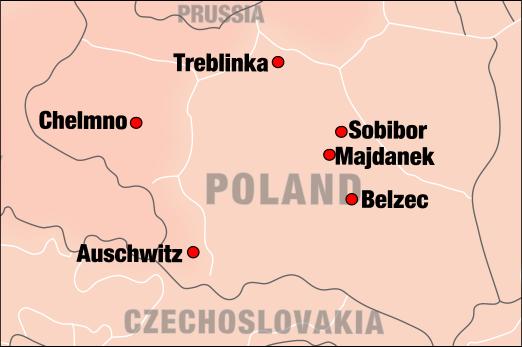
 [Auschwitz
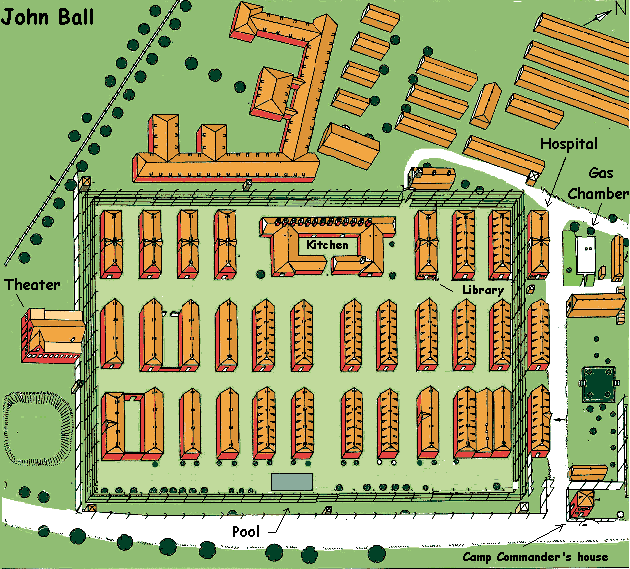
I and Auschwitz II (Birkenau). The centre of the death camp myth. This was a work camp, hence the
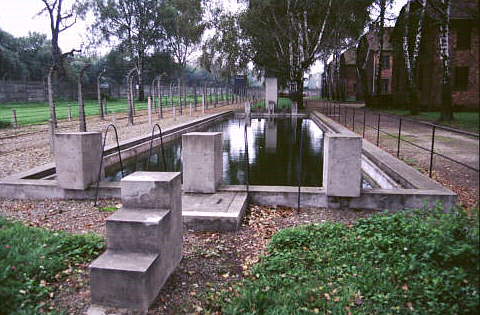
pool,
theatre and
brothel. Do you build a hospital next
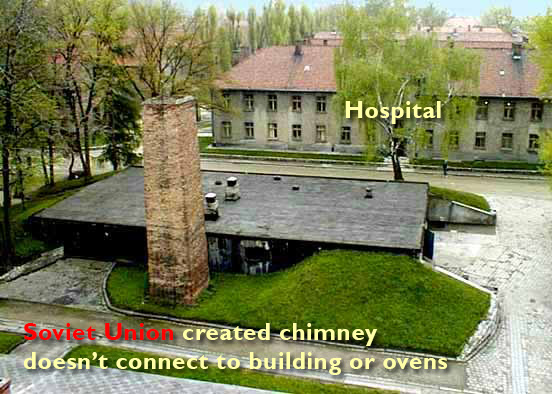
(30 metres) to a gas
chamber? Does the Camp Commander live 400 yds from the gas chamber? See
the absurdity of the
Auschwitz 'gas chamber' (Krema I), and
less obvious (due to it's demolition, by the Russians no doubt) the
Birkenau 'gas chamber' (Krema II-V). If it
was a horrific death camp why did the Auschwitz legend take such a long time to
get off the ground, why did the Russians never let anyone into the camp straight
away, 1 and why has no Forensic examination
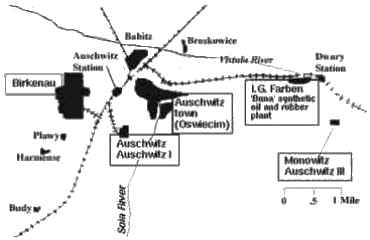
ever been done? And who would place a death camp 2 kilometres from a town?]
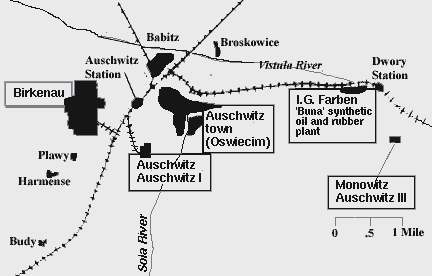
[Auschwitz
I and Auschwitz II (Birkenau). The centre of the death camp myth. This was a work camp, hence the
pool,
theatre and
brothel. Do you build a hospital next
(30 metres) to a gas
chamber? Does the Camp Commander live 400 yds from the gas chamber? See
the absurdity of the
Auschwitz 'gas chamber' (Krema I), and
less obvious (due to it's demolition, by the Russians no doubt) the
Birkenau 'gas chamber' (Krema II-V). If it
was a horrific death camp why did the Auschwitz legend take such a long time to
get off the ground, why did the Russians never let anyone into the camp straight
away, 1 and why has no Forensic examination
ever been done? And who would place a death camp 2 kilometres from a town?]
See: Belsen Belzec Buchenwald Dachau Sobibor Mauthausen Majdanek Treblinka US based Camps Allied Camps
Elie Wiesel Cons the
World When he injures his foot, instead of being sent to a gas chamber
(or the burning pit) because he is no longer useful, he is put into a hospital
where surgery is performed on his foot! Not only that, his father is allowed to
stay there with him.
Hunt, Eric
'Holohoax Survivors Who Tell The Truth' has really hit a nerve. It's
shocking to hear Auschwitz inmates tell about their elaborate stage, with
curtain rings and a grand piano, where they had plays and other musical
performances. It's shocking to see video of happy children playing in
Theresenstadt juxtaposed with a woman telling about fun costumed children's
plays in her Auschwitz block, along with arts and crafts activities, with
beautiful children's murals painted on the walls. According to the official
Holocaust narrative, all children were immediately gassed upon arrival!
"Testimony" such as this is extremely important to cast doubt on the "factory of
death" Holocaust promoters push. Auschwitz and Buchenwald inmates speak
about being paid for their work in special currency, using their currency in
camp cantinas and at the camp movie theater, receiving and sending postcards,
and playing in well organized soccer tournaments.
English translation by KZ Kladderadatsch
Published on 22 Dec 2014. This nice little old German lady is breaking the law. What she says in twenty minutes in this video could land her in prison for up to five years. That law is wrong.
Find out why, as Ursula Haverbeck challenges "The Greatest Problem of Our Time."
Visit Ursula's site (in German): http://ursula-haverbeck.info/
Read the text of Germany's Criminal Code Section 130 ("Agitation of the People"), especially subsection 3: http://www.iuscomp.org/gla/statutes/S...
Send a message to German Chancellor Angela Merkel telling her what you think of the suppression of freedom of speech and conscience in Germany under section 130: https://www.bundeskanzlerin.de/Webs/B... (Try to be polite now!)
Football at Auschwitz-Birkenau
Books
[2010] Auschwitz: The Underground Guided Tour by Carolyn Yeager
[2010] Auschwitz—The Case for Sanity by Carlo Mattogno Auschwitz: the Case for Sanity is the revisionist response to Robert van Pelt. Its first revelation is that van Pelt has committed plagiarism: he plundered and basically regurgitated the research results published in 1989 and 1993 by French researcher Jean-Claude Pressac – yet without naming his source even once. On more than 700 pages, Mattogno thoroughly scrutinizes van Pelt’s contorted assertions by juxtaposing them to material and documentary facts. Mattogno’s analysis is devastating for van Pelt, as it reveals that van Pelt’s study of Auschwitz ignores crucial counter-arguments, fails to approach pivotal technical issues with technical means, is highly inconsistent, uses deceptive methods, presents conflicting sources without due source criticism, deforms all sources to serve the author’s perspective, and reveals a shockingly threadbare knowledge of the history of Auschwitz.
The Auschwitz Myth by Wilhelm Stäglich
The Auschwitz Lie by Thies Christopherson
[1994] Auschwitz: The End of a Legend by Carlo Mattogno
Carlo Mattogno, Auschwitz: The First
Gassing. Rumor and Reality
Download: PDF:
8.8 MB - HTML-ZIP: later |
Buy this item
The first gassing of human beings in Auschwitz is claimed to have occurred on
Sept. 3, 1941. The accounts reporting it are the archetypes for all later
gassing accounts. This study exhibits the sources about this alleged event and
analyzes them critically. It shows that these sources contradict each other in
every essential point, rendering it impossible to extract a consistent story.
Original wartime documents inflict a final blow to the tale of the first
homicidal gassing
Carlo Mattogno, Special Treatment in
Auschwitz. Origin and Meaning of a Term
Download: PDF: 6.8
MB - HTML-ZIP: later |
Buy this item
According to official historiography, terms like "special treatment," or
"special action," when occurring in German documents in the context of the
"Holocaust", were camouflage words which really meant the killing
of inmates.
By bringing numerous documents into their proper historical context, Carlo
Mattogno shows that this interpretation is profoundly wrong...
Carlo Mattogno, The Bunkers of Auschwitz.
Black Propaganda versus History
Download: PDF: 6
MB - HTML-ZIP: later |
Buy this item
The so-called “Bunkers” at Auschwitz are claimed to have been the first
homicidal gas chambers at Auschwitz specifically erected for this purpose in
early 1942. With help of the files of the Auschwitz construction office, this
study shows that these “Bunkers” never existed, how the rumors of these alleged
gas chambers evolved as black propaganda created by resistance groups within the
camp, and how this propaganda was transformed into ‘reality’ by historians
Carlo Mattogno, The Central Construction
Office of the Waffen-SS and Police Auschwitz. Organization, Responsibilities,
Activities
Download: PDF: 6.8
MB - HTML-ZIP: later |
Buy this item
The Central Construction Office of Auschwitz was responsible for the planning
and construction of the Auschwitz camp complex. This study sheds light into
hitherto hidden aspects of this camp’s history. This pioneering study, which is
based on mostly hitherto unpublished Moscow documents, is indispensable for
those wishing to avoid misinterpretations of Auschwitz documents
Germar Rudolf (ed.), Special Treatment in
Auschwitz. Origin and Meaning of a Term. Download:
PDF: 2.8 MB
- HTML-ZIP: later |
Buy this item
French pharmacist Jean-Claude Pressac was praised by mainstream Europe for his
alleged refutation of the revisionists. Auschwitz: Plain Facts subjects
Pressac's works to a devastating critique by leading revisionist scholars. The
verdict: Pressac did not pay any attention to "the technique" of mass murder, as
his books claim. In fact, he reveals such a massive technical incompetence that
his works belong into the category of novels rather than history.
Germar Rudolf, Carlo Mattogno, Auschwitz Lies.
Legends, Lies, and Prejudices on the Holocaust. Download:
PDF: 14.3 MB
- HTML-ZIP: later |
Buy this item
What do Prof. G. Wellers, Prof. J. Markiewicz, Prof. J. Roth, Dr. R. Green,
Prof. J. Zimmerman, and Prof. M. Shermer have in common? They all tried to
refute the scientific findings of Holocaust revisionism -- and they all failed.
This volume discusses these and more authors and exposes their attempts at
refutation as a mixture of scientific bungling and fraud.
Germar Rudolf, The Rudolf Report. Expert
Report on Chemical and Technical Aspects of the "Gas Chambers" of Auschwitz
Download: PDF: 4.4
MB -
HTML-ZIP: 1.4 MB |
Buy this item as
paperback | Buy
this item as hardcover
The so-called Leuchter Report about the alleged gas chambers of Auschwitz
and Majdanek has been subject to massive, and partly justified, criticism.
Rudolf wrote a thorough forensic study about the alleged gas chambers of
Auschwitz which irons out the deficiencies and discrepancies of the Leuchter
Report. The Rudolf Report is the first English edition of this sensational
scientific work.